
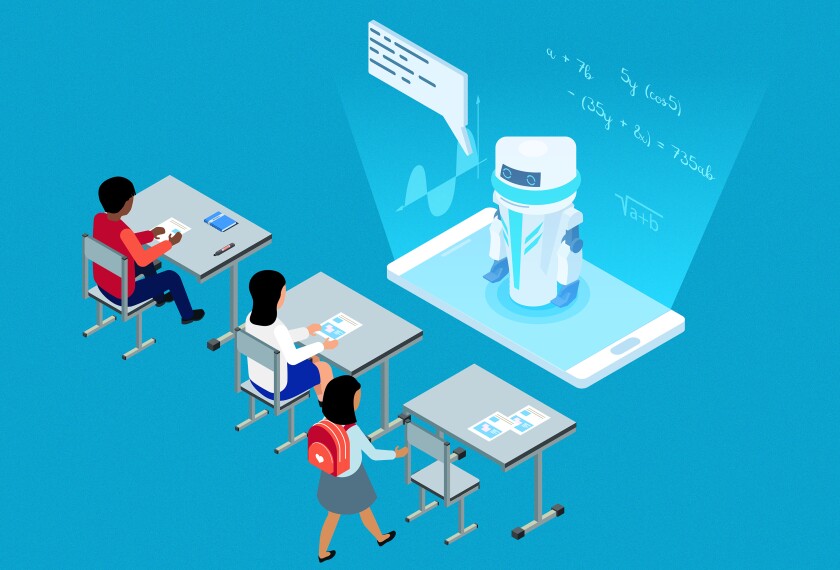
Encouraging a student to try a problem another way. Offering suggestions about what strategy to try next. Reminding students why solving problem A requires a different process than solving problem B.
These are all steps that a tutor might take in a session with a struggling student. They’re also moves that Khanmigo, the new artificial intelligence chatbot from Khan Academy, can make.
The online learning platform is one of several ed-tech organizations to harness powerful new AI technology that can hold conversations and produce all kinds of text in response to prompts to support tutoring. Interest in individualized student support has swelled after the disruptions of the pandemic.
Experts say that there are some aspects of tutoring that AI could handle well—but they also caution that human connection is a key part of making tutoring work and something no bot can truly emulate. And some companies are focusing on back-end applications of the AI, rather than asking it to do the tutoring itself.
Here’s how AI could play a part in tutoring and where its limitations may lie.
How could AI support tutoring?
One way is for AI to streamline some of the work that has to happen behind the scenes for tutor-tutee sessions to go smoothly—acting as a sort of support staff for tutoring.
That’s how Saga Education, a nonprofit that works with districts to design and implement tutoring programs, is approaching this new technology, said Krista Marks, the company’s chief technology officer. The organization has partnered with the University of Colorado Boulder to embed AI developed by the institution’s researchers.
Saga Education feeds the technology recordings of tutoring sessions, which evaluates tutors’ work against a rubric and then provides feedback. Tutoring site directors can then review these notes before meetings with individual tutors, to inform coaching conversations.
The tool was piloted this past school year and will be rolled out fully in 2023-24. The company hasn’t yet released an evaluation of the tool’s effectiveness, but Marks said that reports from pilot schools were positive.
The hope is that tools like this can help schools scale tutoring programs, Marks said. Ongoing coaching and training make tutors better at their jobs, but it puts a financial and logistical burden for schools, she said. If AI could take on part of that work, schools might find it more realistic to maintain these programs over the long term, Marks said.
Could AI actually be a tutor?
What if AI could ask students questions to prompt their thinking, or offer a suggestion about what to do next when they’re stuck? That’s the premise behind Khanmigo, the new AI chatbot that Khan Academy debuted in March.
Khanmigo uses the technology behind ChatGPT, coupled with data from Khan Academy’s platform, to help students with assignments. The bot is designed to be a helping hand, rather than give students the answers outright, said Kristen DiCerbo, the company’s chief learning officer.
Still, she emphasized that the technology can’t replace all human interaction. Most schools that are piloting the tool now are using it in a classroom setting, to help kids get “unstuck” during independent work, she said.
The bot can also get things wrong—like ChatGPT, it makes some mistakes in math problems. It’s important to impress upon students that “you shouldn’t take this as the source of truth,” DiCerbo said.
Ideally, teachers—or other adults—would work in concert with AI tutors, said Helen Crompton, an associate professor of instructional technology at Old Dominion University in Norfolk, Va. Some students might get the help they need from the bot alone, while others might need more guidance and direction from a human.
Can AI build relationships with students the way that tutors do?
An AI can be programmed to be encouraging and supportive. In some cases, it may demonstrate empathy more readily than humans do.
One recent study found that an AI delivering written medical advice had a better bedside manner than human doctors. The researchers asked healthcare professionals to compare written responses to patient questions—one set of responses from doctors, and one from AI. The raters found the AI’s responses to be higher quality, and more empathetic.
Ultimately, though, AI doesn’t actually feel empathy or connection. “It’s faking that interaction,” Crompton said.
There will always be a need for human connection in tutoring, Crompton said. “We know our students personally better than AI,” she said. Teachers and tutors can pick up on the kinds of subtle emotional cues that a bot can’t—the body language or demeanor that can signal a child is frustrated or overwhelmed, she said.
A tutor-tutee relationship can also provide motivation and accountability, said Carly Robinson, a senior researcher at Stanford University’s Graduate School of Education who works with the National Student Support Accelerator, a group promoting research-based tutoring programs.
Tutors push students to keep trying; they can help kids focus their attention. They remember what students have struggled with over time, and what stumbling blocks continue to trip them up. That demonstrates care about kids in a way that technology can’t.
“That kind of consistency matters, and is something that the human brings,” Robinson said.


