

Teacher strikes have a profound and often unrecognized role in national politics, a new working paper suggests: They put education front and center in Congressional campaigns and advertisements.
Holding a strike more than doubles the likelihood that a Congressional candidate will air an education ad in the area where the labor action occurred, write the authors of the paper, which has not yet been peer reviewed.
The upshot is that despite the risky nature of shutting down schools, strikes may elevate the importance of education issues, and ultimately could give teachers’ unions more power in the national arena.
“We were really interested in some of these broader political effects of teacher strikes,” said Melissa Arnold Lyon, a co-author of the study and a postdoctoral research associate at the Annenberg Institute at Brown University. “Teachers’ unions have increasing prominence as national actors in education politics.”
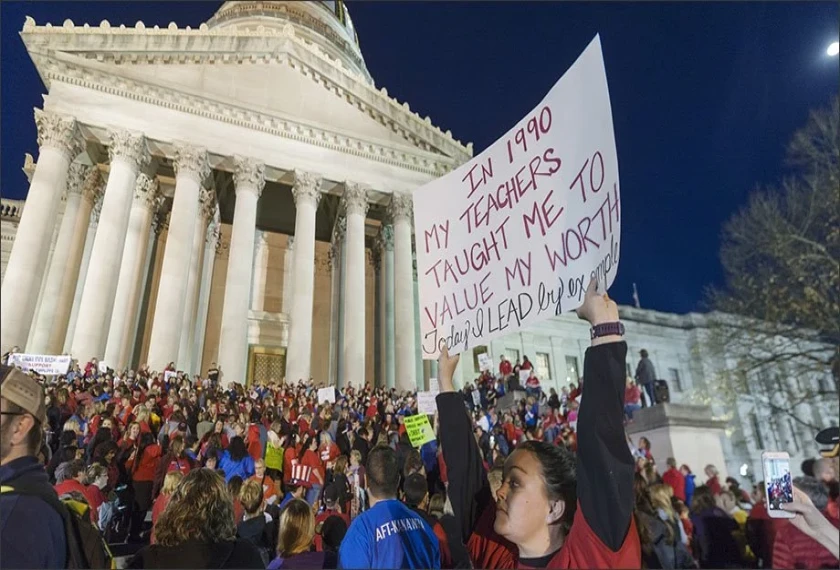
Teacher strikes are generally rare, but in 2018, a surge of activism—deemed the #RedforEd movement—led to teachers across entire states walking out of their classrooms to call for higher wages and more school funding. There were statewide strikes or walkouts that year in West Virginia, Oklahoma, and Arizona, as well as large-scale protests that shut down schools in North Carolina, Kentucky, and Colorado.
That level of activism helped boost support for raising teacher salaries and triggered sympathetic media attention to the plight of teachers. Still, the working paper found that the statewide strikes were not necessarily driving the overall findings—even individual strikes increase the probability of education-focused advertisements being aired.
Lyon and Brown professor Matthew Kraft created a dataset of all U.S. teacher strikes between July 2007 and November 2018—totaling 540 district strikes, many of which were part of coordinated efforts in a single state—and analyzed that alongside databases of TV political ads for U.S. House of Representatives elections. The researchers compared election ads in media markets where strikes occurred and in markets that didn’t experience strikes.
The researchers focused on ads from House of Representatives campaigns to show how the effects of teacher strikes reverberate beyond local or state politics. Also, campaign ads are expensive and represent a significant investment from a candidate—and past research has shown that political ads can affect voter preferences, election turnout, and future legislative agendas.

The researchers found that most of the ads were positive: They promoted a candidate (instead of attacking them) and had uplifting music. Although teacher strikes have negative consequences on parents and students in the form of lost instruction time and child care, few ads disparaged teachers’ unions or called for stricter laws against striking, Lyon said. That effect holds true for both political parties.
“Republicans just as much as Democrats are talking about education more as a result of teacher strikes, and they’re doing so in largely positive ways,” she said.
The study also found that the effects of strikes on political ads are strongest in political battleground areas, where candidates are appealing to swing voters.
“These findings highlight how candidates with the greatest concern for their election prospects are the most reactive to strikes,” the researchers wrote. “This implies that strikes lead political elites to believe that they have something to gain from discussing education issues.”
Teacher strikes often have the public’s support
The statewide strikes and those that happened in big cities in 2018 and 2019 were notable for going beyond the bread-and-butter issues typical in labor disputes. While teachers were fighting for salary increases, they framed the strikes as efforts to do what’s best for their students. They pointed to sparsely resourced classrooms, shoddy school infrastructure, and gaps in available student supports. That framing—that teachers were on the picket lines, sometimes risking their jobs, in order to provide what’s best for their students—helped galvanize public support.
Before 2018, local teachers’ unions typically didn’t frame strikes as being student-centered, Lyon said, although the demands were often similar. However, unions would still coordinate child care for working parents and meal distribution for those who needed it, which helped bring the public on board.
Still, the study found that the effects of strikes on campaign ads are mostly driven by strikes that last a week or less. The researchers wrote that longer strikes may not be as successful at generating sustained public support since they impose steeper costs on the community.
The lengths of teacher strikes vary from just one day to up to six weeks. If a strike lasts a long time, districts must make up school days, which could mean shortening scheduled breaks.
Last school year, teachers’ unions received some criticism for pushing to keep schools closed due to COVID-19 safety concerns, leading many teachers to say they felt as if the public had turned on them. Lyon said it will be interesting see how the pandemic-related school closures affect education ads compared to strikes.
“It doesn’t seem, in a broad scale, that the same attention has been paid to the child-care needs of parents experiencing school closures,” she said. “That was the driving wedge between parents and teachers [last school year].”
Still, Lyon said, many parents were also worried about sending their children back into school buildings, and trusted teachers to tell them if conditions were safe. And now that more schools have resumed in-person instruction this year, there might not be such a big backlash to unions during the 2022 election cycle.
The researchers cautioned that if the frequency of teacher strikes continues to increase, strikes may lose their power and effect on political campaign ads.


