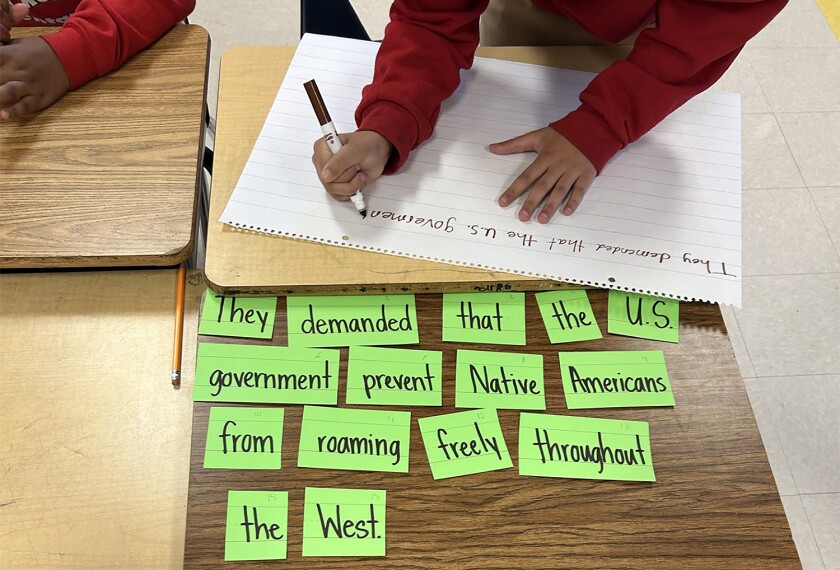
Constructing an assignment that elicits good writing may be as difficult for teachers as writing the essays is for students, a forthcoming study suggests.
Teachers must strike a delicate balance between giving students too much or too little choice about what to write about; select topics that engage students in complex thinking; and tell them to write for an audience that will actually read their work, according to the review of classroom writing samples conducted along with the 1998 National Assessment of Educational Progress writing exam.
“We literally saw some 4th grade classrooms where the students were filling in the blanks,” said Barbara Storms, an associate professor of educational leadership at California State University-Hayward.
But the same students wrote good essays when their teacher gave an assignment that had the correct balance of ingredients, Ms. Storms said. She spoke June 26 at a roundtable discussion of the research at the Council of Chief State School Officers’ annual conference on large-scale assessment.
For the research, Ms. Storms and a team from the Educational Testing Service and the National Writing Project reviewed classroom writing samples collected as part of the 1998 NAEP writing test.
Students’ writing was collected separately from the tests administered to a national sample of 4th, 8th, and 12th graders. The tests found that 16 percent of both 4th and 8th graders scored below NAEP’s level of “basic.” Twenty-two percent of 12th graders ranked in that category. (“Record Number of States Commit to NAEP,” Oct. 6, 1999.)
State of Writing
Researchers are using the classroom writing samples from 100 4th grade classes and 100 8th grade classes to analyze the state of writing instruction throughout the country. They also interviewed all of the teachers of classes that submitted writing samples.
“They were very forthcoming and very thoughtful about their practice,” said Charlotte D. Solomon, the director of state services at the Princeton, N.J.-based ETS, who led the research project. “After reading the interviews, I got a wonderful, reassuring sense that people are thinking about their practice.”
In their smaller study, Ms. Storms and Claudia Gentile, another ETS researcher, found that teachers needed to be especially careful about what they ask their students to do.
In their in-depth study of writing samples from 35 of the 4th grade classes and 26 of the 8th grade classes, Ms. Storms and Ms. Gentile discovered that the quality of a teacher’s assignment could determine the quality of students’ writing.
For example, a 4th grade teacher’s assignment to “compare and contrast what you like and do not like about winter” yielded papers that were little more than sentences saying “I like winter because ...” and “I don’t like winter because ...”
By contrast, one 8th grade assignment had students compare and contrast any two characters from a novel the class had read. The assignment worked better because it gave students a choice of which characters to write about, but limited the scope of the content, the researchers said.
“If the content was too small, it didn’t seem to work,” Ms. Storms said. “If it was too big, it didn’t seem to work either.”
“Total choice [of topic matter] was a nightmare,” Ms. Gentile said, “and no choice was deadly.”
Real-Life Reader
Another important ingredient, the researchers found, was that students had to write for an audience that actually would read their work.
For example, asking a class to write letters to the editor isn’t a useful exercise unless the students know the letters will be actually sent. Anything that involves such a “pretend audience” makes the exercise seem “artificial,” Ms. Gentile said.
By contrast, an assignment that lists the teacher as the only potential reader can elicit good writing.
“The teacher can be a real audience,” Ms. Storms said. “That’s something we didn’t expect.”
The researchers discussed their findings at the conference here, but the formal reports are still being reviewed by the National Center for Education Statistics, the arm of the U.S. Department of Education that underwrote them. Neither study will be formally released until that review is complete.