
As thousands of delegates of the nation’s largest teachers’ union gathered in Florida—a state at the forefront of restrictions on the LGBTQ+ community—they defiantly pledged to “say gay.”
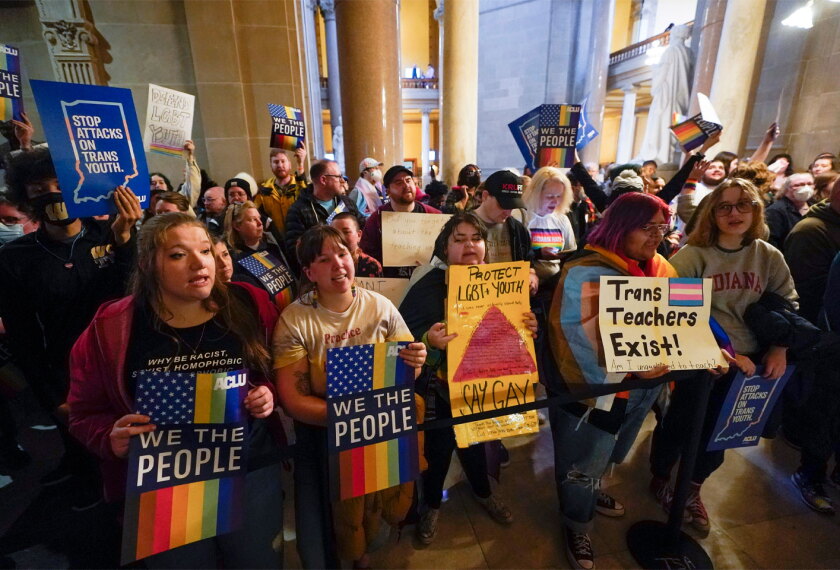
Educators wore shirts donning the phrase, a reference to the state’s Parental Rights in Education law, dubbed by critics as the “Don’t Say Gay” law, that now bans most instruction on sexual orientation or gender identity for all grades. “We say gay,” they chanted, as they rallied in the Florida heat against similar legislation taking root across the country, holding signs calling for the freedom to love, learn, and teach.
And the National Education Association delegates passed a measure to address “the prevalence of discrimination and violence targeted” at those in the LGBTQ+ community, which includes mobilizing against legislative attacks, providing professional development on LGBTQ+ issues for educators, and strengthening contract protections for LGBTQ+ educators.
The new business item, which was voted on during the union’s annual representative assembly here, carried a hefty price tag of more than $580,000. (NEA delegates have spent more than $1.2 million this week in new business, with this measure being the most expensive by far.)
Over the past two years, lawmakers in much of the country have introduced dozens of bills prohibiting classroom discussions on LGBTQ+ issues, limiting transgender students’ ability to participate in school sports or use bathrooms that align with their gender identity, and restricting the use of pronouns that don’t match students’ or teachers’ assigned sex at birth.
The consequences for LGBTQ+ students and teachers have been devastating, NEA delegates said.
LGBTQ+ teachers are “leaving in droves,” said Emilly Osterling, an exceptional children facilitator in Durham, N.C. “And the ones that are staying are, unfortunately, ... being pushed back in the closet because they’re so fearful of what could happen.”
Since the laws are so new, educators are unsure of what enforcement will look like, she said. Experts have said that state-level restrictions on instruction often lead to a chilling effect, where educators fearing backlash or retribution end up censoring themselves even more than the laws require.
Dan Gutmann has taught elementary special education in Des Moines, Iowa, for seven years, but when the state passed a law in May that bans instruction on sexual orientation or gender identity before the 7th grade level, Gutmann told his husband that he could no longer teach under those conditions.
“I don’t run around the school with a pride flag or whatnot,” he said. But he wants to be able to display his wedding picture or talk about his husband to students, and intervene when students use the term “gay” as a derogatory insult—and he wasn’t sure if any of that would be permissible under the new law.
“I didn’t want to get to the point next year where I’m put in a position where I either feel like I can’t live authentically, or I can’t do some teaching around different family structures,” Gutmann said, adding that he feels as if his family has been “criminalized.”
He left his elementary school and will be teaching 7th and 8th grade in the fall within the same district. But he’s scared that the state will expand the law to include all grades, like Florida did. (Florida’s law, passed in 2022, initially applied to K-3; the state board of education extended it in April to all grades.) If that happens, he’s not sure what he’ll do, Gutmann said with tears in his eyes.
“I love teaching, and I love teaching elementary,” he said. “If Iowa stays on this trajectory, then I don’t know that we can stay in Iowa—which is awful.”
An expansive measure to address LGBTQ+ discrimination
Osterling and C. Scott Miller, a 5th grade teacher in Santa Ana, Calif., chair the NEA’s LGBTQ+ caucus, an internal advocacy group. They introduced the new business item that directs the NEA’s response to anti-LGBTQ+ legislation and rhetoric.
“We know that in ‘24, the next presidential election, [the attacks on LGBTQ+ communities are] only going to get worse,” Miller said. “This helps give NEA a roadmap on how we maneuver through those attacks and how we’re coordinated and making sure we’re one voice rather than fragmented or not on the same page.”
The NEA’s goal is to provide state and local affiliates with the resources they need to be able to combat anti-LGBTQ+ legislation and policies from both state legislatures and school boards, Osterling said.
The measure, which is in place for one year, calls for the NEA to:
- incorporate defense of LGBTQ+ rights into the NEA’s political strategy during the 2024 election;
- update guidance and training for “member mobilization” that combats anti-LGBGQ+ legislation or rhetoric, particularly at the local school board level;
- promote and facilitate programs that address LGBTQ+ youth homelessness, suicide, and access to gender-affirming care, and include specific LGBTQ+ cultural competency training for NEA and field staff in those programs;
- create or update grant opportunities for educator-led professional development in the areas of using pronouns, supporting transitioning students, and adopting LGBTQ+-inclusive practices and policies, among others;
- update bargaining guidance around LGBTQ+ issues, including access to gender-affirming care for school employees, and circulate it to state and local affiliates; and
- assist and provide resources to state affiliates facing anti-LGBTQ+ initiatives.
“When you’re being attacked, you don’t always know [how to ask] somebody for help because it becomes all-encompassing—they’re trying to make you feel bad about doing the right thing,” Miller said. “If you’ve ever been attacked before, you can’t go through that alone. You have to have support.”
The measure also emphasizes education and training. For example, Osterling said, NEA field staff and local union presidents should learn how to support school employees who are transitioning genders and how to bargain language within contracts that assists and encompasses LGBTQ+ members.
George Kemery, a high school English teacher in Voorhees Township, N.J., had introduced a separate new business item that would have called on the union to inform state and local affiliates of contract language that’s more inclusive to the LGBTQ+ community. For example, he said, contracts should include the phrase “birthing parent” and “non-birthing parent” in addition to “mother” and “father.”
His new business item was not voted on and will instead be incorporated into the main LGBTQ+ measure. Kemery said he thinks more inclusive language will make sure all educators are covered in their districts’ contract language so they can build their families.
“The contract is the floor for what you get, not the ceiling, and administrators typically use it as the ceiling,” he said. “And as a result, that’s an easy way to diminish results further and further and further.”
‘We’re still on our learning journey’
NEA President Becky Pringle said in an interview that she’s not sure yet what the implementation of the measure will look like—but she thinks it’s work that needs to be done.
“Even for us who are staunch advocates for LGBTQ rights, there’s still more you have to learn,” she said. “That’s why it needed to be as expansive as it was, because we’re still on our learning journey.”
(One point of contention among some LGBTQ+ delegates has been the NEA’s decision to hold its representative assembly in Florida, a state many say they didn’t feel safe visiting. Pringle said she wanted the convening to serve as a show of solidarity for Florida delegates, but NEA leadership will be revisiting its guidelines for choosing future meeting locations.)
Meanwhile, the LGBTQ+ caucus will be monitoring the progress of the implementation of their new business item over the course of the next year.
After all, Miller said, it’s time for the nation’s largest teachers’ union to act: “We’ve made so much progress in the last 30, 40 years. And we’re going back to times that it’s just not good for anyone.”


