

At least six South Carolina school districts will be required to adopt new grading policies for the 2026-27 school year after the state passed a law banning “grading floors.”
Grading-floor policies require teachers to assign students a minimum grade for assignments or grading periods—typically 50%.
Districts that have adopted such measures say the higher minimum score helps motivate students by making it possible to recover their overall grade after bombing an assignment or quarter.
But opponents, including the sponsors of the new South Carolina law, argue grading floors rob students of a chance to learn personal responsibility and provide them opportunities to “game the system” by doing the minimum work necessary to pass a course. Theoretically, under a grading-floor system, students can pass classes even if they skip some assignments because they know they will get a 50 even if they don’t turn them in.
“This is going to make grades matter again,” said state Rep. Fawn Pedalino, a Republican who introduced the bill, said at a Feb. 12 education subcommittee hearing. “We are actually hurting the kids when they get an automatic 50 because that is going to push them through to the next grade when they don’t know the content.”
Leaders in other states have criticized grading floors, and Texas bans them. Concerns about the policies swelled during the COVID-19 pandemic, when many schools adopted them on an ad hoc basis to address concerns about students’ ability to complete assignments during remote learning.
The policy change touches on an often contentious issue for schools and districts: how to measure and communicate students’ progress. Many leaders have wrestled with the question as schools seek to retool their offerings to make education more relevant and engaging.
While grading policies may appear objective and precise on the surface, they actually reflect an array of choices about what educators measure, how students’ academic habits factor into their scores, efforts to ensure consistency across classrooms, and choices about whether final marks represent a cumulative score of every assignment or students’ final mastery of core concepts.
Grading floors, also known as nonzero grading, seek to address some of those questions, but every choice about grading comes with tradeoffs and consequences, said Thomas Guskey, a professor emeritus at University of Kentucky who has studied such policies. And merely setting minimum grades can serve as a half-step in an area that requires much more comprehensive change to ensure grades are consistent and meaningful, he said.
“You understand the reasonableness of [grading floors] from the mathematics perspective, but you are putting a Band-Aid on an arterial cut,” Guskey said. “There are deeper issues involved. Plus, it just drives teachers nuts.”
Law restricts district grading policies
No public school district or school may adopt a grading system that “requires a teacher to assign a minimum grade or score that exceeds the student’s actual performance on required assignments,” states South Carolina’s new law, which took effect July 1.
The law contains other measures, including a requirement that students are only eligible for credit-recovery programs if they submitted all required assignments for the course in a “timely” manner. If a district or an individual school within a district fails to comply with any of the law’s requirements, they risk losing 10% of their state funding.
The new law also establishes a task force of educators, administrators, school board members, and students to examine the state’s grading policies and recommend changes to the state board of education.
This is going to make grades matter again.
The South Carolina Association of School Administrators argued against the bill, asking lawmakers to delay changes to grading policies until the task force could complete its work.
“Each of the prohibitions included in the legislation have additional nuance behind their intended and unintended impact on students,” Ryan Bailey, the organization’s membership and communications director, argued at the February subcommittee hearing.
It’s unclear how many schools and districts will have to make changes under the new law. A 2025 report by the Palmetto Promise Institute, a conservative think thank, found six of the state’s 80 school districts had posted minimum-grade policies, which typically applied to quarterly grading periods. A survey of administrators identified 12 additional districts with some form of grade-floor policy at the high school level. In some other districts, individual schools had adopted nonzero grading policies, the report found.
Now, those schools and districts must adjust their learning-management systems to align with new grading requirements and make plans to communicate with parents, students, and educators about the shift.
Setting minimum grades gives students a chance to ‘bounce back’
The Lexington School District Two in Columbia, S.C., set its grading floor policy in 2016, requiring teachers to give students quarterly grades of at least 50%.

“A floor of 50 creates five equal 10-point distributions on the grading scale,” Rob Burggraaf, the district’s senior director of academics, assessment, and accountability, wrote in an email. “This means that an A and an F average to a C. Without a floor, a student could theoretically earn an A and an F and still average an F.”
The change was implemented as a “safety net” for students to allow them to “bounce back” after a poor quarterly grade due to sickness, a death in the family, or other unplanned life circumstances, he said.
Experts call for broader grading reforms
Grading floors are often part of larger reforms like “equitable grading” policies, which focus on mastery of concepts and seek to decouple behavior-related factors, like turning in work late, from students’ overall marks. Such policies often give students multiple chances to redo work and establish clear rubrics to determine when students have mastered a skill or concept.
Guskey, who supports many of those reforms, says it makes sense to equalize grade bands so that the difference between an F and a D is the same as the difference between an A and a B. But he advocates for a simplified, 1-5 grading scale, rather than a 100-point scale with a 50-point floor.
“The choice of zero to 100 is completely arbitrary,” he said.
A simpler grading scale—often used in standards-based grading systems— would be less confusing for parents and students and help improve consistency between teachers’ grading practices, Guskey said. And under a 1-5 scale, a student who didn’t turn in an assignment would get a zero, indicating “no evidence of mastery,” he said.
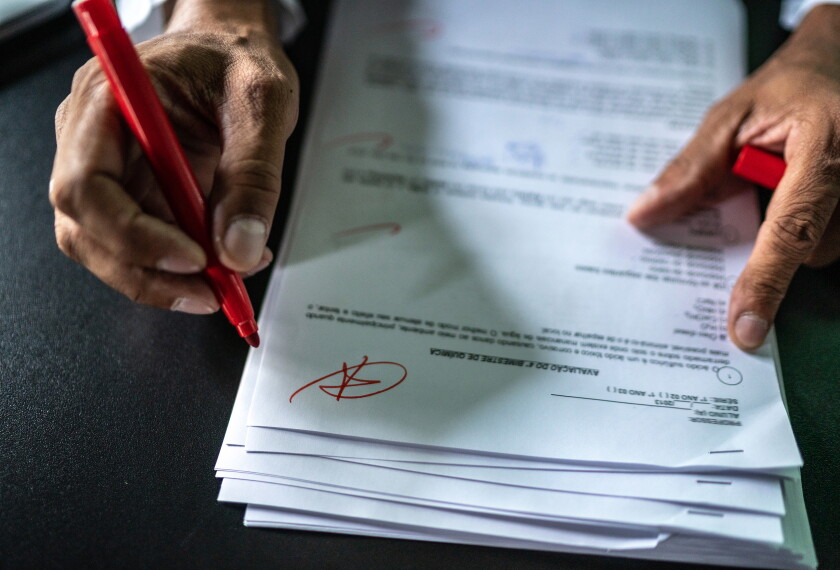
There’s no national data on district grading policies, but in a 2024 survey of 967 K-12 teachers conducted by RAND, 27% said their school or district has a “no zeros” policy. Eighty-one percent of respondents said “giving partial credit for assignments that are never turned in” is harmful or very harmful to academic engagement, according to an analysis conducted by the Fordham Institute, a conservative think thank that commissioned the survey.
South Carolina is not the first state to weigh in on minimum grade policies. In 2009, the Texas legislature passed a “truth in grading” law that prohibits districts from requiring teachers to set minimum grades for assignments. Eleven school districts ultimately failed in a lawsuit that challenged the law, arguing that they could still require minimum grades for grading periods, rather than individual assignments.
“If a student has no chance of making up a poor grade, he or she is more likely to give up on a class and cause disciplinary problems or drop out of school,” an alliance of large Texas districts argued at the time.


