
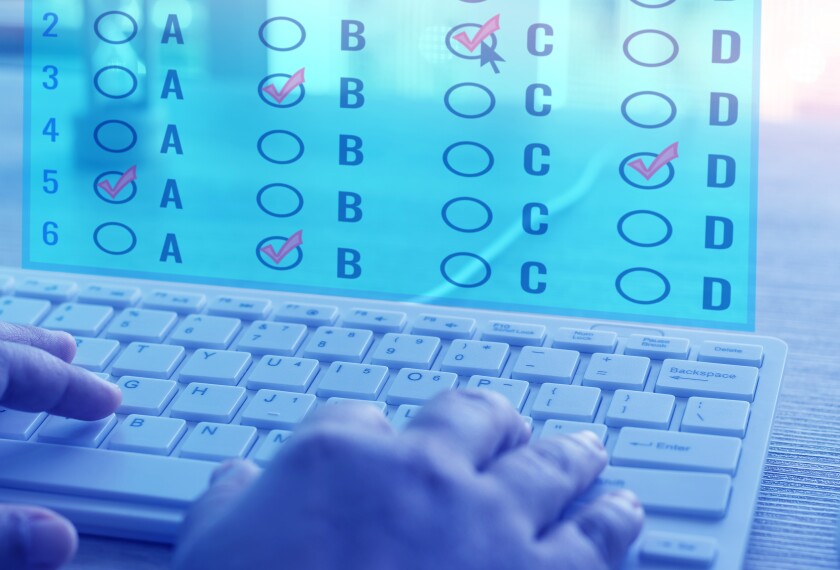
The digital version of the College Board’s college admissions standardized test known as the SAT officially launches across the United States this spring.
The test still measures students’ abilities in math, reading, and writing but is now shorter, more adaptive to students’ performance, and more secure from possible cheating, said Priscilla Rodriguez, who leads the SAT and related PSAT programs for the College Board.
The SAT went digital abroad in March 2023, with over 300,000 students participating. The new digital PSAT, through which students may be eligible to receive scholarship opportunities, and its related PSAT 8/9 for 8th and 9th graders, both went live in the United States in October 2023.
“We were hearing increasingly from students and schools, districts, and states, that they were ready to have our assessments be delivered digitally,” Rodriguez said. “By and large, these students are learning and testing and living digitally.”
Juniors and seniors will be eligible to take the new digital SAT starting in March either on a Saturday or a school day.
Here are four important details for educators to keep in mind as they help prepare students for the exam, including how to contact the College Board for technical support.
1. The test is now adaptive
One of the unique aspects of a digital test students can access via an application on a computer is how it can adapt to student performance.
In the case of the SAT, there are still two standard sections: math, and reading and writing. Each section is split in two.
For example, say a student is working on the first half of the reading and writing section. Within a given time frame they can work on all the questions, go and back forth to check their work, or change answers if needed. Once that first half is done, the testing system evaluates what they got right and wrong. Then the system offers the second half of the reading and writing section with questions that are either slightly harder or easier depending on how the student performed in the first half, Rodriguez said.
Specifically, Rodriguez said that “students are given material on the second half of the reading and writing section and the second half of the math section based on what they showed they know on the first half of those sections, and their score is based on how they perform across all of the questions they answered. We’ve done studies that show that a student’s score would be the same regardless of whether they went to the harder or the easier module.”
(The PSAT is similarly adaptive.)
With this change to the test format, Rodriguez said that students “aren’t seeing content that is so challenging as to be demotivating to them, or that they’ve already shown they have mastery of. We hear from students who get discouraged by seeing so much very hard content that they disengage and give up on the test, and we want to combat exactly that.”
This adaptive format also makes the test shorter: down to about two hours instead of three.
“In a paper test, because you’re testing everyone across every level of performance, you have to have a lot of questions at each level of performance on each skill to make sure you’ve adequately honed in on each student’s knowledge. That’s why the test is much longer on paper,” Rodriguez added.
Students at St. Albans High School in West Virginia have welcomed the news of a shorter test because the previous length would discourage students, even though they had the skills to perform well, said Richard Tench, a school counselor at St. Albans and member of the board of directors for the American School Counselor Association.
Rodriguez added that “higher education institutions will not see how a given student’s test is adapted. They will only know the final score, which our studies have shown would be the same regardless of which path the student saw.”
2. Test content formatting has changed a bit
Smaller changes were made to each of the test sections. In math, for instance, students can now use their calculator for the entire section as opposed to only certain questions and the test app has a built-in graphing calculator so students no longer need to bring their own, Rodriguez said.
The passages for the reading and writing section are now much shorter.
In the previous paper test, students would read a long passage and answer multiple questions related to the passage. To avoid students having to scroll through multiple screens, the passages are now brief and with one question tied to each.
“It feels a lot less scary to have a shorter passage with a single question tied to it,” Rodriguez said. “So if you don’t understand that passage, all it’ll cost you is one question on the SAT, not nine to 12.”
Tench said that his students were previously concerned about having to engage with long passages knowing they were on the clock to get through as many questions as possible.
3. Solutions to technical issues are available
While the new digital SAT testing app doesn’t require much by way of bandwidth, the College Board was cognizant of potential technical issues that could arise, particularly in rural schools, Rodriguez said.
It’s why for the PSAT suite of exams rollout last fall, the organization set up a bandwidth support program which continues into this spring. If a school or district feels it doesn’t have the fundamental minimum bandwidth to administer digital exams to hundreds of students at a time, the College Board can connect it with technicians to test the internet and figure out how many students could test at one time, in a given room, in a given building, Rodriguez said.
The organization even sent internet routers to eight schools that requested them to reliably administer exams.
Tench’s district in West Virginia was proactive in compiling data and running tests on its bandwidth. The district was able to successfully administer the PSAT for grades 8, 9, 10, and 11 all on the same day, with only iPads having some technical issues that were quickly resolved.
“By the end of the day, there was no student that wasn’t able to completely submit their exam that day,” Tench said.
If schools or districts come across any additional technical issues moving forward regarding the digital SAT, they can reach out to (877) 348-5728 or sateducator@collegeboard.org. For questions regarding the digital PSAT, educators can reach out at psat@info.collegeboard.org and (888) 477-7728.
Rodriguez added that now, if needed, educators can break up how many students take the digital exams on a given day or across multiple days because the tests now pull from a bank of questions for each student. So while everyone is still tested on the same skills, the individual questions might be worded differently or have different numbers.
4. Equity, anxiety relief found in test prep
Rodriguez acknowledged research that has found gaps in SAT performance related to factors such as a student’s family income.
She said that “inequities, in access to high quality education, support, resources, go back to birth and are present and are measured in many, many ways. The SAT is just one of the ways that those differences and inequities get measured and are made visible.”
To address this issue, the College Board in 2016 partnered with the nonprofit Khan Academy to offer a free online SAT prep course to all students.
At St. Albans, all juniors take this course and College Board practice tests because much of SAT test anxiety stems from lack of familiarity with the test setup, Tench said. That’s why the school is offering test prep for the digital SAT to current seniors who completed test prep last year for a paper exam.
“The most important thing for us is the accessibility that we’re giving to our students and parents to have a firsthand look at the new platform,” Tench said.


