
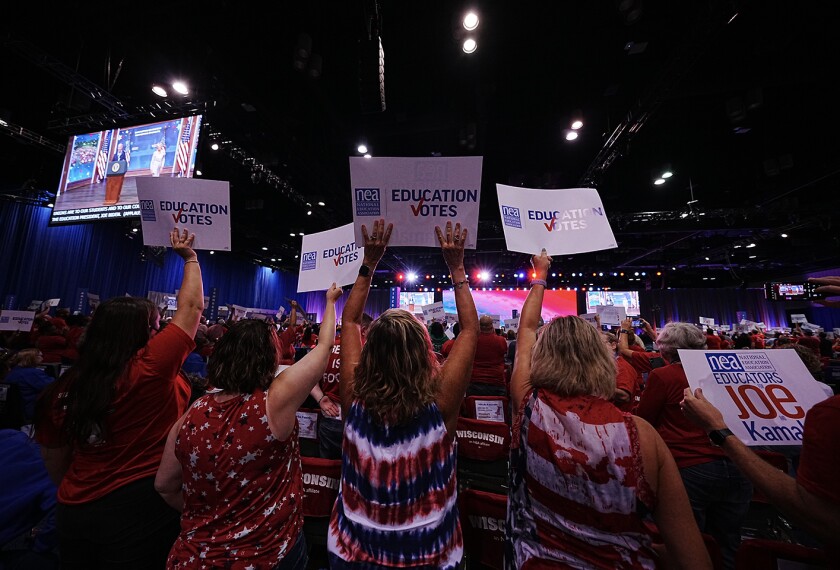
Thousands of educators who are part of the nation’s largest teachers’ union will flock to Philadelphia over the Fourth of July holiday to vote on pressing education issues, amid a politicized focus on public schools as the country gears up for an election year.
As the National Education Association brings together more than 6,000 delegates, who represent the union’s approximately 3 million members, for its annual representative assembly, leadership plans to “ramp up” the work for endorsed candidates this summer, from the school board level all the way up to the presidency, said Becky Pringle, the president of the NEA.
“We understand the important role that educators play in electing friends of public education,” she said in a phone interview ahead of the conference, which will run July 4 to 7.
The NEA voted to endorse President Joe Biden for re-election last year by secret ballot; about 84 percent of the delegates voted yes. Their endorsement allows the union to contribute funds, and mobilize on-the-ground campaigning efforts.
Last year, Biden and first lady Jill Biden appeared virtually to speak to the union. Meanwhile, U.S. Secretary of Education Miguel Cardona addressed the union in person. Officials for the NEA did not say whether the administration had plans to attend this year.
But the work continues up and down the ballot, Pringle said.
Union leaders are preparing educators to tell stories to their communities about their students and what they need and “why we need to reelect Joe Biden and [Vice President] Kamala Harris, why we need to have a Senate and a House that understands the importance of voting rights in this country, understands the importance of women’s rights, of LGBTQ+ rights, that particularly embraces the poetry of our Constitution,” she said.
The election is just one sliver of what delegates will be weighing during the four-day conference. They will also vote on where to direct the union’s money and attention, passing—and voting down—measures that set the NEA’s priorities for the next school year.
Top of mind will be artificial intelligence. A task force, assembled last year during the previous representative assembly, will give its recommendations on AI use in the classroom to the NEA’s top decision-making body for the delegates to vote on.
The rapid access to AI and its impact on education—from data privacy concerns, to cheating possibilities, to simplifying daily tasks for educators—has created a gap between the teachers who use it, and those who refuse.
Many teachers have reported receiving slim guidance from school leadership about how to use the technology, with some embracing it and considering it a “game changer” when it comes to administrative work, and others more skeptical of its place in schools.
Pringle said at last year’s gathering in Florida—and in her work across the country—she heard numerous delegates bringing forward issues around AI. She thought it was important for members “to really dig into this.”
The task force convened throughout the year and met with experts. They’ll bring a policy statement and recommendations to the delegates in Philadelphia, with the goal of keeping educators at the center while also addressing inequities, she said.
NEA delegates to address wide range of issues beyond AI
Beyond AI, educators will debate a number of other issues during the representative assembly. A group of 50 or more delegates can introduce new business items that, if passed, direct the NEA to do something for a year. Delegates typically consider dozens of these measures each year.
Last year, delegates passed such a measure to address “the prevalence of discrimination and violence targeted” at those in the LGBTQ+ community, which includes mobilizing against legislative attacks, providing professional development on LGBTQ+ issues for educators, and strengthening contract protections for LGBTQ+ educators.
They set aside more than $580,000 for that work—part of $1.2 million delegates spent on new business during last year’s representative assembly in Florida.
The continued politicization of education through state legislative measures targeting books and curriculum will likely be a continued theme this year.
This year’s representative assembly could also see discussions of student and educator well-being and discipline, especially as schools continue to grapple with students’ mental health needs, Pringle said. Cellphones in schools, which are being banned more and more, could also arise as a debate topic.
Private school choice vouchers—where students are able to use public funds to attend private schools—may also surface; that conversation will come at a time when Pennsylvania’s politically divided legislature is debating such a measure that attracted celebrity attention earlier this month.
“We will continue our fight against any efforts to pass vouchers,” Pringle said. “We’ve had great success in beating them back, but they keep coming back. We will continue to fight them.”
The Israel-Hamas war, which has prompted campus protests and walkouts, has also created turbulence in K-12 education with educators facing tough decisions on how to handle it in the classroom, and may factor into discussions.
Delegates will also vote on the NEA’s strategic plan and budget, which allocates member dues toward advancing the union’s priorities and operations.
“It is my goal to have these almost 7,000 delegates who come together to leave inspired, motivated, ready to take action,” Pringle said. “Because it’s not just the four days we’re there. It’s all they do after.”


