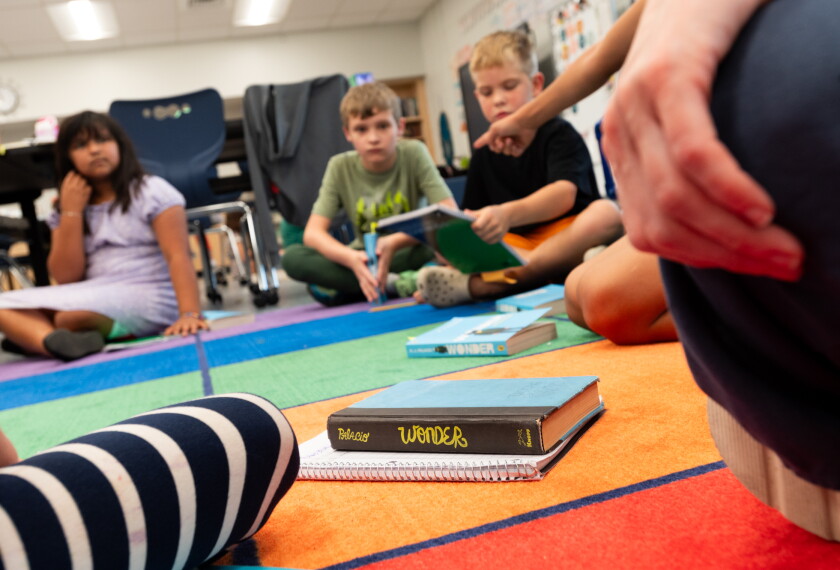

Helping students learn to read is usually the job of early elementary educators. But teachers of older children—who report that nearly half of their students have difficulty reading—say they need more training in this area, too, concludes a new survey.
The nationally representative survey from the RAND Corporation includes 1,483 teachers in grades 3-8. On average, teachers in these grades reported that 44 percent of their students always or nearly always faced challenges reading the content in their classes. Ninety-seven percent of teachers said they modified their instruction to support struggling readers at least once or twice a week.
The results come on the heels of a previous RAND survey that found many secondary teachers still work with students on foundational reading skills like sounding out words and spelling.
As states have pushed school districts to adopt evidence-based practices in early elementary reading instruction, a movement known as the “science of reading,” these two reports suggest they might also have to fill in knowledge gaps for teachers of older students.
“K-3 is when we expect that most students learn these skills,” said Anna Shapiro, an associate policy researcher at RAND, and the lead author of the report. “But we’re at a point where we have older kids in some grades that are still developing these skills.”
Why reading struggles can be more complex for older kids
Reading problems for older students can have disastrous ripple effects across the school day. In these older grades, it’s not only English/language arts classes that require strong reading skills, but social studies, science, and even math. In the RAND survey, teachers of subjects other than ELA said their students spent about half of class time reading and writing.
But teachers of older students usually don’t receive training on addressing the kinds of foundational reading difficulties that can bar students’ access to more complex text. And there often isn’t time to remediate basic skills when teachers are working with their students toward higher-level goals, like writing argumentative essays or analyzing poetry.
The reasons why older students struggle with reading can also be more complex and layered than they are for younger children.
“There’s no ceiling to learning to read,” Shapiro said. “As soon as a child has mastered the foundational skills that they need to look at a word and decode it, the higher-order reading skills that students continue to develop just get more and more complex as students get older, and they also vary by discipline.
“For a student who has gotten to 4th, 5th, 6th grade and is still struggling with those foundational skills, it is making it harder for them to access that higher-order literacy skill development that we hope students are achieving,” she said.
There’s evidence that older students do have some of these foundational gaps. Nearly half of upper elementary teachers, and almost 1 in 5 middle school teachers, reported that they are teaching word-reading skills like phonics and spelling three or more times a week.
Most states have passed legislation requiring schools to use evidence-based methods to support younger struggling readers. But few have extended these mandates to middle grades.
“We feel like the national literacy discussion has still almost exclusively focused on young readers,” said Christina Cover, a special education teacher and literacy coordinator in the Bronx borough of New York City. Cover is also the project lead of the Project for Adolescent Literacy, a new, educator-led group created to support middle and high school students with reading difficulties.
“We know that shift to reading to learn—that doesn’t happen for kids who are still struggling,” she said.
Older students need different supports than beginning readers
To help students make that shift, teachers say they need more resources.
More one-on-one help for students was particularly popular: 48 percent of middle school teachers said they had a moderate or major need for reading specialists, while 45 percent identified a moderate or major need for tutors.
“It might be that teachers are thinking, ‘I need somebody else’s help, I don’t have the training or the expertise that I need to do this,’” Shapiro said.
Teachers also wanted more training:
Two in 5 teachers surveyed held at least one misconception about how children learn to read, such as agreeing with the statement that “most students will learn to read on their own if given the proper books and time to read them.”
Shapiro stressed that training and resources for teachers in older grades should be age-appropriate for their students.
“When we’re thinking about policy changes, … we’re not suggesting that you should throw all the 3-8 teachers in the reading class that the K-2 teachers take in their teacher preparation,” she said.
For example, research shows that interventions targeting multiple skills at once—such as fluency and comprehension—can have higher positive effects for older students than single-skill practice.
Cover’s group, the Project for Adolescent Literacy, has fielded a survey to identify practices middle and high school teachers employ to support struggling readers and plans to build a bank of resources that these teachers can use.
She also hopes that teachers attend to the social-emotional issues that often accompany reading difficulties in teenagers.
Students who have gone from grade to grade without seeing much progress tend to develop “avoidance strategies” for reading, she said.
“They’ve seen it all before, and they feel like it won’t help them,” Cover said. “I think students are rightfully a bit skeptical when they’re in high school, and they’re still struggling with some of those foundational skills.”