

So many people believe they’re “experts” in education because they’ve gone to school for at least 12 years.
I’ve been in plenty of buildings, but that doesn’t make me an architect. And I’ve been in lots of doctor’s offices, but that doesn’t make me a health professional.
Today’s post kicks off a series on misconceptions teachers think many folks have about schools.
‘Teaching Is an Underappreciated Art’
Stephen Katzel is the author behind Win Your First Year of Teaching Middle School: Strategies and Tools for Success. He is an educator with a passion for middle school education and helping new teachers:
The biggest misconception nonteachers have about classroom teaching is that it’s “easy” and that it’s a profession for those who couldn’t succeed in other industries.
Any teacher has likely heard this statement: “Those who can’t, teach.” It is misguided and chips away at the complex role and ever-changing educational objectives teachers have to meet.
Regardless of the grade level or subject area, teachers have to plan for 25-35 students to be engaged in their lesson, deliver curriculum mandated by their state, and differentiate instruction to meet the needs of learners in their room. Add in planning to include students who have classroom accommodations through 504 plans and IEPs, planning a 45-minute lesson is more complex than the average person would believe. In fact, many nonteachers believe that teaching is easy since there is a curriculum to follow.
The best analogy to teaching I have used with my friends in the business world is the following: Imagine presenting a 30-60-90 day plan to 30 colleagues in your company. Ten of the colleagues will only absorb the presentation if you differentiate the presentation to include less text and more images, while 10 people watching your presentation will understand the material quickly and need extra information about the deliverables while the remaining 20 people need to absorb the rest of your presentation.
Now, imagine doing that every day and creating two presentations for your colleagues to understand the objective and main ideas. (This is a shout-out for my teachers that have two preps). Most of the time, my friends are surprised by the level of planning teachers must do each day. There are no cutting corners or “easy” parts to teaching.
Teaching isn’t lecturing in front of the class or just working nine months of the year. Teaching is planning a lesson to drive engagement. Teaching is ensuring all students achieve academic success. Teaching is meeting the needs of all students, no matter what. Teaching is an underappreciated art that is the backbone of our societal fabric.

People Don’t See the ‘Invisible Layers’
Tim Cusack currently serves as dean of education at Concordia University of Edmonton. He is a co-author of Leader Ready: Four Pathways to Prepare Aspiring School Leaders, The Mentor’s Guidebook, and Navigating the First Years and is passionate about honoring the professional expertise of teachers and developing the next generation of school leaders:
There’s an old saying in education: “Everyone thinks they’re an expert on teaching because they once sat in a classroom.” As cliché as it sounds, every classroom teacher knows that watching teaching is not the same as doing it. Doing it well—day in and day out—demands far more skill, stamina, and strategic thinking than most people realize.
In my years as a teacher, principal, superintendent, and now dean of education, I’ve heard nearly every opinion about what teaching “really” is. If I had to name the most prevalent misconception nonteachers have stated about classroom teaching, it would be this: that teaching is just about delivering content.
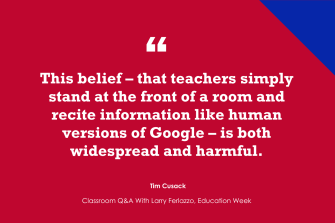
This belief—that teachers simply stand at the front of a room and recite information like human versions of Google—is both widespread and harmful. It reduces the teacher’s role to that of a presenter, when in reality, teaching is built on relationships, adaptability, and real-time decisionmaking.
Teaching is a deeply human endeavor. It’s not just the transfer of knowledge but the intentional design of experiences that spark curiosity, build confidence, and create a sense of belonging. It’s helping a student who’s failed three quizzes believe they’re still capable. It’s modifying a lesson on the fly when students don’t understand it as expected. It’s coaching, mentoring, parenting, guiding—and sometimes, even entertaining. Put simply: if teaching were just about delivering information, we wouldn’t need teachers at all—we’d just need better Wi-Fi.
Changing the Narrative
How do we correct this misconception? By lifting the veil. School leaders can open classrooms to families and community members. Policymakers can shadow a teacher for a full day—not just for an hour. Moreover, those of us who are and who have been in the classroom must keep telling our stories—not to complain but to inform, to enlighten, to advocate, to educate. We must invite others into the reality that teaching is a profession of purpose and precision. It is both science and art. It requires both heart and hustle.
The next time someone says, “I could be a teacher; plus, I’d love to have the summer off,” smile kindly—and invite them to walk a day in your shoes. Because anyone who truly experiences the reality of teaching will never again think it’s just about delivering content.
‘Teaching Is Not Just Delivering a Lesson’
Abeer Ramadan-Shinnawi, M.Ed., is a Palestinian-American educator, curriculum consultant, and founder of Altair Education Consulting. With over 20 years of experience in public education, she specializes in culturally responsive teaching, curriculum design, and supporting Arab and Muslim students and their communities:
One of the biggest and most persistent misconceptions noneducators have about teaching is that it’s not a skilled profession. Far too often, the public narrative around teaching is reduced to the visible surface: managing a classroom, delivering content, and assigning homework. This shallow perception overlooks the deep expertise, intellectual labor, emotional intelligence, and adaptability that skilled teachers bring to their practice every single day.
Teaching is not just a job, it’s a calling, it’s a complex profession grounded in both art and science. It requires a mastery of subject content, knowledge of pedagogy, child and adolescent development, classroom management, trauma-informed practices, assessment literacy, and cultural responsiveness. But perhaps more importantly, it demands the ability to build relationships, design inclusive learning environments, and continuously adapt to the shifting academic, emotional, and social needs of every student. No other profession I know requires such a combination of cognitive agility, emotional resilience, and interpersonal finesse.
Nonteachers often believe that anyone with content knowledge can teach. “You know math? You’d make a great teacher!” This mindset fails to acknowledge that knowing a subject and teaching it well are two entirely different skill sets. A great teacher doesn’t just know the material, they know how to translate that knowledge into differentiated learning experiences that reach every student, regardless of their learning style, background, or language proficiency. This takes years of practice, training, and reflection.
What often gets dismissed is how much emotional labor and relationship-building are embedded in the profession. Teaching is deeply emotional and relational work. Skilled teachers recognize trauma responses in students who appear “disruptive.” They build bridges with families, serve as unofficial social workers, mediate conflicts, and create brave spaces for young people to express themselves, all while being expected to close academic gaps and raise test scores. This level of emotional and cultural dexterity is neither intuitive nor accidental. It is honed through experience, professional development, and a deep commitment to student well-being.
Moreover, many underestimate how much of what teachers do is design work. Teaching is not just delivering a lesson from a textbook; it’s about designing meaningful, equitable, and student-centered learning experiences. Teachers are expert facilitators of inquiry, collaboration, and critical thinking. They use formative assessments, adjust instruction in real time, and weave together academic rigor with creativity. They also design for accessibility and inclusivity, ensuring that English learners, students with IEPs, and those with social-emotional needs are not left behind.
This misconception also erases the transferable skills that educators carry. A veteran teacher is a project manager, data analyst, curriculum designer, coach, event planner, public speaker, researcher, and crisis manager. Teachers develop skills that would be highly valued in other industries, from strategic planning to cross-cultural communication to organizational leadership. And yet, our society often devalues this work because it is tied to children and care, roles often gendered and dismissed.
If we want to retain passionate, effective educators and attract new ones, we must reframe teaching as the skilled, intellectual, and human-centered profession it is. This means elevating teacher voice in policy, compensating educators fairly, investing in ongoing professional development, and cultivating a public understanding that teaching is not a fallback career. It’s a calling, yes, but it’s also a profession rooted in expertise.
Until we honor the full scope of what teaching entails, from lesson design to trauma response to cultural navigation, we will continue to mischaracterize one of the most important and complex professions in our society.

Thanks to Stephen, Tim, and Abeer for contributing their thoughts.
Responders today answered this question:
What do you think is the biggest misconception nonteachers have about classroom teaching?
Consider contributing a question to be answered in a future post. You can send one to me at lferlazzo@epe.org. When you send it in, let me know if I can use your real name if it’s selected or if you’d prefer remaining anonymous and have a pseudonym in mind.
You can also contact me on X at @Larryferlazzo or on Bluesky at @larryferlazzo.bsky.social
Just a reminder; you can subscribe and receive updates from this blog via email. And if you missed any of the highlights from the first 13 years of this blog, you can see a categorized list here.


