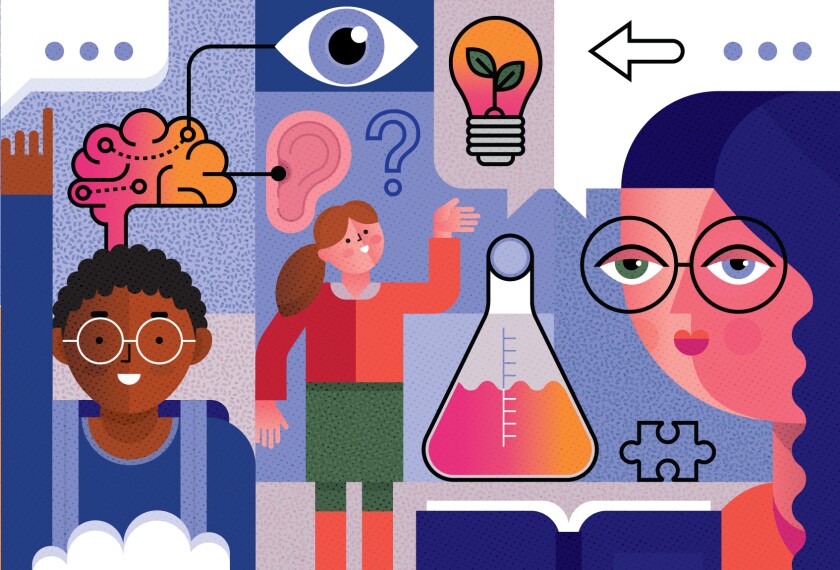
“Education is not the filling of a pail, but the lighting of a fire.” —William Butler Yeats
I love the quote above because it captures the essence of what arts integration does for our children. By teaching in and through the arts, our children carry the creative spark across the curriculum for all content areas.
Arts integration is an innovative teaching strategy that fuses the arts curriculum—dance, music, visual arts—with standard curricula.
For example, a science teacher may instruct students to create a dance to demonstrate what happens when water freezes in a pipe when it is cold. Through arts integration, students will explore the different states of matter through dance. The kinesthetic learner now has access to the curriculum, and students can visually understand the concept. When there is a natural connection between two or more curricula, arts integration provides engaging context and enhances the learning experience.

Education Week Commentary asked leading educators and advocates to discuss the arts in K-12 education. Some of the contributors assert that the arts are a bridge between traditional academic subjects and the creative skills necessary to thrive in a global, 21st-century economy. Others argue for the critical part the arts play in child development.
Regular contributing artists illustrate the package, which continues online with a video that explores the role of the arts in classroom engagement.
This special section is supported by a grant from The Wallace Foundation. Education Week retained sole editorial control over the content of this package; the opinions expressed are the authors’ own, however.
I discovered this early in my career. In 1992, I had been a principal for approximately two weeks when PTA members came to my office and said, “Mr. C., we need more arts in our school.” I said what any new principal (who didn’t have any ideas) would say, “I’ll look into that.”
At the time, our school didn’t have an art teacher. But I was true to my word. I looked into the PTA request and, in fact, committed the next 22 years of my career to exploring why and how arts integration is an effective strategy for learning.
First of all, I saw early on that every time I brought an artist-in-residence or visiting artist into the building, the school came alive. Students were engaged, teachers had collaborative discussions on the curriculum, and the level of excitement and energy exploded. I knew after the first year that somehow I would make sure to have an arts-integration program.
The following year, my school district provided money to hire a testing coordinator. I asked permission to hire an arts-integration teacher instead. This teacher would lead my staff members in the mission of integrating the arts into their curriculum. Even though they thought I was crazy, the district administrators approved my request, and that year and subsequent years, the scores on the state assessments improved. I discovered firsthand the impact of arts integration on student achievement.
Neither the arts nor the sciences have a monopoly on teaching creativity, collaboration, or problem-solving skills. Students learn common skills that can be applied between all STEM and arts content areas."
My school, Rockledge Elementary in Prince George’s County, Md., grew into a national model. In 1997, we received the Maryland Blue Ribbon School award and became a pilot school for the John F. Kennedy Center’s Changing Education Through the Arts, or CETA, professional-development program. The Harvard Graduate School of Education included Rockledge in its study “Arts Survive,” which examined arts education partnerships. Success bred success, as our school and community grew proud of our accomplishments.
The research confirms what we know to be true. The arts impact all learning. As early as 2002, the Arts Education Partnership and the National Endowment for the Arts prepared a compendium of 62 research studies that support the powerful positive academic and social effects of learning in and through the arts. The compendium, “Critical Links: Learning in the Arts and Student Academic and Social Development,” was groundbreaking.
Neuroscience has also provided an emerging branch of research related to studying the arts. For instance, “Learning Arts and the Brain: The Dana Consortium Report on Arts and Cognition” reinforced the positive impact arts learning has on a young person’s ability to retain information.

My experiences, affirmed by the research, compelled me to continue my journey in arts integration. Even though I retired from the Prince George’s County school system to run a statewide arts-advocacy organization called the AEMS (Arts Education in Maryland Schools) Alliance, I ultimately wanted to return to a school as an arts-integration practitioner. From 2012 to earlier this year, I served as the principal of a so-called STEAM school, Seven Oaks Elementary School in Anne Arundel County, Md. STEAM takes the benefits of STEM (science, technology, engineering, and mathematics) learning and partners them with arts learning to reinforce 21st-century skills. STEAM has at its core the foundation of integration.
Neither the arts nor the sciences have a monopoly on teaching creativity, collaboration, or problem-solving skills. Students learn common skills that can be applied between all STEM and arts content areas. The critical-thinking skills of analyzing, assessing, categorizing, classifying, predicting, justifying, interpreting, and more are reinforced by both the STEM disciplines and the arts.
With collaborator Maria Barbosa (an accomplished artist and scientist), the central theme of the Seven Oaks STEAM program became the creation of our “Garden of Knowledge.” This outside courtyard became a place where students studied ecosystems and plant physiology, but also incorporated the principles of artistic design. For example, our 5th graders designed a pond while learning about pond ecosystems. They then designed a bridge that was both functional and had aesthetic appeal. The design process proved to be as important as the finished product.
Schools must provide opportunities for students to learn across disciplines. No longer can we teach in silos. Yes, STEM subjects and the arts are important as standalone content. But when there are opportunities for integration, why not use each content area to reinforce the other? We know that students learn in different ways, so why not use the positive attributes of each to support the other?
Arts integration is a powerful tool for engaging students. My years of observation as a principal and the plethora of research leave no doubt. There should not be some STEAM schools—all schools should teach using the STEAM approach. Teachers must be the facilitators of student-centered learning. They must light the fire in all our students. Arts integration provides the tools to prepare our students for the future.