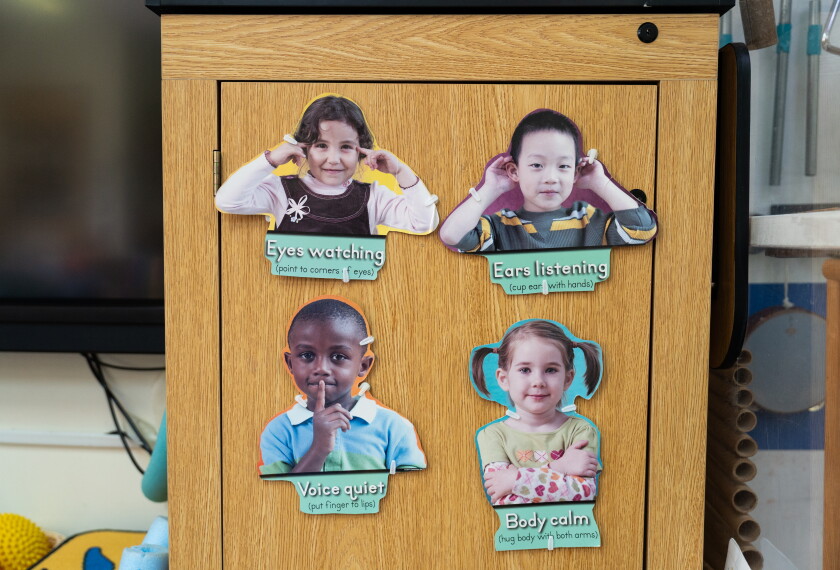
How do we, as a nation, perceive the child?
Do we see the child as a passive recipient of information, vulnerable to destructive emotions, who must be trained to meet uniform standards of behavior? Or, instead, as a capable, curious, creative, caring, connected individual who can naturally develop meaningful relationships from which knowledge and well-being are constructed?
A nation’s image of the child has important implications for the kind of early-education system that it supports and what becomes of it. A country that values the social and emotional development of each child in relationship to other human beings—or social constructivism—is likely to invest in effective early-childhood education for all of them. Yet there are substantial racial, ethnic, and socioeconomic disparities in access to early-childhood education in America. Those gaps create early barriers to a child’s educational, social, and economic success that can be very difficult to overcome.

The most prominent education reform movements thus far have focused on greater accountability and privatization as paths to lowering those barriers. However, as David Kirp has insightfully demonstrated in his latest book, Improbable Scholars: The Rebirth of a Great American School System and a Strategy for America’s Schools, those movements tend to generate divisive and distracting debates, particularly about the efficacy of standardized tests, charter schools, and vouchers. Advocates on all sides of those debates who really want to improve educational opportunities for our children, and in the most cost-effective way, have a shared interest in supporting investments in early-childhood education.
Faced with budget deficits, some federal and state lawmakers and school district administrators have mistakenly redirected scarce resources away from early education. Farsighted and fiscally prudent policymakers recognize an investment in early-childhood education can ultimately reduce budget deficits and produce robust economic, educational, and social returns.
More than 120 separate empirical studies have demonstrated the dramatic benefits of such an investment in children and the country. Children who attend early-childhood-education programs at age 3 or 4 are better prepared for school. They also perform better academically, are likelier to complete high school, and require fewer remedial and special education services. They have fewer instances of externalized behavior, emotional impairment and disturbance, delinquency, encounters with law enforcement (including criminal activity or imprisonment), and mental and physical illness, and they incur lower health-care costs. Their marriages are more stable, and they have better familial relationships. They surpass their peers economically, including having sustained employment and a higher taxable income and rate of home ownership.
Every dollar invested in early-childhood education produces a return on that investment of <i>at least</i> $7."
The numerous longitudinal studies demonstrating these significant investment returns have been analyzed, reanalyzed, and meta-analyzed. In fact, as the Nobel Prize-winning economist James Heckman and others have concluded: The evidence is unassailable that every dollar invested in early-childhood education produces a return on that investment of at least $7.
If we are going to invest additional resources in early-childhood education, we must also consider what works best. Although children receive some benefit from programs that prioritize direct instruction of traditional academic skills, an impressive body of reliable comparative data now shows that the most effective programs employ social-constructivist practices. In social-constructivist early-learning environments, educators encourage children to develop their natural capacity to build knowledge by developing meaningful relationships with their families, caregivers, teachers, peers, and surrounding communities.
Inspired by the world-renowned early-learning centers in Reggio Emilia, Italy, educators in exemplary social-constructivist programs in the United States entrust children with the freedom to form relationships, to engage in role-playing and shared projects, and to represent and communicate their knowledge through multiple forms of expression.
Read more coverage of early-childhood education at the Early Years blog.
Educators in these programs also provide an excellent model of authentic assessment and accountability through documentation—observing, recording, interpreting, and sharing the process and products of learning, making it visible to multiple stakeholders.
The most recent neuroscience research reveals how and why an investment of resources in this particular kind of early-childhood education has produced, and will continue to produce, remarkably healthy educational, social, and economic benefits. It turns out that children are not innately passive, nor are they easily overcome by destructive or competitive emotions. To the contrary, children are naturally capable, curious, caring, and empathetic. Children are hard-wired to pursue meaningful relationships, which are critical to the development of their mental processes.
These relationships are initially apparent in the wondrous nonverbal communication that occurs when a parent or primary caregiver responds reflectively to an infant’s crying, cooing, mimicking, laughing, smiling, and gesturing. But these relationships also can be reinforced or repaired in social-constructivist early-education settings. These programs help to build a child’s natural desire and capacity for “attachment” (the ability to form and maintain emotionally significant, reliable, and enduring bonds with others); “inter-subjectivity” (the ability to perceive, respect, and respond to the thoughts, feelings, and intentions of others); “cognitive integration” (the ability to marshal associations, intuitions, calculations, and memories); and “executive functioning” (the ability to control impulses, maintain focus, and make and implement flexible plans).
These relationship-building capacities are sometimes belittled as “soft skills,” unlike the hard academic skills of literacy and math. But there is nothing soft about them. They are inextricably tied to cognition and to the development of indispensable habits of mind, such as discipline, synthesis, creativity, respect, and ethics. These particular habits of mind, rather than just traditionally tested academic skills, significantly increase the chances that a child will grow to experience lifelong success and well-being, regardless of his or her race, ethnicity, or socioeconomic status.
Early-childhood-education programs that develop these critical habits do not use standardized or canned curricula. Not surprisingly, an education system that trains its young children to consume prepackaged information produces a nation of really good consumers.
An education system in which highly trained and respected teachers encourage children to construct knowledge by building meaningful relationships, in contrast, produces collaborative leaders and innovators. By investing in social-constructivist early-childhood education, the nation would not only reap great benefits, it would also come closer to realizing and reflecting the true image of the child.