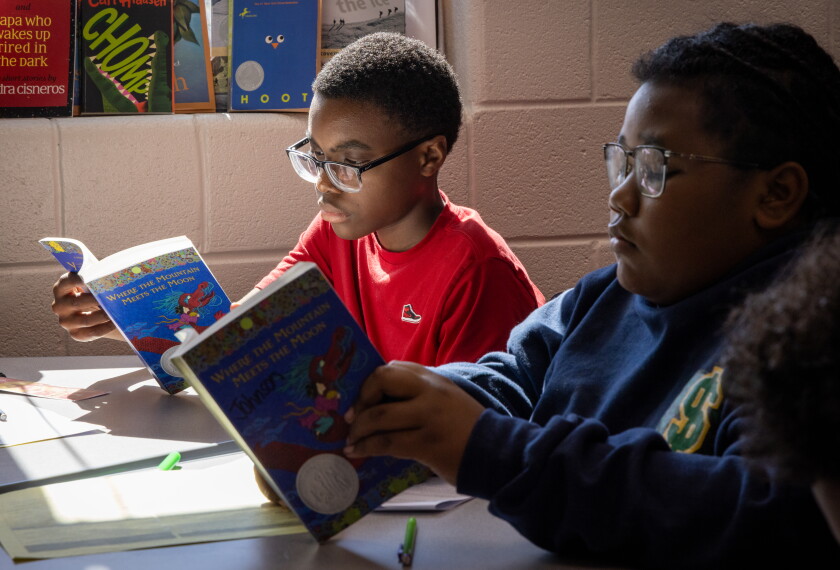
The science of reading has affected teachers and students across the country.
This series shares the direct experiences of educators with these efforts.
‘Core Parts of My Practice Have Changed’
Lizzie Hetzer is a Brooklyn-based literacy consultant and curriculum writer, co-founder of Daffodil Hill Press and its Literacy Learning Collaborative, and the author of an upcoming book with Stenhouse about her personal journey shifting her teaching in light of the science of reading movement:
The recent attention to the science of reading has made a huge difference in my teaching. At first, I was surprised by the intensity of the rhetoric. I felt called out—blamed, even—for the way I had been teaching. Because of that, I couldn’t help but feel defensive at first. As I separated some of the tone from the message, I became curious, too. I’ve only ever wanted the best for students as readers and writers. I knew that despite my personal discomfort, I needed to learn more.
As a result, core parts of my practice have changed. I always believed phonics was fundamental to learning to read, but some of the strategies I used to get kids into books conflicted with that belief—like asking them to guess a covered word or emphasizing meaning cues as equal to decoding. I’ve since learned even more about explicit instruction, rethought how I structure small-group lessons, and shifted the assessments I use to guide my planning. I’ve also come to understand the power of engaging, curiosity-driven, content-rich reading and writing units.
What’s interesting is I always sought to be systematic and intentional in my teaching. I created thoughtful plans, mapped out units, and worked incredibly hard to reach every student. But I now know that I wasn’t systematic in the ways that matter most for beginning readers. The science of reading didn’t really change my values—it changed my approach.
I know that the shifts I’ve made have increased students’ success in decoding and supported faster progress for students who previously struggled. I’m grateful to know better. I recognize my former knowledge gaps and advocate supporting—not shaming—everyone who is learning more or ready to learn more.

The Missing Link of Grammar
Patty McGee is a literacy consultant, author, educator, and advocate for delightful literacy practices. Her recent publication through Corwin (2025) with Tim Donohue is Not Your Granny’s Grammar: An Innovative Approach to Meaningful and Engaging Grammar Instruction. Learn more about Patty at www.pattymcgee.org:
The science of reading movement has been both a blessing and a challenge for literacy instruction. While it’s finally given grammar, a forgotten foundational skill, the research backing it deserves, the heavy emphasis on phonics and prescriptive programs has inadvertently squeezed out time for writing and grammar instruction, ultimately undermining the comprehensive literacy profile the movement aims to achieve.
Grammar: The Overlooked Foundation
Research clearly shows that grammar is essential for language comprehension within Scarborough’s Reading Rope model, with syntax being foundational to helping students understand language at the sentence level. Yet, many schools implementing science of reading programs have become so focused on phonics that writing and grammar get pushed aside.This creates a critical gap because when students don’t write using their developing grammar and phonics skills, we miss opportunities to integrate language comprehension and word recognition—not to mention build stronger writers.
However, the science of reading’s focus on foundational skills presents an opportunity. Grammar is foundational, so this moment allows us to envision grammar learning differently from traditional rote memorization and worksheet approaches.
Grammar Study: A Fresh, Research-Aligned Approach
The grammar-study approach affords students the opportunity to experience grammar with curiosity, inquiry, explicit instruction, experimentation, and reflection. Students learn grammar with greater interest and effectiveness through brief, focused sessions. Because the science of reading emphasizes systematic and explicit instruction, our 10-minute sessions, three to five times per week, provide multiple entry points without sacrificing other literacy components.
Three key strategies maximize limited time:
Efficient Integration: Grammar instruction doesn’t require separate periods when inquiry-based lessons weave seamlessly into existing literacy time through engaging, contextual experiences.
Dual-Purpose Learning: Conversations about grammar build both oral language skills and grammatical understanding, supporting multiple science of reading components simultaneously.
Repeated, Yet Brief: Multiple and varied experiences with grammar learning across days, weeks, or units support grammar learning for reading and writing.
Reclaiming Grammar’s Rightful Place
Prescriptive programs often crowd out effective grammar instruction through ineffective exercises or complete omission. The science of reading provided crucial research backing, but we must advocate truly comprehensive implementation that honors grammar as the foundational skill it is.

It Helped ‘Connect the Dots’
Jan Burkins and Kari Yates of TheSixShifts.com are authors and consultants who partner with K–5 educators across the globe. Through their books, classroom resources, workshops, and online courses—including “Shifting the Balance: Six Ways to Bring the Science of Reading into the Classroom"—they support educators in making science-aligned, compassionate, and practical shifts in literacy instruction:
When we think about the impact of the science of reading on our work, one word rises to the surface: transformational. But our journey hasn’t been simple or straightforward. It’s been filled with both headwork and heart work—challenging us to reexamine long-held beliefs, acknowledge past misunderstandings, and explore new ways of teaching.
When the conversation around the science of reading began to pick up national attention, our initial reaction was a mixture of skepticism and defensiveness. After all, like so many educators, we had spent decades pouring our hearts into fostering joyful, responsive classrooms. Having written multiple professional books for balanced-literacy audiences, hearing criticisms of balanced-literacy practices felt deeply personal.
At first, we approached the research defensively, eager to protect our practices.
But as we dug deeper, something shifted.
We discovered that some of our well-intentioned strategies weren’t fully aligned with how the brain learns to read. That realization was humbling—but also freeing. When we shifted our defensiveness to curiosity, we discovered an opportunity to better serve teachers and the children in their care, particularly those for whom learning was more challenging.
This exploration changed how we think about almost every aspect of literacy instruction and how we support teachers in translating research into high-leverage classroom routines. From phonemic awareness to phonics, from word reading to comprehension, from the role of background knowledge to the nature of independent reading—we started exploring the why behind these shifts with teachers, helping make connections between classroom practices and how the brain learns to read, so that more students could become the proficient, confident readers they deserve to be.
Thankfully, not every past practice needed to be dismantled. Read-alouds, small-group differentiation, independent reading, and turn-and-talks are still essential. Some practices needed refining—not replacing.
As for our feelings about all of the changes, they are complex. On one hand, there’s a sense of loss. We had to say goodbye to some practices we believed in. Letting go of familiar routines—and, more importantly, admitting that some of them might have made reading harder for children—was painful.
On the other hand, we have a deep sense of hope. The science of reading isn’t about abandoning joy, curiosity, or authentic engagement with texts. It’s about layering those essential elements of literacy instruction on top of a firm foundation in the skills that allow children to access (and understand) print independently. It’s about tending to decoding and comprehension—and doing a better job of teaching both.
Most of all, we feel grateful. Grateful to the researchers and thought leaders who challenged us. Grateful to the courageous educators who continue to grow and adapt—not because it’s trendy, but because it’s right for kids.

Thanks to Lizzie, Patty, Jan, and Kari for contributing their thoughts.
Responses today answered this question:
How has the relatively recent attention to the science of reading impacted your teaching, and how do you feel about it?
Consider contributing a question to be answered in a future post. You can send one to me at lferlazzo@epe.org. When you send it in, let me know if I can use your real name if it’s selected or if you’d prefer remaining anonymous and have a pseudonym in mind.
You can also contact me on X at @Larryferlazzo or on Bluesky at @larryferlazzo.bsky.social
Just a reminder; you can subscribe and receive updates from this blog via email. And if you missed any of the highlights from the first 13 years of this blog, you can see a categorized list here.