Editor’s Note: Dr. Jennifer Williams, International Literacy Association Board of Directors Member, co-founder of TeachSDGs, and professor of education at Saint Leo University, shares the new Children’s Rights to Read initiative, launched by the International Literacy Association (ILA). The International Literacy Association (ILA) is a global advocacy and membership organization dedicated to advancing literacy for all through its network of more than 300,000 literacy educators, researchers, and experts across 146 countries.
Join her on Twitter this Thursday, September 13, at 8 p.m. US Eastern time as #Globaledchat joins forces with #ILAChat to engage in a global conversation around the Rights.
The United Nations Educational, Scientific, and Cultural Organization (UNESCO) in 1966 proclaimed that 8 September be named International Literacy Day and be observed by all countries of the world from then onward. The proclamation stated that UNESCO, "[r]ecognizing the need for a concerted and vigorous international effort to promote world literacy, [i]nvites, consequently, in the name of human solidarity, Member States, non-governmental organizations, foundations, and private enterprises to do everything possible to give financial, technical, moral and any other appropriate forms of support for international action against illiteracy under the auspices of UNESCO, in order, as soon as possible, to eliminate illiteracy throughout the world.”
The language reflected urgency. It called for solidarity. It was the beginning of a global effort. But it was only the beginning.
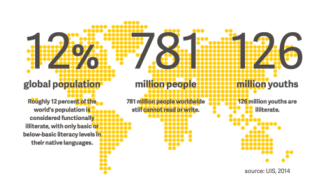
Today, following 52 annual International Literacy Day celebrations and the commitment of our world to promote literacy as a basic human right for all, we have seen progress. Through awareness and advocacy, world organizations have helped to create a common language on the critical importance of literacy for children and for adults. Conversations have led to global declarations, including Sustainable Development Goal 4.6, which states that by 2030, all youth and a substantial proportion of adults, both men and women, will achieve literacy and numeracy. The people of a united world have indeed established literacy as a foundation for learning, for opportunity, and for peace. But, there is still an incredible amount of work to be done.
Educators, as protectors of all children’s rights, work each day to deliver on a promise of equitable and accessible learning for all. Educators are on the front line. They respond and take action on learning and on literacy by connecting children to reading, writing, listening, and speaking. And, as our world looks to celebrate the 52nd International Literacy Day this September, teachers now are armed with the Children’s Rights to Read as offered by the International Literacy Association (ILA). These 10 Rights, created by and for educators around the globe, put the power for positive change in the hands of schools, teachers, and students:
Children have the basic human right to read.
Children have the right to access texts in print and digital formats.
Children have the right to choose what they read.
Children have the right to read texts that mirror their experiences and languages, provide windows into the lives of others, and open doors into our diverse world.
Children have the right to read for pleasure.
Children have the right to supportive reading environments with knowledgeable literacy partners.
Children have the right to extended time set aside for reading.
Children have the right to share what they learn through reading by collaborating with others locally and globally.
Children have the right to read as a springboard for other forms of communication, such as writing, speaking, and visually representing.
Children have the right to benefit from the financial and material resources of governments, agencies, and organizations that support reading and reading instruction.
In addition to releasing the Rights, ILA launched a yearlong Children’s Rights to Read campaign. Over the next 12 months, the organization, which for 60 years has set the standard on literacy instruction and provided teachers and school leaders with resources and expertise to support and inspire learning, will continue to equip educators with the resources needed to enact the Rights and advocate for students of the world.
The time to get started is now. Here are five ways to mobilize on your role as a protector and enactor of the Children’s Rights to Read for every child, everywhere:
Take the pledge to support the Children’s Right to Read by visiting literacyworldwide.org/rightstoread.
Download, print, and display the Children’s Rights to Read in your classroom (or purchase the printed poster) at literacyworldwide.org/rightstoread.
Encourage your school and district leaders to sign the formal Resolution to Adopt the Children’s Rights to Read available at literacyworldwide.org/rightstoread.
Share messages of support on social media by using #RightsToRead on Twitter, Facebook, and Instagram.
- Engage and empower students to advocate and take action on their rights to read by sharing and incorporating the Children’s Rights to Read into instructional practices. Equip children with the resources, information, and support they need to lead efforts for change.
Connect with Jennifer, ILA, Heather, and the Center for Global Education on Twitter.
Image: Used with permission of ILA, www.literacyworldwide.org


