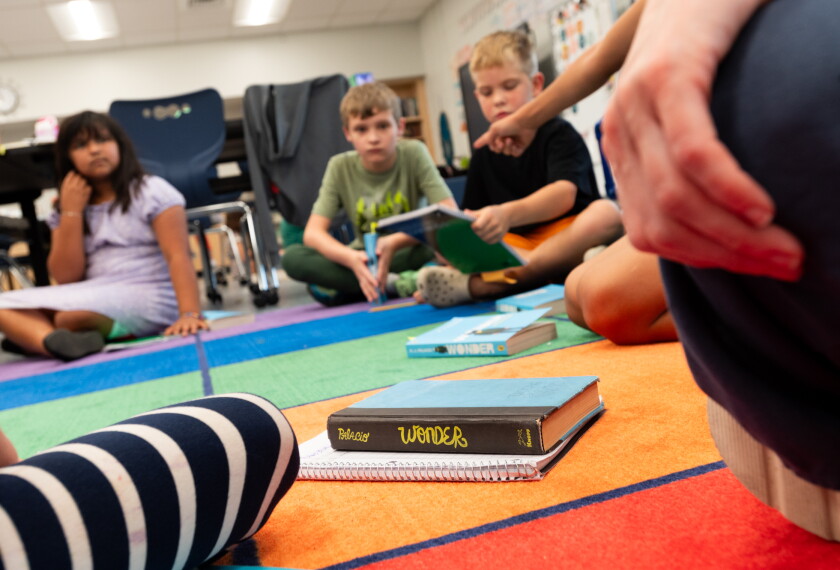

Many teenagers struggle with basic reading skills. But middle and high schools don’t always have structures in place to support them.
Now, some educators are trying to change that, bringing the “science of reading” to older students.
Last month, Education Week profiled Bow Memorial School, a middle school in New Hampshire that has launched a “structured literacy” program for students in grades 5-8 who need support with foundational reading skills, like decoding multisyllabic words.

Bow is at the forefront of a growing movement to provide more systematic and targeted support to struggling readers in older grades.
Creating a program like this can be difficult at the secondary level, where school schedules usually don’t include time for extra reading classes and teachers are trained as content-area specialists—not reading experts. Still, more schools are starting to tackle the challenge.
Education Week spoke with three educators who are putting these strategies in place in their districts. All of them emphasized that middle and high schools have a duty to help struggling students become successful readers—even though that task is usually seen as the responsibility of elementary school teachers.
“When students get to a middle school or a high school with the kinds of gaps that you might see, they deserve the benefit of teachers who know how to help them,” said Rhonda Nelson, the coordinator for curriculum, instruction, and assessment for the Bettendorf Community school district in Iowa.
Read on for four takeaways from teachers and leaders about how districts can provide this help.
1. Want to make reading support a priority? Get it on the schedule
Most elementary schools set aside some time in the day for reading support or intervention. But it’s not universal in middle and high schools. Only a third of high school educators say that their schools offer dedicated time for reading intervention, according to a recent EdWeek Research Center survey.
“There aren’t the structures in place at the secondary setting to support the level of need that these students have,” said Nelson.
Bettendorf is an exception. There, English/language arts teachers, interventionists, and instructional coaches in grades 6-8 have all received training to support struggling readers. Middle schoolers with the greatest needs are all enrolled in reading support classes.

Taking these steps was only possible because school and district leadership protected time in the schedule to make it happen, Nelson said.
The teacher training took place during the school day, and teachers also received time to discuss takeaways and how to implement the suggested practices. Starting this school year, the middle school set a policy that other scheduling priorities wouldn’t cut into time set aside for reading interventions.
Other districts have created dedicated courses for middle and high schools, too. But the logistics of fitting them into the established bell schedule can still sometimes pose challenges.
The Boston public schools, for instance, allow high schools to offer an “advanced word study” class for high school students who need support with decoding, said Silvia Gonzalez-Powers, a lead reading interventionist in the district and an instructor with the Institute for Multi-Sensory Education.
But not all schools offer this option, some due to scheduling challenges.
Schools within the district have a lot of individual autonomy, Gonzalez-Powers said. “You can put out lots of guidance, but it really depends on the administration and the level of teacher leadership.”
2. Pinpoint what kind of help students need
Reading assessments for older students usually test general comprehension. They can identify when a student can’t understand what they read, but not the underlying reasons why they’re struggling.
Students might have trouble with reading stamina or vocabulary knowledge, for instance, but it’s also possible that their problems lie deeper, at the word level.
Many older struggling readers have trouble decoding complex, multisyllabic words, even if they can use their phonics skills to read short words like “cat” or “dog,” researchers say. (For more on why students might struggle with multisyllabic words, see this story.)

At East Irondequoit Middle School in Rochester, N.Y., reading teacher Cindi Bauman brought in new diagnostic assessments to determine which specific reading skills students needed more help with. The tests she used—the Gallistel-Ellis Test of Decoding Skills, and Acadience Learning’s Oral Reading Fluency measure—assessed students’ decoding skills and oral reading fluency, along with overall reading comprehension.
The detailed results about students’ underlying difficulties help Bauman and other teachers who work with middle schoolers in reading labs more effectively target instruction, she said.
3. Finding age-appropriate reading resources is difficult
As the “science of reading” movement has spread, and more than 40 states have passed sweeping legislation mandating schools use evidence-based approaches to teach young readers, curriculum publishers have flooded the market with options for foundational skills instruction in the early grades.
But there aren’t as many resources designed to teach decoding skills to older students, educators and researchers say.
That can pose a problem, because many teenagers who have struggled with word reading for years need different kinds of support than children learning how to crack the code for the first time. And materials designed for 5- and 6-year-olds can feel infantilizing for middle and high schoolers, teachers say.

“Because the research has focused so long in that K-3 window, there is definitely a lack of understanding about what older students need,” said Bauman, the New York reading teacher. “Teachers are usually scrambling for resources, especially if the district isn’t willing to pay for those.”
When Bauman started teaching struggling readers in the district, she created her own lessons, pulling pieces from materials designed for younger students that she said could sometimes feel “a little hokey.”
She’s since compiled a patchwork curriculum that includes some lessons from REWARDS, a reading intervention for students in grades 4-12, and Corrective Reading, an intervention for students in upper elementary grades and above.
“There’s definitely a need for programs that are specifically designed for older students,” said Kelly Williams, an associate professor in the department of communication sciences and special education at the University of Georgia.
Williams, funded through a federal grant, is working with a school district in Georgia to create and test a new program for adolescents with word-level reading difficulties.
The idea that teachers in these grades, many of whom don’t have training in supporting struggling readers, could create their own materials “is really unrealistic,” Williams said.
4. Schools should equip all teachers to support reading skills—not just reading teachers
In middle and high school, reading demands intensify across subject areas. Science and math classes introduce technical vocabulary; social studies requires close reading of dense primary sources.
At East Irondequoit, Bauman is preparing to train teachers of grades 6-12 in all content subjects in strategies they can use to help students tackle these harder reading assignments.
She’s planning to teach educators routines for pre-teaching complex, multisyllabic words. And she’s going to introduce them to “paragraph shrinking,” an evidence-based routine for summarizing the main points of a reading.
If students get to middle school and beyond with gaps in foundational reading skills, catching them up has to be a schoolwide effort, Bauman said.
“They have to be aware, even at the high school. We have to close the gap,” she said. “We can’t just worry about K-3, and check the box.”