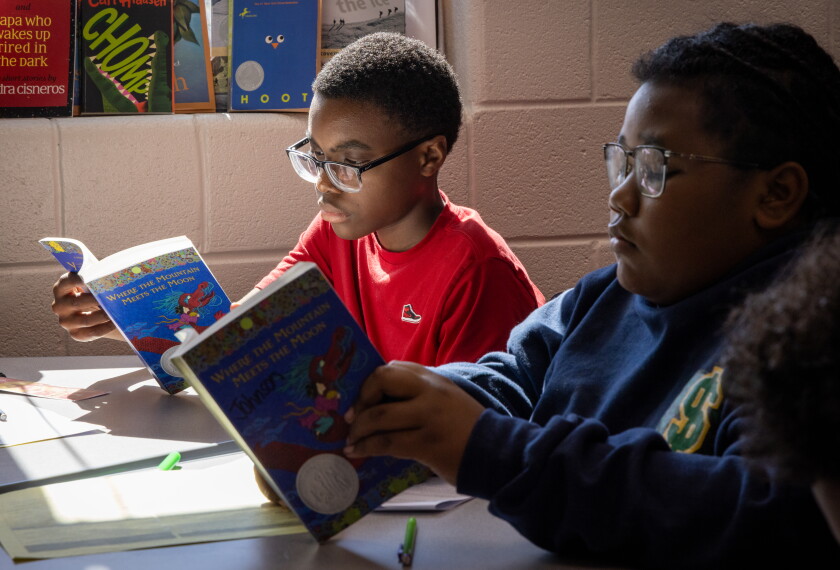
Reading aloud to students during class time may sound like a simple, almost quaint, endeavor, as if from a bygone era. But literacy experts insist that it’s every bit as relevant now as ever, and they urge English/language arts teachers—especially of early elementary students (although many experts espouse the practice as meaningful throughout K-12)—to make the ritual part of their daily instructional practice.
The “read-aloud” requires a significant commitment by the teacher—beyond simply committing to the act of reading aloud to students routinely. In its most effective form, the read-aloud demands thoughtful advanced preparation. It’s time well-spent, say literacy experts.
“I would argue that, of all components [of reading], read-alouds have one of the longest-standing research bases. There’s a lot of data showing the power of read-alouds,” said Molly Ness, a former teacher, reading researcher, and vice president of academic content at Learning Ally, a nonprofit volunteer organization that supports educators.
Ness’s perspective isn’t new. The Commission on Reading, in 1985, declared read-alouds “the single most important activity for building the knowledge required for eventual success in reading.”
The rationale behind support for the read-aloud is simple: The activity offers an engaging way to pack a big literacy “punch” into a single classroom activity, particularly regarding reading comprehension.
“The read-aloud increases vocabulary and background knowledge, which increases comprehension. And the better you can understand, the more likely you are to read, and it becomes this cycle, an upward spiral of a literary trajectory,” Ness said.

Despite the benefits of read-alouds, it’s unclear how frequently teachers use them in the classroom. Further, research suggests that even when teachers do engage in read-alouds, there’s a tendency not to prepare adequately, thereby limiting the activity’s potential for positive outcomes.
In a survey of approximately 63 preschool, kindergarten, and elementary teachers, 50 to 70 percent of respondents acknowledged not allotting intentional planning time for their read-alouds. Megan McCaffrey, an education professor at Governors State University, led the survey.
Below, literacy experts and teachers share three strategies on how to plan for read-alouds that ignite a passion for the joy of reading while also boosting literacy skills.
1. Examine texts for literacy components
Ness recommends that, well before picking up a text to read to students, teachers consider its potential obstacles and opportunities by asking themselves questions like: Will the vocabulary present a challenge? Do students have the background knowledge to grasp the text’s content? Weighing these elements beforehand can help teachers plan a developmentally appropriate read-aloud accordingly, she explains.
Brittany Brooks, the multilingual learner teacher at Coltrane-Webb STEM Elementary in Concord, N.C., suggests scanning the text for vocabulary students may not know and pre-teaching any unfamiliar terms. She also recommends using visual aids to help the vocabulary stick, especially for students in the early elementary grades and English learners.
Brooks, who wrote about the topic for ASCD, also advises choosing texts whose content matches what is being taught in other classes. With her own students, Brooks strives to integrate content in reading units with what is being taught in social studies.
This strategy mirrors an instructional strategy a growing number of districts are implementing called “knowledge-building curriculum,” which is intentionally designed to grow students’ knowledge about topics they’re learning in other classes, including in social studies and science.
2. Choose texts that unlock the joy of reading
While read-alouds aim to boost literacy skills, their goal of sparking the joy of reading is perhaps equally important. Not every student will be attracted to the same text, but there do seem to be some common features in literature that children find engaging, according to recent research on the topic.
A 2023 Harvard study surveyed 66 students, ages 9 to 11, to learn what factors contribute to “story absorption”—the mental state a reader experiences when fully immersed in a story. The student respondents reported preferring information that was presented in a narrative format, regardless of whether the text was fiction or nonfiction. Mysteries and fast-paced plots proved to be engaging genres to young readers. Respondents said they were also drawn to characters who are misfits as well as those to whom they could personally relate.
3. Make seating arrangements a high priority
Seating arrangements can impact students’ learning experience. At the very least, all students should be able to see and hear the teacher with ease. To promote the read-aloud as a special ritual, teachers may consider emphasizing students’ physical comfort, some proponents of the practice suggest—perhaps allowing them to stretch out on a rug or use pillows or bean-bag chairs. But ultimately, teachers will need to assess their students individually and as a class before determining how to balance the twin goals of creating an environment for the read-aloud that encourages comfort yet supports students’ ability to focus on the learning activity.
Presenting a read-aloud differs from a standard classroom presentation. Appropriate prosody—reading with expression and meaning, which includes elements like correct pronunciation, appropriate pace, effective pauses, and adopting different dialects—takes practice. Doing it daily, as literacy experts suggest, allows for plenty of practice.
“There are so many reasons to read aloud to students,” Ness said.