Early Childhood Photos

Kindergartners Write Letters to the President-Elect

By Kristen McNicholas — November 14, 2016 2 min read
  • Save to favorites
  • Print

Three teachers at the Co-op School, a private school in Brooklyn, N.Y., had each of their students write letters to the new president-elect, Donald Trump. Teacher Dahna Bozarth wrote about the exercise for Education Week. Photos by Bozarth, and her teacher colleagues, Allison Woodin and Emily Silver.
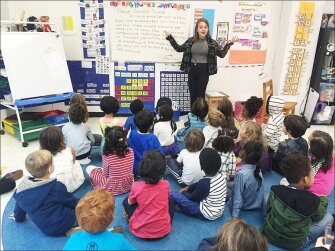
Teacher Emily Silver helps kindergartners at the Co-op School in the Bedford-Stuyvesant community of Brooklyn, draft letters to President-elect Donald Trump. The letters will be mailed to the new President.

Today in the Lion class, it was important to talk about the Presidential results. We knew that with a life lesson or disappointment, there is a teachable moment. We compared President-elect Donald Trump to our many new friends (aka our persona dolls). We remembered that on each of our students’ first days in our class, we were expected to be role models, to show them what’s important in kindergarten.

02 k ke

We discussed how Donald Trump will be totally new to the presidency, and maybe isn’t quite sure how to do his job just yet. He will look around and see beautiful hearts like ours and know that compassion and kindness is something that is important for his people. We concluded we have to be his role model.

The Lions wrote a letter to President-elect Trump, and we will later take a trip to a mail box to send our letters to him. In the classroom, we are talking about what we can do to spread positivity, think constructively, empower ourselves and exercise our powerful words.

03 k ke

The Lions were asked two questions. Here are some of their responses:

What is the President’s job?
Chance – to take care of the world
Liev – He goes in a big building and sits on the top and works to be compassionate
Gus – to take care of the world and treat everyone with respect
Rishi – to be respectful and kind to other people
Calvin – to rule our state (country)
Ellie – President is supposed to run the country
Mateo – he is the boss of the country
Robin – to keep everybody safe and next year Hillary Clinton will be the president

How will he know what makes us happy?
Nico – if we teach him how to be nicer than he is now
Chance – we can teach him to be kinder and not to do bad things
Liev – to teach him to be compassionate be kind be nice and to not make a wall
Lee – we can teach him compassion
Zymair – we can teach him a lesson
Khalifa – keep the town safe and don’t let it be destroyed
Miles – he will know if we write him a letter
Ogden – the president could go some where to not learn bad words and learn good words. As president he could say good words

04 k ke

It is important we…
Are nice – Joseph
Use kind words – Alice
We should not hate women we should treat them nice – Lee
Be nice to boys – Khalifa
Are happy and love everybody – Robin
Are nice – Mateo

We spoke about how it is our new president’s job to make us feel happy and safe. We concluded that he will be new at his job and maybe needs some of our suggestions and advice. Just like a common cold, kindness and compassion are contagious. It starts with us.

05 k ke

The teachers had full hearts as the Lions worked together to spread the love that comes so naturally to them. We are so proud of our young activists!

06 k ke

Related Tags:

A version of this article first appeared in the Full Frame blog.

Events

This content is provided by our sponsor. It is not written by and does not necessarily reflect the views of Education Week's editorial staff.
Sponsor
Recruitment & Retention Webinar
Hiring, Retention, and Fill Rates: A Data-Driven Sub Strategy
Explore what keeps substitutes coming back and hear how one district rebuilt its substitute hiring process and improved its fill rate.
Content provided by Frontline Education
Early Childhood K-12 Essentials Forum Early Childhood Education: Building Essential Skills for Success
Join this free virtual event to examine the biggest challenges in supporting young children, from preschool through elementary school. 
This content is provided by our sponsor. It is not written by and does not necessarily reflect the views of Education Week's editorial staff.
Sponsor
Student Absenteeism Webinar
Attendance Isn't an Attendance Problem
Boost attendance by strengthening relationships, belonging, and support with practical strategies from Doug Fisher & Nancy Frey.
Content provided by Corwin

EdWeek Top School Jobs

Teacher Jobs
Search over ten thousand teaching jobs nationwide — elementary, middle, high school and more.
View Jobs
Principal Jobs
Find hundreds of jobs for principals, assistant principals, and other school leadership roles.
View Jobs
Administrator Jobs
Over a thousand district-level jobs: superintendents, directors, more.
View Jobs
Support Staff Jobs
Search thousands of jobs, from paraprofessionals to counselors and more.
View Jobs

Read Next

Early Childhood Q&A If District Leaders Support Pre-K, Then Why Is It Not a Top Priority?
Superintendents can empower other leaders to nurture and grow their district's pre-K program.
6 min read
WASHINGTON,DC - JUNE 10: Dr. Aaron Spence, Superintendent, Loudoun County Public Schools and Dr. Macquline King, Superintendent and CEO of Chicago Public Schools speak during a House Education and Workforce Committee hearing titled “Breaking Trust: Attacks On Parental Rights, Inappropriate Content, And Legal Abuses In America’s Schools” on Capitol Hill on Wednesday, June 10, 2026 in Washington, DC.
Dr. Aaron Spence, Superintendent, Loudoun County Public Schools, and Dr. Macquline King, Superintendent and CEO of Chicago Public Schools, speak during a House Education and Workforce Committee hearing on Capitol Hill on June 10, 2026, in Washington, D.C. Superintendents believe pre-K is a priority for their districts, but it doesn't often translate to actively supporting early grades.
Jabin Botsford For Education Week
Early Childhood Q&A The Pre-K Push: Are Current Preschool Models Heading the Wrong Way?
Dale C. Farran has spent five decades studying early education, and shares her insights with EdWeek.
7 min read
In this Friday, March 13, 2020 photo, Pre-K students Nivayeh O'neal, 4, left, and Harper Lietchy, 5, go through the lunch line at Rivermont elementary school in Chattanooga, Tenn.
Pre-K students go through the lunch line at Rivermont Elementary School on March 13, 2020, in Chattanooga, Tenn. As a growing number of states plan to expand access to publicly funded pre-K, experts question its impact and direction.
Troy Stolt/Chattanooga Times Free Press via AP
Early Childhood Hey Diddle Diddle: What the Decline of Nursery Rhymes Means for Early Literacy
Nursery rhymes aren't just a quaint nod to the past: They're an engaging way to grow literacy skills.
5 min read
Nursery Rhymes, Disappearing, children's books, kids books, early childhood, early literacy
Illustration by Gina Tomko/Education Week + Canva
Early Childhood Opinion Finland Is a Model of Academic Success. The Reason Starts Earlier Than I Thought
Learning about community comes before academics in Finnish preschools, writes a teacher educator.
Marilyn M. DePietto
5 min read
Collage-style illustration of young Finnish students in snowsuits, a cut out image of the Supreme Court of Finland building, a map and flag of Finland, as well as two other students working with pencils on paper.
Illustration by Emily Wright for Education Week + Getty
