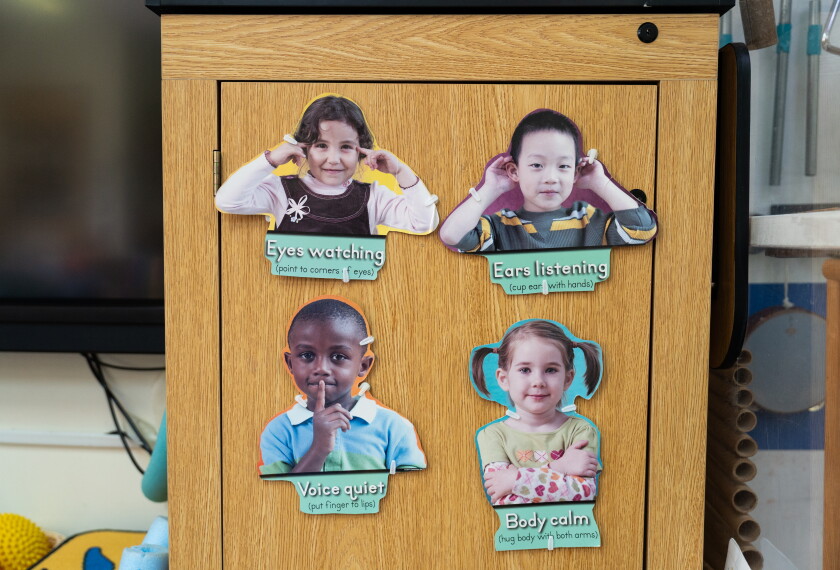
It’s not unusual for kindergarten teachers to spend a chunk of their school days trying to get their young learners to stop talking. Advice on managing classroom noise is easy to find. Far rarer, experts say, are classrooms where teachers intentionally encourage students to talk.
In her recent book American Kindergarten, developmental psychologist Susan Engel documented this pattern. After observing 29 kindergarten classrooms across the country over two years, she found few instances where teachers deliberately encouraged extended conversations among students.
When it did happen, it stood out. Engel described one classroom where students regularly “turn and share,” effortlessly shifting to talk with peers as “the room hums with excited discussions.”
Engel isn’t the only childhood expert to notice that young learners are less likely to find opportunities in school to practice oral language—a key component to developing strong, comprehensive literacy proficiency.
“The oral language piece, I think, is given too short a shrift in the U.S. [school system],” said Sonia Cabell, the Sigmon endowed professor in reading education and core faculty at the Florida Center for Reading Research.
In recent years, kindergarten has become increasingly focused on teaching children to read. That emphasis, some experts argue, has unintentionally crowded out time for conversation.
Why too few conversations are happening in kindergarten
The focus on reading in kindergarten is not new. A decade ago, a widely disseminated study, “Is Kindergarten the New First Grade?,” revealed that kindergarten teachers in 2010 were more than twice as likely as those in 1998 to expect most children to leave their classrooms knowing how to read. Today, that expectation is widespread.
Some experts believe this singular focus on teaching students to read is to blame for too few conversations in the kindergarten classroom.
“I think, sadly, the emphasis on literacy has actually exacerbated the reduction in conversations,” said Ellen Frede, an early learning consultant and recently retired co-director and research professor for the National Institute for Early Education Research at Rutgers University.
Teachers, she said, often feel pressed for time under curriculum pacing guides and accountability demands, leading to more whole-group instruction and less student talk.
Much of that time focuses on decoding and understanding written text, said Cabell. But children develop vocabulary and syntax—the building blocks of comprehension—through conversation.
Lessons in science and social studies create opportunities for these conversations, Cabell noted. But studies show that schools are spending less time in both subject areas during the early grades. In a recent national survey of K-3 teachers, respondents reported spending a daily average of 89 minutes on English/language arts, 57 minutes on math, and just 18 minutes on science and 16 minutes on social studies.
Playtime has also declined. Kindergartners today spend less time in unstructured play, another key setting for language development. During play, students build their oral language as they negotiate, collaborate, and solve problems.
Frede agrees that the conversations among students that take place during play are important, especially when their teachers are adequately trained to encourage and further these opportunities to build on language skills.
Jessica Arrow, a seasoned kindergarten teacher at Symonds Elementary in Keene, N.H., who spearheaded her school’s renewed focus on play-based learning, agrees.
“I often think to myself how much less practice the kids would get with these standards if we don’t have this 45 minutes to an hour every morning [during choice time] to actually be utilizing and expressing verbally—especially for those students who aren’t yet communicating as much verbally,” she told Education Week.
Why early conversations matter
Practicing verbal skills during kindergarten can pay off in later grades, experts note.
“Words are your toolbox for understanding and communicating about the world,” said W. Steven Barnett, director of the National Institute for Early Education Research. “If kids start school thousands of words behind or even hundreds of words behind, that’s a big gap to make up.”
Research suggests that interactive conversation—not just exposure to words—drives language development.
A 2018 study by MIT cognitive scientists found that back-and-forth conversations between young children (ages 4 to 6) and adults led to measurable changes in brain physiology associated with language skills.
“It’s not just about dumping language into your child’s brain, but to actually carry on a conversation with them,” Rachel Romeo, lead author of the study, said in a news release.
These interactions don’t have to be limited to home. Experts say teachers play a critical role in fostering them in classrooms.
Yet gaps remain in how educators are prepared.
“I don’t know that we’re doing a great job as a country in our teacher preparation programs of helping students understand the importance of [oral] language to later reading,” said Florida Center for Reading Research’s Cabell. District leaders frequently tell her that, in K-2, they’re focusing on teaching students to read, and that in grades 3-5, they’re focusing on comprehension, she said.
“But the problem with that,” Cabell said, “is if you don’t focus on how students develop those comprehension skills from the beginning—if you’re not focusing on the language and the knowledge that you need to understand texts right from the start—then they’ll get to 3rd and 4th grade and not understand the texts that they’re reading or that are being read.”