Want to know if it’s time for phonics in Belinda Williams’s kindergarten classroom? Stand in the hall and listen.
“I love phonics because it’s something that’s so easy to make fun,” Williams said. “We’re always doing something very active and very musical.”
Williams said her Franklin Community Schools in Franklin, Ind., uses a 90-minute reading block each day, of which 55 minutes cover phonics instruction and practice. Yet she said she usually also dedicates her personal flex time later in the day to phonics, too, with different games everyday, using magnets and Slinkies, among other activities.
There’s something to be learned from teachers who end a lesson with singing and dancing students, especially when covering skills some bemoan as the most boring part of early literacy.
“Early reading instruction needs new thinking. Phonics instruction needs to change as well,” said Jeannine Herron, a research neuropsychologist and reading coach in San Rafael, Calif. “Traditional instruction usually presents the skills needed for good reading as isolated skills. First comes phoneme awareness, then phonics, then comprehension and fluency. However, the brain needs to link new learning to something it already knows.”
Herron argues a traditional emphasis on worksheet practice and drills of isolated sounds that are still common in many early reading classrooms turns off teachers and students. She and other educators favor a faster, brighter approach. While research suggests early readers benefit from learning phonics in a structured, systemic way, young students in particular have been shown to remember more when given frequent activity.
Only 1 in 20 teachers reported learning most of what they know about reading instruction before they started teaching, according to a nationally representative survey by the Education Week Research Center. One-third of teachers reported learning it from professional development or coaches in their district.
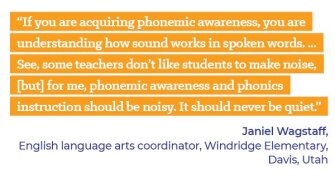
When Janiel Wagstaff, the English/language arts coordinator for Windridge Elementary in the Davis, Utah, school district first started teaching, “I felt like it was a worksheet factory,” she said. Every new sound or concept called for practice worksheets, and it was a grind.
“So the kids are working hard, you know, but I was basically doing back flips and handing out M&M’s to get them motivated. ‘Cause if you’re sitting in your seat by yourself doing a worksheet, how fun and motivating is that?” she said.
Worse, Wagstaff said, “What I found was that what [students] did on the worksheets didn’t transfer to real reading and writing, because it was simplified. Kids can do a lot of those worksheets without much actual deep thinking or ... any real application of what they’d just learned. ... It’s gotten better, but that’s still a rampant problem. Look at [the online marketplace] Teachers Pay Teachers; they are selling massive amounts of [worksheets].”
Wagstaff said she now keeps silent, solitary work to a minimum, instead incorporating chants, nursery rhymes, and partner reading, and encouraging students to play with the patterns of sounds in words.
Herron, who works with the National Institute of Child Health and Human Development on literacy programs including one called “Talking Fingers,” recommended that teachers move beyond having students visually identify elements like blends and diagraphs—for example, underlining them—to focus more on feeling the movements their mouths make as they say the sounds.
Over time, these sound analyses can turn into games, said Herron, who works on one program called “Talking : “If the teacher starts with a simple rhyme like /at/, she can play with different sounds to start the word—'What would you add to make this word say ‘cat,’ ‘fat,’ ‘hat,’ ‘sat’?” In a few lessons [the student] has learned to segment four words, identify six speech sounds, and link the appropriate shapes (letters) to the sounds.”