English Learners

How a Spanish Spelling Bee Winner Serves Her Community as an Adult

By Jennifer Vilcarino — July 15, 2025 5 min read
Evelyn Juarez speaks during the awards dinner for the National Spanish Spelling Bee at the National Hispanic Cultural Center on July 12, 2025. Juarez, the first winner of the NSSB, is a medical student at the University of New Mexico.
  • Save to favorites
  • Print

Evelyn Juarez began competing in Spanish spelling bees in 3rd grade. By the time she was in 7th grade, she became the first-ever winner of the National Spanish Spelling Bee.

“It’s actually a funny story,” she told Education Week, recalling how she got started. Juarez placed third in her classroom competition at James H. Rodriguez Elementary School in Española, N.M., and entered the district-level competition as an alternate in 2006. Juarez ended up stepping in to compete by chance—a judge saw and told her she could compete despite being an alternate—and won.

This was her first of six consecutive district spelling bee victories. Then, in 2011, at the age of 13, she became the first winner of the National Spanish Spelling Bee, a now annual event where spellers compete entirely in Spanish.

See Also

Andres Arreola, the 2014 National Spanish Spelling Bee champion, plays video games as his mother, Silvia Rios, reads words for him to spell earlier this month at his home in Sunland Park, N.M. Arreola will defend his title at the 2015 National Spanish Spelling Bee competition in mid-July.
Ivan Pierre Aguirre for Education Week
English Learners Spanish-Language Spelling Bees Catch On Around the U.S.
Jacob Bell, July 1, 2015
5 min read

“Winning that national spelling bee and all the district and state ones, they really did leave a pretty profound mark on me beyond memorizing words,” said Juarez. “The resilience, determination, and strong work ethic that I built during those competitions and preparing for those competitions carried over and shaped every part of my journey ever since.”

The history of Spanish spelling bees

Spanish spelling bees originated in New Mexico shortly after the state signed the Bilingual Multicultural Education Act in 1973, said Jose Reyes, a bilingual instructional specialist for the Gadsden Independent School District.

While Congress established the Bilingual Education Act of 1968, New Mexico was the first to mandate a statewide requirement of having bilingual programs and professional development for these specialized educators.

Reyes started his career as a 4th-grade teacher at Sunland Park Elementary School in 1982 in Sunland Park, N.M., and, along with colleagues, wondered why there weren’t Spanish spelling bees. That year, they hosted classroom competitions and eventually it became an annual occurrence.

By 1985, the Spanish spelling bee became a district-wide event with 12 schools in the Gadsden Independent School District participating, and in 1992, New Mexico became the first state to host a state Spanish Spelling bee.

Reyes got involved in organizing Spanish spelling bees in 1996 when he joined the district organizing committee. Then, in 2011, Reyes joined the organizing committee for the first national Spanish spelling contest, which was spearheaded by David Briseño.
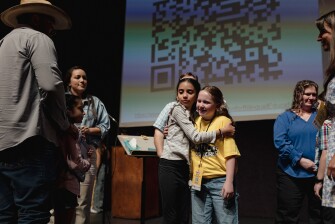
Danaé Tinajero, who finished second, hugs winner Melody Hinkle after the National Spanish Spelling Bee at the National Hispanic Cultural Center on July 12, 2025.

This year, the competition took place on July 11 and July 12 in Albuquerque, N.M., and the winner was Melody Hinkle from Fort Worth, Texas.

The competition doesn’t have as many rules or qualifications as its counterpart, the Scripps National Spelling Bee, which has been in place for 100 years. The main criteria listed on the National Spanish Spelling Bee site is that students must be in grades 4 through 8 to compete, and they must have already placed in a state or regional Spanish spelling contest—which not all states offer. On average, there are between 30 to 35 participants coming from states like New Jersey, Georgia, Oregon, California, New Mexico, Texas, and more.

See Also

Classroom teachers learn from subject matter experts during a training session at Alicedes Figuera Bilingual School Grades 6-12, a National Professional Development grant school partner, in Añasco, PR. NPD grants of the federal office for English language acquisition provide training and micro-credential programs on serving English learners. Schools partner with universities and nonprofits for these services.
Courtesy of Belinda Gimbert

Over the years, a chunk of the winners of the Spanish spelling bee have come from Reyes’ New Mexico district, and as the district coordinator, he has taken the students to nationals.

“The greatest challenge, from my perspective, is trying to get interest from higher level—parents are always excited, but principals at the school need to know why we have this event,” said Reyes. “This is a celebration of language.”

Reyes, a native Spanish speaker, recalls his experience in school: “Many of us were chastised and we were punished for speaking a language other than English, and it traumatized us.”

This motivated him to become a bilingual teacher, he said.

“I usually tell my students we need bilingual police officers, mayors, nurses,” he said. “We need everyone to use a language other than English in the country because then you are left out.”

Today, a bilingual education is about inclusion

A bilingual education includes both native English speakers and English learners, said Patrick Proctor, a professor of bilingual language and literacy at Boston College.

“The significance of having a bilingual education for a child with Mexican or Puerto Rican or Ecuadorian roots in the United States ... has lots of connections with intergenerational communication, cultural maintenance, and language vitality,” said Proctor. “But if you’re talking about a kid who comes from a middle-class native English-speaking home, the benefits of bilingualism are often framed as monetary.”

As a result, speaking a language other than English has been more accepted in recent years, said Proctor.

Matt Hinkle and Eva Valenzuela take photographs of Melody Hinkle during the awards dinner for the National Spanish Spelling Bee at the National Hispanic Cultural Center on July 12, 2025.

Even so, under President Donald Trump’s administration, actions like declaring English the official language of the country, withholding federal funds for English learners, and gutting the U.S. Department of Education’s office of English language acquisition could prove to hurt bilingual students, advocates say.

“Control of educational decisionmaking does reside at the state, but that declaration makes it easy for states that are more friendly to Trump, for example, to dismantle any bilingual education programs they may have; it’s a shield to stand behind,” said Proctor.

See Also

Illustration of English and Spanish textbooks.
Chris Whetzel for Education Week<br/>

The National Spanish Spelling Bee reminds Proctor of the seal of biliteracy, an award given to students to recognize they have attained proficiency in two or more languages.

“It’s rewarding people for being literate in Spanish—that is a good thing,” he said.

Evelyn Juarez, then 13, competes at the first National Spanish Spelling Bee held in Albuquerque, N.M., in 2011.

For Juarez, what motivated her to participate in spelling bee competitions was three-fold: to celebrate the Spanish language, to stay connected to her roots, and to give back to her community.

Not much has changed at 27, says Juarez. She is now a 4th-year medical student at the University of New Mexico’s School of Medicine and uses her bilingual skills to help Spanish-speaking patients in northern New Mexico.

“That same kind of drive [I had for the spelling bee] is continuing to fuel my passion to serve rural New Mexico in the future, where I hope to use my skills and my medical degree to bridge health care gaps and build trust in the communities that need it the most,” said Juarez.

Video: How This Small, Title I District Is Churning Out Spelling Bee Champions

Related Tags:

A version of this article appeared in the September 01, 2025 edition of Education Week as How a Spanish spelling bee winner serves her community as an adult

Events

This content is provided by our sponsor. It is not written by and does not necessarily reflect the views of Education Week's editorial staff.
Sponsor
Reading & Literacy Webinar
Unlocking Success for Struggling Adolescent Readers
The Science of Reading transformed K-3 literacy. Now it's time to extend that focus to students in grades 6 through 12.
Content provided by STARI
Jobs Regional K-12 Virtual Career Fair: DMV
Find teaching jobs and K-12 education jubs at the EdWeek Top School Jobs virtual career fair.
This content is provided by our sponsor. It is not written by and does not necessarily reflect the views of Education Week's editorial staff.
Sponsor
College & Workforce Readiness Webinar
CTE for All: How One School Board Builds Future-Ready Students
Discover how CPSB uses partnerships and high-quality digital resources to build equitable, future-ready CTE pathways for every student.
Content provided by Cengage School

EdWeek Top School Jobs

Teacher Jobs
Search over ten thousand teaching jobs nationwide — elementary, middle, high school and more.
View Jobs
Principal Jobs
Find hundreds of jobs for principals, assistant principals, and other school leadership roles.
View Jobs
Administrator Jobs
Over a thousand district-level jobs: superintendents, directors, more.
View Jobs
Support Staff Jobs
Search thousands of jobs, from paraprofessionals to counselors and more.
View Jobs

Read Next

English Learners From Our Research Center How Schools Serve English Learners Today, in Charts
New national survey data sheds light on where schools can improve English learners' instruction.
4 min read
A look at the state of teaching with English learner students in Antioch, Tenn.
English-language teacher Tameka Marshall leads a lesson dissecting a speech at John F. Kennedy Middle School on Dec. 3, 2025, in Antioch, Tenn. A national survey found that, while English-learner teachers are viewed as primarily responsible for these students, they are not always included in schoolwide instructional decisions.
William DeShazer for Education Week
English Learners How Federal Changes Affect English Learners, Immigrant Students
Since January 2025, several federal policy changes carry implications for ELs and immigrant students.
2 min read
Federal policy moves carry implications for ELs, immigrant students
Gina Tomko/Education Week + Canva
English Learners How to Make English-Learner Funding 'Fair and Effective'
Experts share how state funding models can better support English learners with various needs.
5 min read
TahSoGhay Collah, right, teaches a third-grade English learners class at the 700-student intermediate school that serves grades 3 through 5, in Worthington, Minn., on Oct. 22, 2024.
TahSoGhay Collah, right, teaches a 3rd grade English-learner class at a school that serves grades 3 through 5, in Worthington, Minn., on Oct. 22, 2024. Experts say there is no one-size-fits-all funding model for English learners.
Jessie Wardarski/AP
English Learners 'They're Our Kids’: How Teaching English Learners Is Changing
As the national English-learner population continues to grow, the role of EL teachers is evolving.
12 min read
English Language Teacher Olga Dietz, middle, talks with Glenda McKinney, another English Language Teacher, in between classes at Mt.View Elementary School in Antioch, Tenn.
English-learner teacher Olga Dietz, middle, talks with Glenda McKinney, another EL teacher, in between classes at Mt. View Elementary School in Antioch, Tenn., on Dec. 3, 2025. Across the country districts are increasingly in need of these teachers with specialized skills for helping students learning English as the national EL population continues to grow.
William DeShazer for Education Week
