Citing American students’ relatively poor showing in math and science on international tests such as PISA—the Program for International Student Assessment—a nationally renowned professor of education at Stanford University is calling for strengthening rather than bypassing teacher-preparation programs to improve student achievement.
At the annual conference of the Association for Teacher Educators, held here Feb. 18-22, Linda Darling-Hammond decried what she said were attempts by politicians such as former U.S. Secretary of Education Rod Paige to erode teacher preparation. Pointing out that student-achievement gains are more influenced by classroom teachers than any other factor, she said the focus should be on providing new teachers with enough tools to be successful.
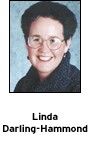
“We need to be artistic in articulating how to prepare teachers, rather than lowering standards. It would be penny-wise and pound-foolish to bring people into teaching unarmed,” she said.
As an example, Ms. Darling-Hammond pointed to Finland, where students have zoomed to the top on PISA. The Finns, she said, “put most of their investment into teacher education. … They invest in the abilities of professionals.”
To make her point that teacher education is “one of the most important and challenging fields,” Ms. Darling-Hammond outlined a plot for a segment of the popular reality-television show “Survivor”: Six business people would be dropped into an elementary school that included high-needs students, some with ADHD and some who speak no English. They would be expected to multitask as every teacher does, from teaching students to documenting benchmarks to maintaining discipline. There would be no golf, except on Sundays, but that wouldn’t matter because they couldn’t afford to play anyway on their new salaries.
“The winner,” she concluded to peals of laughter from the audience, “will be allowed to return to his or her job.”
At Western Washington University in Bellingham, all teacher-education students are required to take an acting-skills class. By the end of the course, even the most socially awkward students are well on their way to becoming engaging teachers, Lauren G. McClanahan, one of the course’s founders and teachers, told her audience at one ATE session.
At the beginning of the acting class, students are asked to create an original pantomime between 3 minutes and 5 minutes long on teaching adolescents, parenting adolescents, or being an adolescent. Students are also challenged to project their voices effectively while maintaining eye contact with the audience.
Ms. McClanahan said students, although initially wary about taking the class, show great creativity once they are actually in it.
She showed video recordings of students at the start and end of the course to demonstrate the difference it made. In one instance, a gawky man who appears fidgety and afraid to make eye contact is transformed into a confident speaker.
The idea for the class, Ms. McClanahan said, originated with the realization that new teachers often fail to do well because of inadequate presentation skills.
At the end of their university program, she said, students often recall the acting-skills class as being their most memorable. “It was not the most intellectually challenging, perhaps,” Ms. McClanahan said, “but they say it was the most practical.”
In the usual portrait, new teachers are so overwhelmed by the basics of the job, they can’t focus on individual students who are falling behind.
But Steven Z. Athanases, an education professor at the University of California, Davis, and Betty Achinstein, a researcher at the New Teacher Center of the University of California, Santa Cruz, challenged that view in a session here. They said that even first-year teachers who get the right mentoring can serve underperforming students better than they often do now.
Drawing on the “wisdom of practice” provided by 37 teachers who lead new-teacher-induction programs and case studies of pairs of mentors and new teachers, the researchers detailed the wealth of knowledge mentors need to do the job. Mentors must be equally adept observers of the teacher’s students and of the teacher, for instance. They should also know the academic expectations for the teacher’s grade and subject, according to the researchers.
Especially important for mentors, the researchers said, is being ready with multiple ways of assessing both the progress of the teacher’s students and the skills of the teacher.
With the help of mentors, Ms. Achinstein said, “beginning teachers were able to see how to use assessment to individualize instruction.”
“Betty and I firmly object to the notion,” added Mr. Athanases, “that ‘survival mode’ must occur.”
The research won the ATE’s distinguished-research award this year. A book building on that research, Mentors in the Making: Developing New Leaders for New Teachers, was published this year by Teachers College Press.


