
More than two years of academic and emotional disruptions during the pandemic have significantly increased both the number of students who dropped out of high school and the intensity of support needed to get them back on track.
Across the country, more districts are opening or expanding dropout-recovery programs—via district alternative schools, charters and contracted services—the educators in these programs say they must provide more hands-on care than before the pandemic for students disenchanted with online remote learning.
“Pre-pandemic, if a school district had a dropout-prevention program, or they had an alternative school in their system, once they set students up, they just kind of left them there,” said Raymond McNulty, the president of the National Dropout Prevention Center and a former Vermont education commissioner.
“What we’re seeing now is schools taking a deeper look at their alternative schools, a deeper look at online services that they provide,” he said. “I think we’re seeing a lot of growth in schools recognizing the needs of our kids were greater than the academics and [recognizing] a lot of the issues around kids managing their own behaviors and the stresses and trauma of growing up in the world today.”
Acceleration Academies, a network of 14 dropout-recovery centers serving more than 2,800 students nationwide, has seen a dramatic uptick in demand. Margaret Sharp, the chief education officer for the network, which operates under partnerships with districts, said that while the number of students overall has risen since 2020, the growth in the number of students entering the academies needing more than 15 credits to graduate—the highest tier of need—has been especially high. The number of students doubled from 500 to more than 1,000. Acceleration has opened five new academies in the last eight months alone in Florida, Kansas, South Carolina, and Texas because of rising demand, with three more opening this fall in Florida and Georgia.
Similarly, Superintendent Wayne Lovell of Mountain Education Charter High School, a network of 18 campuses across north Georgia that serves returning students and those at risk of dropping out of school districts in the region, said two-thirds of students now arrive two to three years behind on credits.

And Janice Mills, the principal of Spectrum Academy, a 6-12 grades reengagement school in Martin County, Fla., tells a similar story. While before the pandemic, Spectrum served 80 to 90 students at a time, the Florida school ended the last school year with a roster of 170 students and expects more than 150 this fall.
Acceleration, Mountain Education, and Spectrum all use hybrid online platforms for students to access classes and assignments at home or on campus, but educators at the schools said they use more intensive in-person academic tutoring, mental health programs, and other wraparound services now than they did before the pandemic, as students’ needs have intensified.
Find out how three teenagers who fell off track in the thick of the pandemic found their way back on a path to high school graduation.


Florida, for example, announced at the start of the 2021-22 school year that it was reinstating end-of-course exams, which had been waived from graduation requirements in 2020 and 2021. In response, Spectrum launched intensive math courses to help students catch up enough to take the tests. It also held after-school tutoring sessions and academic “boot camps” in July, after Martin County schools’ summer school programs normally end, to help students who need to pass Florida’s exams in reading and math or the ACT and SAT college-entrance tests.
What happened during remote learning, Mills said, was that “if students were determined to access the resources they needed to get good grades in the classes, they could do that, but students still ended up doing it with a lot of unexcused absences.”
But “many other students just kind of fell off, not attending and not doing the work, so we have to track them down,” she added.
For example, Aubrianna Morris said she was on track to graduate in 2021 from her North Charleston, S.C., high school before the pandemic. After more than a year of remote instruction, however, Morris left her school when she found she would have to retake a full semester of courses she already had taken online because she had not completed them during remote learning. Morris had already started working, and her mother persuaded her to attend the recovery program Lowcountry Acceleration Academy instead.
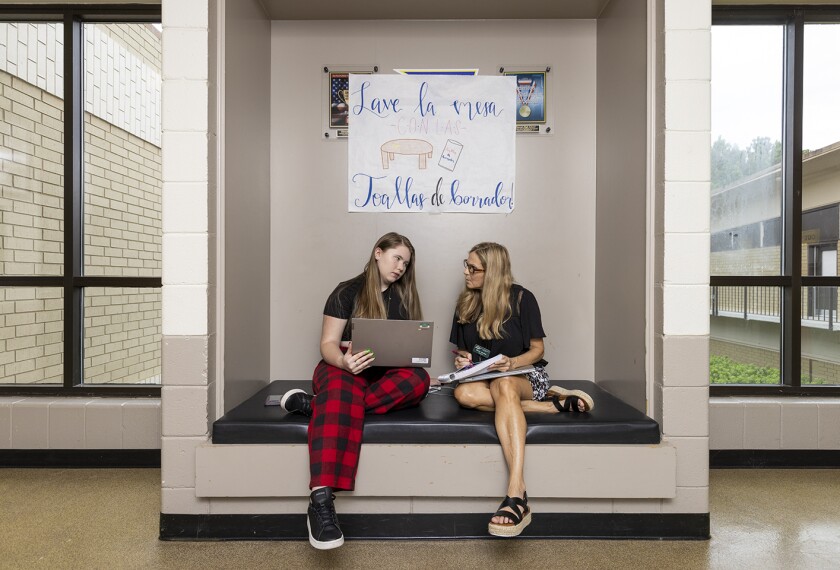
While Acceleration still uses an online platform for courses, teachers assess each student now on their academic needs as well as nonacademic barriers to graduating, such as family and work responsibilities, mental and physical health issues, and transportation or technology needs. Morris, for example, said she took one class at a time from 10 a.m. to noon before working weekday afternoons. Morris graduated from Lowcountry this February and has joined the U.S. Army.
Mentoring provides key support
Many programs have also upped their game by investing more heavily in individual mentoring and social-emotional supports for students, both through staff and community groups.
“Our kids typically do come to us having experienced some sort of trauma, but we are seeing more and more kids coming to us with trauma and mental health issues. It’s not unusual for us to see kids suffering with suicidal ideation,” said Sharp of Acceleration Academies. Acceleration now assigns each student a “life coach”—a licensed therapist or social worker—as well as a career coach for postsecondary guidance.
Mountain Education schools in Georgia used a different strategy, asking more than 1,000 teachers and staff members to write about their life experiences and the social-emotional lessons they had learned. Dubbed “Ridgerider Tales,” these essays became the backbone of a new social-emotional curriculum to teach students how to cope with anxiety, depression, problem solving, and other issues students reported as their biggest challenges during the pandemic.
“We recognized that it was going to be imperative to get the students back to a place where they felt safe and secure and felt supported at school,” Lovell said.

Teams of English teachers and counselors developed activities and lessons for each essay aligned to five social-emotional competencies: self-awareness, self-management, social awareness, relationship skills, and responsible decisionmaking.
“So now, when a student enrolls, we do an initial assessment with regard to their [social-emotional] competencies, and then the student and mentor sit down with some of these tales to process,” said Martha Kent, the director of student and staff wellness at Mountain Education. “When students are learning through the narrative in elementary school, they’re identifying with the characters in a story. Well, these stories are not fictional; these, our kids know, came from our staff. So it makes it easier for kids to identify with them.” Students who are struggling with specific problems, such as caring for a sick family member, also get connected with staff members who had faced similar problems in the past.
The schools provide free mental health services, and each student creates a self-care plan in addition to their academic-recovery plan. Mountain Education created its own wellness app to help students access resources and track their goals.
Spectrum, meanwhile, now trains all staff to be certified in trauma-informed instruction, and everyone from teachers to school secretaries to Mills herself has been enlisted to conduct home visits after district social workers became overwhelmed.
“There are so many students needing to be addressed throughout the county, we had to start to think outside the box,” Mills said. “It’s much more important that someone from our school team shows up at the house to say, ‘Where’s Johnny? Why hasn’t he been here?’ and get down to the root cause of what’s happening.”
Each student has weekly in-person meetings with their school mentors, as well as phone or email check-ins throughout the week. Students also attend weekly “lunch and learn” sessions with outside community groups and employers to answer questions about local careers and trades, ending with a session on applying for jobs and “interview speed dating” with local companies. So far, Mills said, all the students who have participated in the program have been offered at least one job after graduation.
“I think in the long run, we don’t just want kids that are academic graduates. We want our graduates to be thoughtful and caring. We want them to be balanced. We want them to have a strong sense of how to plan and manage their time,” McNulty said. “Because I think the essence of education is not to be successful in school but to be successful when you leave school.”


