Special Education

Diplomas and Disabilities

December 06, 2000 1 min read
  • Save to favorites
  • Print
Diplomas and Disabilities

Graduation Rates Vary
The following shows the number and proportion of disabled students age 17 or older who earned standard high school diplomas in 1997-98, as a percentage of all such students in that age bracket and disability category.
Disability Number Percentage
Specific learning disabilities 99,640 30.5
Speech or language impairments 4,099 35.0
Mental retardation 15,268 13.8
Emotional disturbance 13,861 22.3
Multiple disabilities 2,061 10.3
Hearing impairments 2,761 29.0
Orthopedic impairments 2,037 25.8
Other health impairments 5,052 29.6
Visual impairments 1,157 30.6
Autism 384 8.4
Deaf- blindness 132 39.2
Traumatic brain injury 671 27.7
All disabilities 147,123 25.5

Standard Diplomas Inching Up

There has been a gradual rise in recent years in the proportion of students with disabilities earning standard high school diplomas, as a percentage of all such students ages 17 to 21 who exit their states’ education systems.
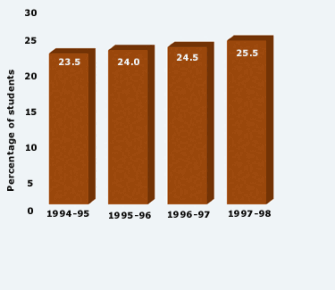
SOURCE: U.S. Department of Education, Office of Special Education Programs, Data Analysis System.


A version of this article appeared in the December 06, 2000 edition of Education Week as Diplomas and Disabilities

Events

This content is provided by our sponsor. It is not written by and does not necessarily reflect the views of Education Week's editorial staff.
Sponsor
Recruitment & Retention Webinar
New Hire, No Laptop, No Login: Preventing Day-One Disruption
What happens before day one matters. Discover how districts are improving the new hire experience.
Content provided by Frontline Education
Teaching Profession K-12 Essentials Forum Supporting the New K-12 Workforce: What Teachers Need to Stay at School
 Join this free virtual event to discover what teachers say they need to feel supported to stay in classrooms for the long haul.
College & Workforce Readiness K-12 Essentials Forum Career and Technical Education Takes Its Next Big Step
Join this free virtual event to hear creative approaches to modernize CTE programs and navigate the shift away from a near-exclusive focus on "college preparedness."

EdWeek Top School Jobs

Teacher Jobs
Search over ten thousand teaching jobs nationwide — elementary, middle, high school and more.
View Jobs
Principal Jobs
Find hundreds of jobs for principals, assistant principals, and other school leadership roles.
View Jobs
Administrator Jobs
Over a thousand district-level jobs: superintendents, directors, more.
View Jobs
Support Staff Jobs
Search thousands of jobs, from paraprofessionals to counselors and more.
View Jobs

Read Next

Special Education Spotlight Spotlight on ADHD, Inclusion, and IDEA: How Schools are Redefining Support for Students with Disabilities
New ADHD research and inclusive practices are reshaping how schools support students with disabilities and learning differences.
Special Education Spotlight Knock Down the Barriers to Inclusive Literacy Instruction
Literacy for all: inclusive classrooms, accessible tools, and strong supports help students with disabilities learn, belong, and thrive.
Special Education Inside a K-12 District’s Plan for a Charter School for Students With Autism
A specialized charter school will serve a fast-growing segment of a Texas school district's student body.
6 min read
Superintendent Roosevelt Nivens speaks after being announced as AASA National Superintendent of the Year in Nashville, Tenn. on Feb. 12, 2026.
Roosevelt Nivens, superintendent of the Lamar Consolidated Independent school district in Texas, speaks after being named superintendent of the year by AASA in Nashville, Tenn. on Feb. 12, 2026. The district Nivens leads will open a new charter school for students with autism in the 2026-27 school year.
Kaylee Domzalski/Education Week
Special Education Spotlight Spotlight on Moving From Awareness to Action for Neurodiverse And Autistic Students
See how schools can better support neurodiverse and autistic students, addressing barriers, elevating strengths, and building more inclusive classrooms for all.