Special Education

Diplomas and Disabilities

December 06, 2000 1 min read
  • Save to favorites
  • Print
Diplomas and Disabilities

Graduation Rates Vary
The following shows the number and proportion of disabled students age 17 or older who earned standard high school diplomas in 1997-98, as a percentage of all such students in that age bracket and disability category.
Disability Number Percentage
Specific learning disabilities 99,640 30.5
Speech or language impairments 4,099 35.0
Mental retardation 15,268 13.8
Emotional disturbance 13,861 22.3
Multiple disabilities 2,061 10.3
Hearing impairments 2,761 29.0
Orthopedic impairments 2,037 25.8
Other health impairments 5,052 29.6
Visual impairments 1,157 30.6
Autism 384 8.4
Deaf- blindness 132 39.2
Traumatic brain injury 671 27.7
All disabilities 147,123 25.5

Standard Diplomas Inching Up

There has been a gradual rise in recent years in the proportion of students with disabilities earning standard high school diplomas, as a percentage of all such students ages 17 to 21 who exit their states’ education systems.
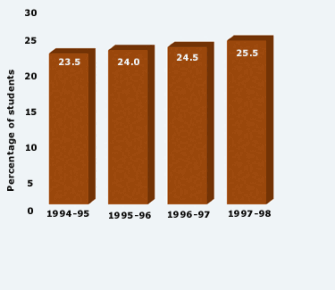
SOURCE: U.S. Department of Education, Office of Special Education Programs, Data Analysis System.

A version of this article appeared in the December 06, 2000 edition of Education Week as Diplomas and Disabilities

Events

This content is provided by our sponsor. It is not written by and does not necessarily reflect the views of Education Week's editorial staff.
Sponsor
Special Education Webinar
Bridging the Math Gap: What’s New in Dyscalculia Identification, Instruction & State Action
Discover the latest dyscalculia research insights, state-level policy trends, and classroom strategies to make math more accessible for all.
Content provided by TouchMath
This content is provided by our sponsor. It is not written by and does not necessarily reflect the views of Education Week's editorial staff.
Sponsor
School Climate & Safety Webinar
Belonging as a Leadership Strategy for Today’s Schools
Belongingisn’ta slogan—it’sa leadership strategy. Learn what research shows actually works to improve attendance, culture, and learning.
Content provided by Harmony Academy
This content is provided by our sponsor. It is not written by and does not necessarily reflect the views of Education Week's editorial staff.
Sponsor
School & District Management Webinar
Too Many Initiatives, Not Enough Alignment: A Change Management Playbook for Leaders
Learn how leadership teams can increase alignment and evaluate every program, practice, and purchase against a clear strategic plan.
Content provided by Otus

EdWeek Top School Jobs

Teacher Jobs
Search over ten thousand teaching jobs nationwide — elementary, middle, high school and more.
View Jobs
Principal Jobs
Find hundreds of jobs for principals, assistant principals, and other school leadership roles.
View Jobs
Administrator Jobs
Over a thousand district-level jobs: superintendents, directors, more.
View Jobs
Support Staff Jobs
Search thousands of jobs, from paraprofessionals to counselors and more.
View Jobs

Read Next

Special Education Teachers Are Using AI to Help Write IEPs. Advocates Have Concerns
Experts call for guardrails around the ethical, legal, and instructional concerns.
9 min read
Female student retrieving an IEP document from a giant laptop equipped with artificial intelligence.
iStock/Getty Images + Vanessa Solis/Education Week
Special Education Opinion ‘Educational Exile’: How Trump’s Layoffs Threaten Students With Disabilities
Here’s what’s at stake for millions of students if we lose federal enforcement of IDEA.
Susan Haas
4 min read
Wheelchair user obstacle metaphor. Conquering adversity. Hurdle on way concept. Overcoming obstacle on road. Vector illustration 3d isometric design. Barrier on way to success.
iStock/Getty Images + Vanessa Solis/Education Week
Special Education Does Extended Time on Tests Actually Help Students With ADHD?
Most students with ADHD receive extended time. Experts say better alternatives exist.
5 min read
close up pencil and alarm clock on answer sheets with yellow background, education concept
iStock/Getty
Special Education Trump Funding Cuts Hit Particularly Hard for Deaf and Blind Children
Programs supporting students with rare, complex disabilities have lost millions of federal dollars.
13 min read
Itinerant teacher April Wilson works with student Ryker Elam at Greenville Elementary on Sept. 29, 2025 in Greenville, Ill.
Ryker Elam works with itinerant teacher April Wilson at Greenville Elementary on Sept. 29, 2025, in Greenville, Ill. Wilson is a teacher of the visually impaired who works at schools across rural Illinois. A Braille training program Wilson enrolled in this fall was among dozens of special education-related programs for which the U.S. Department of Education has ended grant funding.
Michael B. Thomas for Education Week
