Special Education

Diplomas and Disabilities

December 06, 2000 1 min read
  • Save to favorites
  • Print
Diplomas and Disabilities

Graduation Rates Vary
The following shows the number and proportion of disabled students age 17 or older who earned standard high school diplomas in 1997-98, as a percentage of all such students in that age bracket and disability category.
Disability Number Percentage
Specific learning disabilities 99,640 30.5
Speech or language impairments 4,099 35.0
Mental retardation 15,268 13.8
Emotional disturbance 13,861 22.3
Multiple disabilities 2,061 10.3
Hearing impairments 2,761 29.0
Orthopedic impairments 2,037 25.8
Other health impairments 5,052 29.6
Visual impairments 1,157 30.6
Autism 384 8.4
Deaf- blindness 132 39.2
Traumatic brain injury 671 27.7
All disabilities 147,123 25.5

Standard Diplomas Inching Up

There has been a gradual rise in recent years in the proportion of students with disabilities earning standard high school diplomas, as a percentage of all such students ages 17 to 21 who exit their states’ education systems.
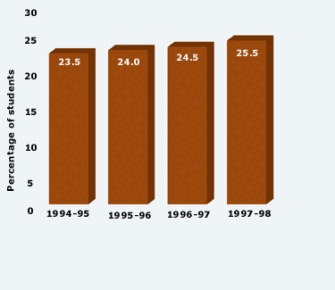
SOURCE: U.S. Department of Education, Office of Special Education Programs, Data Analysis System.

A version of this article appeared in the December 06, 2000 edition of Education Week as Diplomas and Disabilities

Events

This content is provided by our sponsor. It is not written by and does not necessarily reflect the views of Education Week's editorial staff.
Sponsor
College & Workforce Readiness Webinar
Smarter Tools, Stronger Outcomes: Empowering CTE Educators With Future-Ready Solutions
Open doors to meaningful, hands-on careers with research-backed insights, ideas, and examples of successful CTE programs.
Content provided by Pearson
This content is provided by our sponsor. It is not written by and does not necessarily reflect the views of Education Week's editorial staff.
Sponsor
Professional Development Webinar
Recalibrating PLCs for Student Growth in the New Year
Get advice from K-12 leaders on resetting your PLCs for spring by utilizing winter assessment data and aligning PLC work with MTSS cycles.
Content provided by Otus
School Climate & Safety Webinar Strategies for Improving School Climate and Safety
Discover strategies that K-12 districts have utilized inside and outside the classroom to establish a positive school climate.

EdWeek Top School Jobs

Teacher Jobs
Search over ten thousand teaching jobs nationwide — elementary, middle, high school and more.
View Jobs
Principal Jobs
Find hundreds of jobs for principals, assistant principals, and other school leadership roles.
View Jobs
Administrator Jobs
Over a thousand district-level jobs: superintendents, directors, more.
View Jobs
Support Staff Jobs
Search thousands of jobs, from paraprofessionals to counselors and more.
View Jobs

Read Next

Special Education Spotlight Spotlight on Unlocking Potential: Building Resilience and Support for Students with Dyslexia
This Spotlight examines dyslexia, the need for social-emotional support, the value of early screening, and the key role teachers and schools play.
Special Education What the Research Says Schools Have the Special Educators—But Keep Losing Them to General Ed.
A study across seven states finds educators for students with disabilities need more targeted support.
3 min read
Illustration of people using revolving doors.
DigitalVision Vectors
Special Education A Small Change in Special Ed. Rules Could Affect Equity, Accountability, Advocates Warn
The paperwork change could make it harder to track equity in special education, advocates said.
5 min read
A young  student of color struggles to carry a large heavy backpack conceptual
DigitalVision Vectors/Getty
Special Education Spotlight Spotlight on MTSS in Practice: From Life Skills to Learning Strategies
This Spotlight focuses on MTSS, providing a framework to support both students and educators across a range of needs and settings.
