Reading & Literacy

Can Lighter-Touch Tutoring Programs Benefit Kids Too?

By Sarah Schwartz — August 26, 2026 3 min read
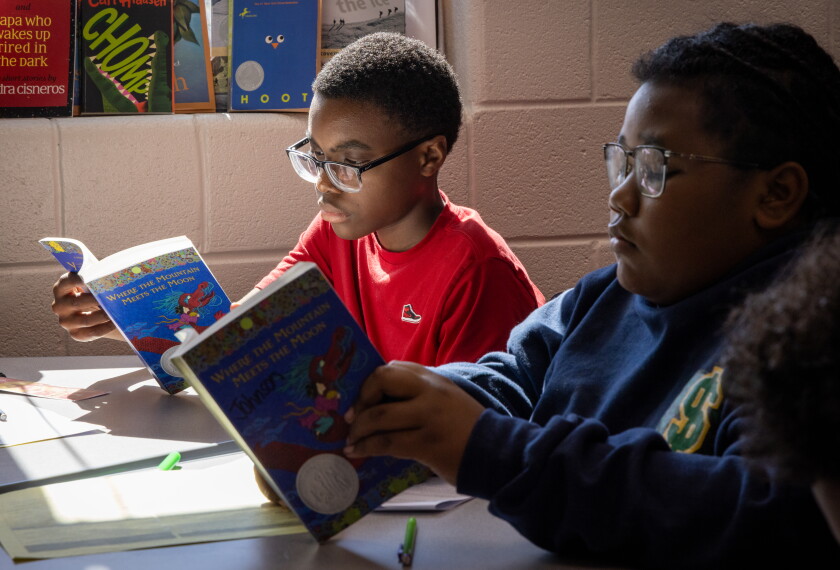
A tutor helps students at Benjamin O. Davis Middle School in Compton, Calif., Thursday, Feb. 6, 2025.
  • Save to favorites
  • Print

Intensive tutoring is supposed to be one of the most effective routes to raise student achievement. But it doesn’t always work out that way.

While meta-analyses of studies on high-dosage tutoring programs find big, positive impacts on learning, it’s often challenging for districts to implement these time- and labor-intensive initiatives in practice. Recent studies of post-pandemic tutoring programs have shown smaller-than-expected gains, or even no student improvement at all.

Could a lighter touch tutoring program be easier for schools to maintain, and still move the needle on student achievement? One new study suggests yes.

The paper comes from researchers at the National Student Support Accelerator, a program of the SCALE Initiative at Stanford University that studies high-impact tutoring. They tested a tutoring intervention called Chapter One, in which part-time tutors delivered 5-10 minute lessons throughout the school day, while students were still in their regular classrooms.

Researchers followed students as the district ran the program for four years, from kindergarten through 3rd grade.

The program didn’t require the district to hire additional staff or change their schedule to allow for blocks of tutoring throughout the day. It cost about $416 per student per year, less than half as much as other intensive tutoring models that were implemented elsewhere in the country at the same time.

Still, students made progress. Those who had been randomly assigned to the tutoring group scored higher than their peers on state standardized tests in 1st, 2nd, and 3rd grades. By the end of the four years, the tutoring group was also less likely to have an individualized education program or be retained.

“There is a lot of evidence saying that intensive tutoring works if implementation is good. But implementation is very difficult,” said Jilli Jung, a postdoctoral researcher at Stanford, and the lead author on the study.

This lower-lift model of tutoring could offer a practical way for districts to support students across multiple years, she said.

The test score gains in this study are smaller than those in other recent studies of high-dosage tutoring interventions—between 0.12 and 0.17 standard deviations, compared with 0.29 standard deviations in a 2024 meta-analysis, for example.

“It’s harder to expect large effects when the intervention is small, but a lot easier to implement,” said Jung. Still, the improvements in this study are meaningful, in part because they’re more feasible for most schools, she said.

How much tutoring time is enough?

The research literature that finds so-called high-dosage tutoring effective usually examines programs with a specific set of characteristics: Tutors meet one-on-one or in small groups with students for at least 30 minutes, three or more times a week.

This kind of tutoring is effective, but expensive and often hard to set up and maintain, as many districts found during the pandemic. Data from the National Center for Education Statistics has also found that it’s relatively rare. While most schools report offering at least some tutoring for low-performing students, only 37% said they offered high-dose tutoring, according to a 2022 survey.

The Chapter One program in the National Student Support Accelerator study worked differently.

Within kindergarten classrooms, students were randomly assigned to participate in either the tutoring group or receive business-as-usual instruction.

In the tutoring group, part-time tutors taught short lessons in decoding, splitting their time among students in the classroom. On average, students had 2.5 sessions each week for a total of 15 minutes weekly. Tutors devoted more time to students with the highest needs, but this time allocation shifted based on regular assessments of students’ skills.

Students also had 10 minutes of daily practice on an online platform, aligned to the skills they worked on with their tutors.

The program represents a somewhat unusual model, said Jung—less intensive than high-dosage tutoring, but more regular and structured than one-off sessions that research has shown don’t boost student outcomes long-term.

“We don’t know much about the perfect dosage for young kids,” Jung said.

The National Student Support Accelerator offers general guidance that lessons last for 30-60 minutes, but also recommends that younger students “may benefit from shorter but more frequent sessions.”

The study suggests that districts could benefit from some programs that chart a middle path, said Jung. “They don’t have to choose between no tutoring and very expensive, intensive tutoring.”

Events

This content is provided by our sponsor. It is not written by and does not necessarily reflect the views of Education Week's editorial staff.
Sponsor
Webinar
Hiring, Retention, and Fill Rates: A Data-Driven Sub Strategy
Explore what keeps substitutes coming back and hear how one district rebuilt its substitute hiring process and improved its fill rate.
Content provided by Frontline Education
Early Childhood K-12 Essentials Forum Early Childhood Education: Building Essential Skills for Success
Join this free virtual event to examine the biggest challenges in supporting young children, from preschool through elementary school. 
This content is provided by our sponsor. It is not written by and does not necessarily reflect the views of Education Week's editorial staff.
Sponsor
Student Absenteeism Webinar
Attendance Isn't an Attendance Problem
Boost attendance by strengthening relationships, belonging, and support with practical strategies from Doug Fisher & Nancy Frey.
Content provided by Corwin

EdWeek Top School Jobs

Teacher Jobs
Search over ten thousand teaching jobs nationwide — elementary, middle, high school and more.
View Jobs
Principal Jobs
Find hundreds of jobs for principals, assistant principals, and other school leadership roles.
View Jobs
Administrator Jobs
Over a thousand district-level jobs: superintendents, directors, more.
View Jobs
Support Staff Jobs
Search thousands of jobs, from paraprofessionals to counselors and more.
View Jobs

Read Next

Reading & Literacy First Reading. Then Math. Is the 'Science of Writing' Next?
Integrating reading and writing can lead to better student outcomes in both areas, studies show.
4 min read
Teacher Donnie Piercey goes over the results of a writing assignment called "Find the Bot" during his class at Stonewall Elementary in Lexington, Ky., Feb. 6, 2023.
Teacher Donnie Piercey reviews the products of a writing assignment during his class at Stonewall Elementary in Lexington, Ky., on Feb. 6, 2023.
Timothy D. Easley/AP Photo
Reading & Literacy A New Phonics Debate Shows How the 'Science of Reading' Movement Is Evolving
Growing momentum behind 'linguistic' phonics has raised questions about how best to use classroom time.
6 min read
Students at R. Brown McAllister Elementary School use exercises in phonemic awareness during literary instruction on March 19, 2025, in Concorn, N.C.
Students at R. Brown McAllister Elementary School practice exercises in phonemic awareness during literary instruction on March 19, 2025, in Concorn, N.C. Consensus exists that teaching students alphabetics, including phonics and phonemic awareness, is critical for reading—but which methods are the most efficient?
Cornell Watson for Education Week
Reading & Literacy What is 'Linguistic' Phonics and Why Are Some Schools Adopting It?
A new question is emerging in the "science of reading": Is one type of phonics instruction better than another?
8 min read
Julie Celestial, center, teaches her kindergarten class a literacy lesson at Mark Twain Elementary School in Long Beach, California on Tuesday, May 6, 2025 . A new bill could change how literacy is taught in elementary schools by providing transitional kindergarten through fifth-grade teachers with training and textbooks that stress what's known as science of reading, an approach to literacy that focuses heavily on phonics and foundational reading skills to combat California's literacy crisis. Though other states have shifted to this evidence-based reading, California's reading instruction has largely been left to the control of school districts, many of which have not made the switch. The school has begun their shift to a science of reading approach and are seen as an example for other California districts.
Julie Celestial, center, teaches her kindergarten class a literacy lesson at Mark Twain Elementary School in Long Beach, Calif. on Tuesday, May 6, 2025. Proponents of a "speech-to-print" phonics approach say it works more efficiently than other methods. But research evidence is inconclusive.
Allen J. Schaben/Los Angeles Times via TNS
Reading & Literacy Middle Schoolers' Reading Scores Are Still Stuck at Post-Pandemic Lows
New data shows that the lowest-performing students are falling the furthest behind.
4 min read
Sixth graders read a passage and give constructive feedback to their partners during Nancy Barajas' class at Fairview Elementary School on May 6, 2026, in Modesto, Calif.
Sixth graders read a passage and give constructive feedback to their partners during Nancy Barajas' class at Fairview Elementary School on May 6, 2026, in Modesto, Calif. New research shows the nation's 6th graders' reading scores have flatlined, and the lowest-performing students are losing ground.
Annie Barker/AP