Teenager Alexander Debo didn’t hike, learn archery, or sing songs around a campfire at summer camp. Instead, he analyzed a quarterly financial report, drew up a business plan, and studied such terms as owner’s equity, amortization, and depreciation.
He and about 140 other high school students or recent graduates took part last month in “Washington Business Week,” a youth business camp at Gonzaga University in Spokane, Wash.
Run by the Foundation for Private Enterprise Education, a nonprofit group based in Olympia, Wash., it is one of an increasing number of business-themed camps that teach teenagers entrepreneurship and financial literacy. Since Washington Business Week began in 1975, such camps have sprouted in almost 30 other states, according to Stephen A. Hyer, the foundation’s executive director.

The camps provide more of a genuine reality check than “The Apprentice,” says Mr. Hyer, referring to the NBC reality-TV show featuring the real-estate developer Donald J. Trump, in which contestants compete in improbable business challenges.
“The kids come out of our program with a better appreciation of business,” he said. “ ‘The Apprentice’ is not real life.”
With curricula often tied to state standards, business camps fill an academic niche not often explored in depth in schools, Mr. Hyer and other experts argue. Though 15 states require students to take economics to graduate from high school, and 17 states require high schools to offer economics courses, tight budgets and state accountability measures often crowd out economic and business education, advocates of such courses say.
“Everyone wants financial literacy,” said Alicia Haus, a Seattle-based financial education consultant and a speaker at the recent business camp in Washington state. “But with the way things are, the kids [often] have to get this information elsewhere.”
Subject Overshadowed
Nonprofit groups, universities, or companies run the camps, which typically last one or two weeks. Some, such as the Tampa, Fla.-based BizKidz and those run by the New York City-based National Foundation for Teaching Entrepreneurship, focus on underprivileged youths. Others, such as Washington Business Week and the for-profit YoungBiz Inc., based in Atlanta, are open to all students.
The business camps for disadvantaged teenagers are free to students. Other camps charge several hundred dollars to attend, although financial aid is available at some of them. Money from fees usually covers only a portion of the cost of operating business camps, so financial institutions, insurance and technology companies, and other corporations tend to underwrite them.
Washington Business Week’s fee of $295, for example, pays for only a third of the cost of teaching and housing one student, according to Mr. Hyer, who heads the camp as well as its parent foundation. Companies and foundations such as Redmond, Wash.-based Microsoft Inc., Seattle-based Pemco Financial Services, and the Weyerhaeuser Company Foundation in Federal Way, Wash., cover the remaining costs.
Yet even as the number of business camps is increasing, they’re finding it harder to recruit students, some supporters of economic education say.
Steve Marriotti, the president and founder of the National Foundation for Teaching Entrepreneurship, which has more than 15 business camps in the United States, China, Germany, and the United Kingdom, contends that the federal No Child Left Behind Act has lowered the profile of economic education in schools. Consequently, he said, it’s become tougher for some business camps to attract students.
“It’s made it harder for us to get shelf space,” he said. “The tragedy of NCLB is that it ignores different learning styles and love of entrepreneurship and business.”
Mr. Hyer said many schools in Washington state are dropping business courses because of increased accountability measures focusing on other subjects, especially mathematics and reading. Ms. Haus, the financial education consultant, said that teachers want her to speak about financial literacy in their classes, but can’t find time during the school day for her to do so.
Alan Weimer, the founder of BizKidz, in Tampa, and an entrepreneurship and management instructor at the University of Tampa, said the hands-on learning at business camp sticks with students in a way that classroom lectures often don’t.
“You learn what you do,” he said. “Not necessarily what you hear.”
Wooing ‘Investors’
At the camp at Gonzaga University, students in the June 19-25 session worked in teams of eight to 10, each overseen by an adult business professional. In one short but intense week, each team managed a simulated manufacturing company, created a new product or service, built a trade display, and studied business-management problems.
Challenges campers faced in the session, which repeats July 24-30 and Aug. 7-13, included marketing their make-believe products in foreign countries, choosing health-insurance plans for company employees, and hiring new production managers.
Mr. Debo, a 19-year-old who just graduated from Edmonds-Woodway High School in Edmonds, Wash., devised a high-tech, hand-held restaurant menu. Erin Keef, 18, who participated in Washington Business Week in 2003 and 2004, and was an intern for the most recent business camp, dreamed up the idea of a motorized scooter for 7- to 10-year-olds.
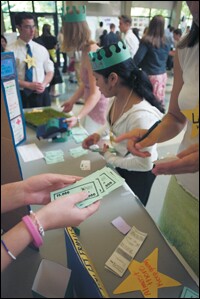
After campers brainstorm their concepts, they have to flesh out business plans, build trade show displays, and deliver oral presentations on their products to a panel of judges.
The students learn to work as members of teams, manage their time to meet project deadlines, and delegate tasks. They also use and refine their writing, reading, math, and abstract-thinking skills, says Washington state’s superintendent of public instruction, Terry Bergeson, who sits on the board of directors of the foundation that Mr. Hyer runs.
“They have to stand and deliver,” she said. “It’s real-world.”
Campers also consider ethical issues. At a time of high-profile business scandals, Joe Hyer, a volunteer company adviser at the camp, says he gets students to think about what it means to be a socially responsible, ethical company.
“We talk about the empowering things that businesses do to improve the world, instead of dwelling on the negative,” said Mr. Hyer, the owner of the Alpine Experience, an Olympia-based outdoor-gear store, and Stephen Hyer’s son.
New Way of Thinking
The 40 judges—executives from small businesses and big companies—act as possible investors, and grade the projects by the amount of money they “invest.” Collectively, the judges can disburse up to $35 million in play money.
Gail Dobberthien, a finance director at the Boeing Co.’s Everett, Wash., office, was impressed as a judge with the concept for the high-tech restaurant menu. She “invested” $150,000 in the project, which the students estimated would cost $2.7 million to develop.
“I would gauge their ability to answer questions,” she said. “I ask them, ‘When do you expect a positive rate of return?,’ ‘What is your internal rate of return?,’ ‘What is [the] service and maintenance strategy for the product?’ ”
It was a whole new way of thinking for students such as Ms. Keef, who just graduated from Walla Walla High School in the Washington community of that name. “I didn’t know what to expect,” she said. “It’s really hard to come out of your comfort zone.”
But she enjoyed the experience so much that she took part in the foundation’s advanced business camp last summer. There, she learned the intricacies of asking for a business loan and managing a simulated pizza restaurant near a college campus, grappling with everything from the cost of cheese to the need for issuing warnings to allergy sufferers.
“There are so many things that interlock,” said Ms. Keef, who plans to focus on math, economics, and chemistry in college. “It was a really good way to put yourself in the real world.”


