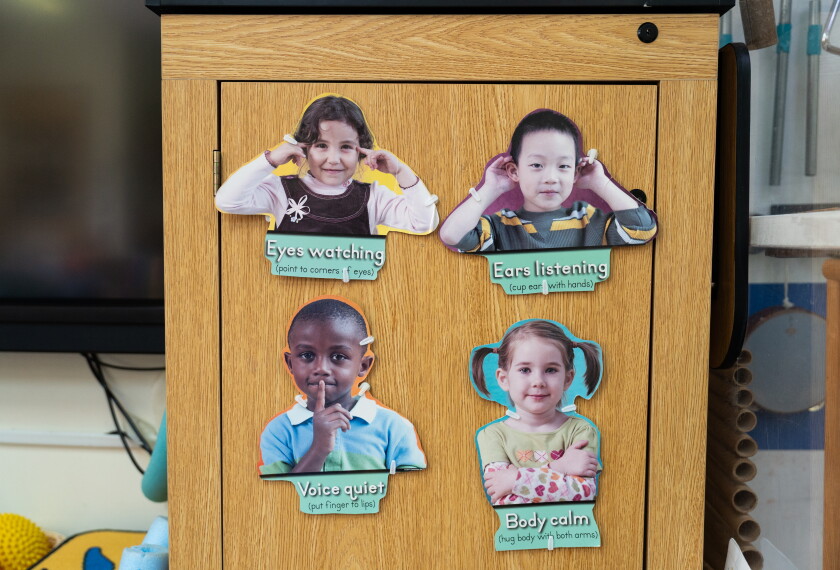
Supporters of California’s Proposition 82—the Preschool for All initiative—are turning to high-profile political and community leaders to help counter a backlash to the measure, which goes to the voters on June 6.
Proposition 82, sponsored by the actor and director Rob Reiner, would make all California 4-year-olds eligible for free preschool through an additional 1.7 percent income tax on individuals earning at least $400,000 a year and couples earning $800,000 or more a year.
Recent polls have shown the initiative continues to enjoy support among likely voters, though the gap between likely “yes” and “no” voters has closed dramatically in recent months as controversy involving Mr. Reiner and questions about the measure’s costs have stalled its momentum.
Backers hope to recapture that energy with support from well-known public figures.
Los Angeles Mayor Antonio R. Villaraigosa and Steve Krull, the president of the California Police Chiefs Association, are among those who have been introduced in a week-by-week countdown to the vote by Preschool California, an advocacy organization that is pushing Proposition 82.
“I support Prop. 82 because it offers a real boost not only to young children, but to our public elementary and high schools,” Mayor Villaraigosa wrote in his endorsement on the group’s Web site. “A quality preschool experience gives children an opportunity to develop important educational and social skills when they are eager and ready to learn.”
Sponsor’s Role
It was not a big surprise when Mr. Reiner kicked off the Proposition 82 campaign. He is a strong advocate of early-childhood education and was the force behind a successful 1998 ballot initiative for a 50-cents-per-pack tobacco tax. That measure created the California Children and Families Commission as well as 58 county-level commissions to oversee the revenue and spend it on programs serving children from birth to age 5.
But this winter Mr. Reiner, a prominent Democrat, drew fire from Republican legislators and advocates of low taxes, who asked whether a pro-preschool advertising campaign launched by the state commission, which Mr. Reiner then chaired, was just a subtle attempt to sway voter opinion in favor of Proposition 82.
Mr. Reiner has maintained that he was not involved in developing the ads, and that he hasn’t done anything wrong. Nevertheless, he resigned from the commission in late March, and a state agency is preparing to audit the commission.
The controversy appears to have swayed voters toward a less favorable stance on the proposal. An April poll by the San Francisco-based Field Research Corp. showed that while 52 percent of likely voters said they would vote for the measure, the initiative’s lead had slipped from a 21-percentage-point margin in February to a 13-point advantage.
A more recent poll, conducted by the Los Angeles Times, shows support for Proposition 82 at 49 percent among likely voters who said they had heard about the measure.
And while education, business, and community organizations continue to endorse the measure, some California newspapers have begun advising voters to turn it down.
The Sacramento Bee, for example, said in a May 7 editorial, “Californians need to see what works and what doesn’t before scaling up free voluntary preschool for 4-year-olds statewide.”
The measure has also sparked a debate among some California scholars.
David Kirp, a professor of public advocacy at the University of California, Berkeley, has said that Preschool for All would guarantee “a first-rate, half-day class for every 4-year-old.”
And Deborah Stipek, the dean of the school of education at Stanford University, has said that the initiative is a prime opportunity for expanding preschool access.
But Bruce Fuller, a leading early-childhood researcher at UC-Berkeley and a co-director of Policy Analysis for California Education, a think tank, issued a report in April saying that Preschool for All, if passed, would benefit many upper-income families that can already afford to pay for preschool.
Mr. Fuller also argues that Proposition 82 is unlikely to have the same kind of long-term academic and social benefits as some model preschool programs already serving disadvantaged children.
Supporters of the measure have repeatedly called attention to a 2005 report by the RAND Corp., a Santa Monica, Calif.-based think tank, that predicted that for every $1 spent on a high-quality preschool program, society would reap $2 to $4.
In an April 26 commentary in the Los Angeles Times, however, the researchers—Lynn A. Karoly and James Bigelow—made the point that they didn’t study Proposition 82 specifically, and stressed that “RAND does not take positions on ballot initiatives.”
Opponents contributing to the “No on 82” campaign include anti-tax organizations, faith-based groups, and small-business associations, as well as private preschool operators who worry about the measure’s specific staffing and curriculum requirements. For example, under the measure preschool teachers eventually would have to have a bachelor’s degree, and preschool curricula would have to be aligned with state standards.
Taking Sides
The initiative, which would generate about $2.4 billion a year, was dealt another blow in April when Gov. Arnold Schwarzenegger, a Republican who is up for re-election in November, finally took a stand on the proposal. He expressed his opposition, largely because Proposition 82 would require a tax increase.
He did not take a side earlier in the campaign, leading some to believe he would remain neutral. But last month he said through a spokesman that he was opposed.
Susanna Cooper, a spokeswoman for the advocacy group Preschool California, said the governor’s opposition doesn’t necessarily mean Proposition 82 is headed for defeat. His influence on the outcome could depend more on how actively he opposes the measure, she said.
Ms. Cooper speculated that he might not personally be opposed to expanding preschool but is unable to back down from his position against new taxes.
The governor’s opinion, however, has increased the partisan tone of the campaign, pitting Mr. Schwarzenegger on one side against the two leading Democratic candidates for governor—state Treasurer Phil Angelides and state Controller Steven P. Westly—on the other. Democrats will choose their gubernatorial nominee in the June 6 balloting.
Still, Ms. Cooper noted that proponents of the plan include Republicans, such as Mr. Schwarzenegger’s former education secretary, Richard J. Riordan.
In recent weeks, Mr. Reiner has stepped back a bit from the campaign limelight, likely because he wants to keep the flap over the preschool advertising campaign from being a distraction.
But other backers have filled in.
On May 10, California Superintendent of Public Instruction Jack O’Connell joined with teachers’ union representatives and the head of the state kindergarten association to release a report saying that 3rd grade reading scores would improve if more children attended preschool where they could learn early literacy skills.
“People have long called it the Reiner initiative,” Ms. Cooper said. “But there are a whole lot of people who are behind this who are not Rob.”