
Reading & Literacy What the Research Says

3 Big Mistakes to Avoid When Helping Readers Grapple With Challenging Texts

By Sarah D. Sparks — October 17, 2022 3 min read
Illustration of students reading with pie chart.
  • Save to favorites
  • Print

Students progress faster when they are challenged to read difficult texts—but doing so may be a daunting task for teachers working with students who are struggling to read.

In a recent online discussion with the nonprofit Read Washington, Tim Shanahan, the founding director of the University of Illinois at Chicago’s Center for Literacy, and a distinguished professor emeritus, highlighted tactics to avoid and offered better alternatives for teachers to support students as they tackle difficult texts.

1. Don’t focus on meeting a students ‘at their level’

Beginning readers in the earliest grades benefit from repetition and easy to sound-out words—think of Dr. Seuss’s Green Eggs and Ham or Eric Carle’s, Brown Bear, Brown Bear, What Do You See?—but research suggests students who have mastered basic decoding make faster progress if they grapple with more complex texts.

Research suggests students learn more with more difficult texts, as long as they have instructional support. For example, one 2017 study found 3rd graders who started as weak readers outscored even proficient readers when they used texts written two to four grade levels above their initial reading level as part of paired-reading exercises.

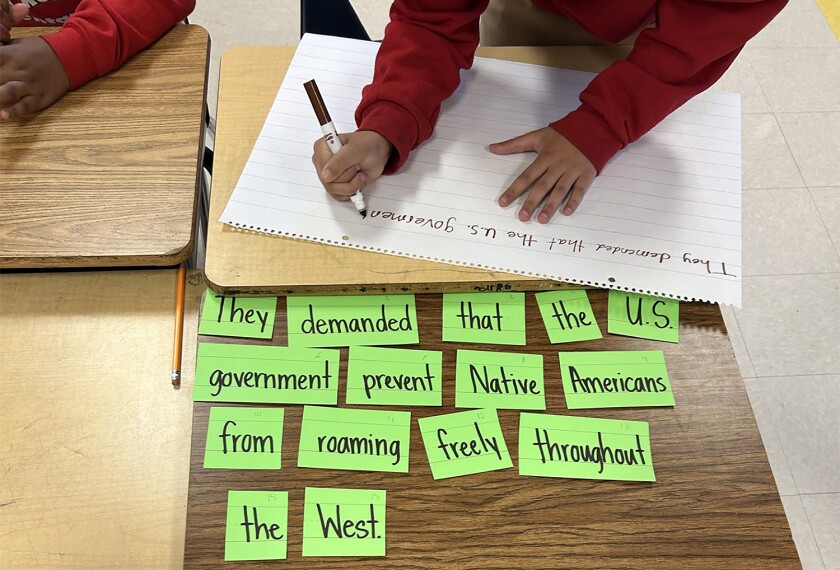
More-difficult texts may have more academic vocabulary and syntax, or require more understanding of literary devices and practices in different genres. Shanahan noted that it is more helpful in the long run—even for struggling readers—to learn tools to break down difficult texts rather than using more simplified reading passages. These might include asking students to paraphrase each sentence in a difficult text to check meaning; or to rewrite a passage that includes sentences with multiple clauses, phrases, or parentheticals.

2. ‘Don’t get ahead of the author’

The better a student understands the subject of a text, the easier it is to read it—even when the text itself is difficult. In fact, studies suggest a poor reader who is well-versed in a particular subject often can make up for low comprehension simply by relying on their own background knowledge.

Supporting information can exacerbate students’ tendency to use their background knowledge to replace their comprehension, especially if it ends up repeating the text instead of simply providing context. For example, Shanahan recalled working with a high school teacher in Illinois who was preparing her class to read works by William Shakespeare. Shanahan agreed that students may need context about cultural differences in the plays written 400 years ago, but “she said, ‘We’re reading, ‘Romeo and Juliet.’ So to prepare them, I explained to them that there are these two families, and the two families are feuding, and the boy and the girl fall in love’ ... And I said, ‘Wait a minute. That’s not the prior knowledge. That’s the story that they’re about to read,’” Shanahan said.

Explaining words or concepts that can be gleaned through the text itself provides less opportunity for students to practice “reading to learn,” he said.

Instead, he suggested brainstorming with a class about what they know about a subject before reading the text, or asking students to write down how what they are reading relates to what they previously knew about the subject. Doing this with a partner can also help build students’ comprehension, according to a study of 9th graders.

3. Don’t overload on vocabulary

Low academic vocabulary is one of the most common problems for struggling readers, but Shanahan cautioned that teachers should be careful in choosing which words to define for students.

“We want to build a lexicon or a dictionary in everybody’s head, and we want that list to get longer and deeper and richer as they go through school,” he said. “but we also teach vocabulary to enable their understanding of the text we’re about to read, and those are two really different goals.”

Rather than preteaching extensive vocabulary lists for each text, Shanahan said it is more important for students to learn how to recognize when they don’t know the meaning of a word and it is interfering with their ability to comprehend a text. Students should also learn how to figure out word meanings on their own, either through clues and close reading of the text itself or through outside tools, such as dictionaries.

For example, he suggested teachers use more passive vocabulary scaffolding, such as a glossary or a vocabulary wall, and give exercises in which readers explain clues in a text that shows the meaning of a particular word.
Events

This content is provided by our sponsor. It is not written by and does not necessarily reflect the views of Education Week's editorial staff.
Sponsor
Special Education Webinar
Bridging the Math Gap: What’s New in Dyscalculia Identification, Instruction & State Action
Discover the latest dyscalculia research insights, state-level policy trends, and classroom strategies to make math more accessible for all.
Content provided by TouchMath
This content is provided by our sponsor. It is not written by and does not necessarily reflect the views of Education Week's editorial staff.
Sponsor
School Climate & Safety Webinar
Belonging as a Leadership Strategy for Today’s Schools
Belonging isn’t a slogan—it’s a leadership strategy. Learn what research shows actually works to improve attendance, culture, and learning.
Content provided by Harmony Academy
This content is provided by our sponsor. It is not written by and does not necessarily reflect the views of Education Week's editorial staff.
Sponsor
School & District Management Webinar
Too Many Initiatives, Not Enough Alignment: A Change Management Playbook for Leaders
Learn how leadership teams can increase alignment and evaluate every program, practice, and purchase against a clear strategic plan.
Content provided by Otus

EdWeek Top School Jobs

Teacher Jobs
Search over ten thousand teaching jobs nationwide — elementary, middle, high school and more.
View Jobs
Principal Jobs
Find hundreds of jobs for principals, assistant principals, and other school leadership roles.
View Jobs
Administrator Jobs
Over a thousand district-level jobs: superintendents, directors, more.
View Jobs
Support Staff Jobs
Search thousands of jobs, from paraprofessionals to counselors and more.
View Jobs

Read Next

Reading & Literacy Few Books Are Tailored for Older Struggling Readers: 'It's an Absolute Wasteland'
Teachers and researchers identify three barriers to finding reading materials that meet these students' needs—and how to overcome them.
6 min read
Students attend Bow Memorial School in Bow, N.H. on Oct. 29, 2025. Bow Memorial School is a middle school that has developed a systematic approach to addressing foundational reading gaps in middle school students.
Bow Memorial School in Bow, N.H., pictured here on Oct. 29, 2025, has developed a systematic approach to addressing foundational reading gaps in middle school students. Teachers who work with older readers say they often have a hard time finding texts that support these students' needs at grade level without feeling babyish or patronizing.
Sophie Park for Education Week
Reading & Literacy Congress Wants to Know What Makes the 'Science of Reading' Work
Experts noted states' careful implementation—and the key role of federal investment in reading research.
6 min read
Students look at books during a book fair at Schaumburg Elementary, part of the ReNEW charter network, in New Orleans, Wednesday, April 19, 2023. Mississippi, Alabama and Louisiana have seen a promising turnaround in their student reading scores after passing a series of similar literacy reforms.
Gerald Herbert/AP
Reading & Literacy Is the Bible Part of the U.S. Literary Canon? Texas Reading List Sparks Debate
Texas may soon be the first state in the country to mandate that every student read the same texts.
6 min read
Books line shelves in a high school library Monday, October 1, 2018, in Brownsville, Texas. The Brownsville Independent School District announced having been awarded a multi-million-dollar grant to revitalize libraries to encourage reading by school-aged children to improve literacy skills. It was stated in the meeting that money could also be used to replace aging furniture in some of the district's libraries.
Texas is poised to be the first state to require that every student read the same texts—including, controversially, selections from the Bible and several Christian parables. Books line shelves in a high school library on Oct. 1, 2018, in Brownsville, Texas.
Jason Hoekema/The Brownsville Herald via AP
Reading & Literacy How English Class Improves Students' Social-Emotional Skills
When students dissect the motivations of a character in a book, they're learning key competencies.
8 min read
Partnership, cooperation, teamwork concept. Diverse people hold in hands, put pieces of emotions puzzle together in front of a bookshelf of books. Diverse team is coworking, works and efforts together.
Vanessa Solis/Education Week + iStock
