
Federal

Trump’s Youngest Son Joins Back-to-School Crowd

By Alyson Klein — September 05, 2017 4 min read
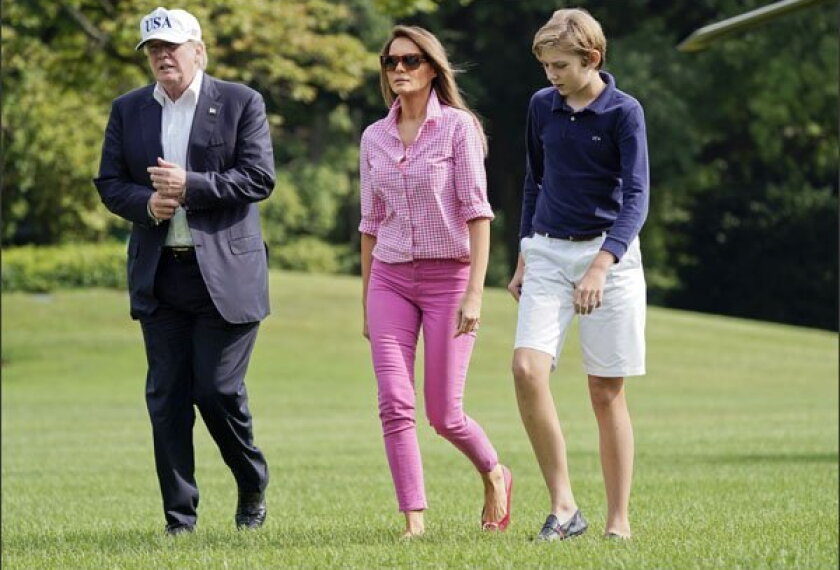
President Donald Trump, first lady Melania Trump, and their son Barron Trump, 11, walk across the South Lawn of the White House in Washington, on Aug. 27, following their return from the Presidential retreat at Camp David, Md.
  • Save to favorites
  • Print

As millions of students start the 2017-18 school year, their ranks will include Barron Trump, the president’s youngest son, who heads off to a private school in the Washington suburbs.

Barron, 11, remained in New York City even after his father became president to finish out the school year at the Columbia Grammar and Preparatory School in Manhattan. But this fall, he’ll start classes at St. Andrew’s Episcopal School in Potomac, Md. In fact, Sept. 5 was the scheduled first full day of the school year, according to St. Andrew’s website.

Historically, schools that have taken on the task of educating presidential children have had to consider things like student privacy and security. So how well will Barron—and the school—adjust to the new arrangement?

Richard Jung, the executive director of the Association of Independent Schools of Greater Washington, expects the school will do everything to ensure that Barron’s experience is as normal as possible.

That seems to be what happened when the Clinton and Obama families sent their daughters to Sidwell Friends School, a Quaker school with campuses in the District of Columbia and suburban Maryland. (The Obamas are sticking around the nation’s capital so that Sasha Obama, their younger daughter, can finish her education there.)

There may have been an “extra charge” in the air at Sidwell when Chelsea Clinton and the Obama children enrolled, Jung said. But ultimately, “the kids did very well,” he said.

Personalized Experience

A spokesman for St. Andrews’ declined to comment. Sidwell Friends also declined to comment.

St. Andrew’s likely will be looking for a way to personalize Barron’s experience—because that’s what the school does for all its students, Jung said.

St. Andrew’s website highlights its connection with Research Schools International, which is led by faculty at the Harvard Graduate School of Education.

The school also partners with the brain-research team at Johns Hopkins University. St. Andrew’s is known for its Center for Transformative Teaching and Learning, which helps tailor instruction to students’ individual learning needs, whether they are high achievers or in need of more academic support. St. Andrew’s graduates often go on to Ivy League colleges, according to its website.

“St. Andrew’s is set up to make adjustments for individual kids. It wouldn’t be unique to Barron” and his status as the son of a president, Jung said. “It’s a hallmark of the school.”

St. Andrew’s is particularly interested in training its teachers on brain science and how it can be applied in the classroom, he said. “They really walk the walk on this.”

And he thinks the school is just far enough removed from Washington to allow Barron to get a break from the pressures of being the first kid. “I’m very, very happy for the boy,” he said.

St. Andrew’s has about 580 students, according to its website, making it a medium- to large-sized private school for the Washington area. The student-teacher ratio is 6-to-1, a lot lower than the national average of 16.1-to-1 in 2013, according to the National Center for Education Statistics. And tuition at St. Andrew’s runs from $23,490 for prekindergarten to $40,650 for high school.

Historical Perspective

So far, the Trump family seems to have put a premium on Barron’s privacy, which is not so different from how the two most recent presidents with minor children—Bill Clinton and Barack Obama—handled the challenge of raising a child in the White House.

“Presidential parents such as the Clintons and Obamas have worked to ensure that their children are given secure, private space within the [White House] as well as opportunities to interact openly but privately with peers inside and outside the building and (where possible) in school,” said Edward G. Lengel, the chief historian for the White House Historical Association, a nonprofit.

In recent years, presidential children have attended area private schools. But that wasn’t always the case, Lengel said. Quentin Roosevelt, Charlie Taft, and Amy Carter all attended District of Columbia public schools. And President John F. Kennedy’s family turned the White House solarium into a classroom. Their own children attended school there alongside the children of other government officials.

The Kennedys “were the only first family to use this as an actual schoolroom adhering to the regulations and academic requirements of D.C. public schools,” Lengel said.

The need for privacy was part of the reason the Kennedys choose to home-school their children in the White House, Lengel said. But that, too, wasn’t necessary until relatively recently.

“Until the 20th century, presidential children lived very much in the public eye and without much attention to security,” Lengel said. “By the mid-20th century and beyond, however, security for presidential families became a round-the-clock affair, and as media scrutiny increased, privacy became nearly impossible outside the actual confines of the White House.”

St. Andrew’s won’t be working alone in protecting Barron’s privacy and security, said Lengel’s colleague, Evan Phifer, a research historian.

“Balancing privacy, education, and security is an effort that incorporates cooperation between schools, first families, and Secret Service,” he said.

Related Tags:

A version of this article appeared in the September 06, 2017 edition of Education Week as President’s Youngest Son Joins Back-to-School Crowd

Events

This content is provided by our sponsor. It is not written by and does not necessarily reflect the views of Education Week's editorial staff.
Sponsor
Recruitment & Retention Webinar
Hiring, Retention, and Fill Rates: A Data-Driven Sub Strategy
Explore what keeps substitutes coming back and hear how one district rebuilt its substitute hiring process and improved its fill rate.
Content provided by Frontline Education
Early Childhood K-12 Essentials Forum Early Childhood Education: Building Essential Skills for Success
Join this free virtual event to examine the biggest challenges in supporting young children, from preschool through elementary school. 
This content is provided by our sponsor. It is not written by and does not necessarily reflect the views of Education Week's editorial staff.
Sponsor
Student Absenteeism Webinar
Attendance Isn't an Attendance Problem
Boost attendance by strengthening relationships, belonging, and support with practical strategies from Doug Fisher & Nancy Frey.
Content provided by Corwin

EdWeek Top School Jobs

Teacher Jobs
Search over ten thousand teaching jobs nationwide — elementary, middle, high school and more.
View Jobs
Principal Jobs
Find hundreds of jobs for principals, assistant principals, and other school leadership roles.
View Jobs
Administrator Jobs
Over a thousand district-level jobs: superintendents, directors, more.
View Jobs
Support Staff Jobs
Search thousands of jobs, from paraprofessionals to counselors and more.
View Jobs

Read Next

Federal Ed. Dept. Would Have More Power to Cut Off Grants Under New Rules
The agency last year ended in-progress grants worth more than $2 billion, with courts often objecting.
5 min read
Jeanette Vyhanek, a counselor at Wellstone Elementary, teaches a class of kindergarten students at the St. Paul school on Oct. 31, 2025 in Minnesota.
Jeanette Vyhanek, a counselor at Wellstone Elementary in St. Paul, Minn., teaches a class of kindergarten students on Oct. 31, 2025. Federal grants to expand the ranks of school counselors and other school mental health services were among hundreds terminated by the Trump administration in 2025. New rules from the U.S. Department of Education would give the federal agency greater latitude to end in-progress grants.
Alex Kormann/The Minnesota Star Tribune via TNS
Federal Q&A Education Data Collection Has Cratered Under Trump. Can It Be Rebuilt?
Ed. Dept.'s data-gathering agency is too unstable to adapt to changing needs, a new report claims.
6 min read
A student raises her hand to ask a question in her third grade classroom at Highland Elementary School in Columbus, Kan., on Oct. 17, 2022. The arm of the government that oversees education data which tracks educational outcomes for students, faces major challenges ahead due to financial cuts.
A student raises her hand to ask a question in her 3rd grade classroom at Highland Elementary School in Columbus, Kan., on Oct. 17, 2022. Federal education data-gathering, like the Condition of Education report, includes baseline information on students and schools. But cuts to the Education Department's statistics wings and mounting criticism of how it operates raise questions about how it can best fulfill its mission.
Charlie Riedel/AP
Federal Education Department Tells Schools Race Can’t Factor Into Student Discipline
A letter to educators follows up on last month's rescission of longstanding discrimination rules.
5 min read
Assistant Secretary for Civil Rights for the Department of Education nominee Kimberly Richey testifies before the Health, Education, Labor and Pensions committee about her nomination in Washington, D.C., on June 5, 2025.
Assistant Secretary for Civil Rights Kimberley Richey testifies before the Senate's Health, Education, Labor and Pensions committee at her nomination hearing in Washington on June 5, 2025. A new letter to educators from Richey instructs schools not to consider race at all in school discipline policies, following the Trump administration's rescission of longtime anti-discrimination rules.
Jason Andrew for Education Week
Federal Q&A What Head Start's English-Only Rule Could Mean for English Learners
Research shows it's not necessary to lose a home language to learn English.
3 min read
Long Beach, CA - March 20 : Teacher Monica Alvarado, left, leads activities with staff in the infant class at Educare Los Angeles at Long Beach , a very high-quality child care center in Long Beach on Wednesday, March 20, 2024 in Long Beach, CA.
Teacher Monica Alvarado, left, leads activities with staff in the infant class at Educare Los Angeles at Long Beach, a very high-quality child care center in Long Beach on Wednesday, March 20, 2024 in Long Beach, Calif. Head Start programs for early childhood education will no longer promote bilingualism under a proposed rule change.
Brian van der Brug / Los Angeles Times via TNS
