Federal Q&A

‘Tell American Students to Be Grateful': What Ukrainian Refugees Told AFT’s President

By Madeline Will — April 05, 2022 4 min read
American Federation of Teachers President Randi Weingarten passes out books to Ukrainian refugees at a makeshift school in a hostel in Warsaw, Poland, on April 4, 2022.
  • Save to favorites
  • Print

American Federation of Teachers President Randi Weingarten traveled to Poland this week to speak with children and educators displaced by Russia’s invasion of Ukraine—an experience, she said, that gave her a sense of what U.S. teachers can expect if they soon have a Ukrainian refugee in their classroom.

The United States is preparing to welcome up to 100,000 Ukrainian refugees and others fleeing the war. Education Week spoke to Weingarten, who heads the second-largest teachers’ union in the United States, about her visit as she was driven back to Warsaw from the Polish-Ukrainian border.

This interview has been edited for length and clarity.

What have you been doing and seeing in Poland these past few days?

We’ve spent the last 48 hours at the border in [the towns of] Medyka and Przemyśl. What has happened over the past four or five weeks is there was a huge number of people, beyond anything than anyone ever expected—two million refugees—that came over the border of Poland. ... We met with two schoolteachers who worked with others so that the schools became hostels for weeks for people who had nowhere to go.

[In Warsaw], we went to three schools—a high school, an elementary/middle school, and a community center that had an after-school program. We met with teachers, we talked with parents, we talked to kids. The Ukrainian teachers really want to go back home. And many of the kids really want to be back home.

The [Ukrainian] kids spoke very good English. And one young man got up and said, “Please tell American students to be grateful for what they have. One day I had this, and the next day I didn’t.” And one of the other students who was leading me around said, “Did you see what happened in Ukraine? Did you see what they did to us?”

Kids want to be in school, and the Polish educators are doing the best that they can to try and create a safe, welcoming environment for the Ukrainian kids. I have deep gratitude for all these regular folks—volunteers, educators—who are really trying to create a climate for the welcoming of children and families and who are opening their borders.

What else did teachers and students say to you?

I talked to Ukrainian teachers who really want us to bear witness to [Russian President Vladimir] Putin’s barbarian behavior and the atrocities right now. The kids want their lives back and very much want to understand why Putin did what he did.

But what was equally meaningful to me was a conversation with the Polish educators who are doing everything they can to help Ukrainians and, at the same time, understand the need for Ukraine to win this fight. The humanitarian effort is absolutely essential, but so is the effort to support their work to keep their country and to keep their democracy.

So, what I heard from teachers, from young kids: great gratitude for what Poland is doing, great fear of Putin, great admiration for the fighters in Ukraine and for [Ukrainian President Volodymyr] Zelensky, and a real yearning to be home.

The United States is expecting 100,000 Ukrainian refugees. What do you think U.S. teachers should be prepared to see if those children arrive in their classes? How can they support them?

First off, many [Ukrainian] students who were in this Polish, Warsaw classroom that I was in wanted to go to America. I was asking, “How many of you want to go to America?,” and almost every hand went up. What I think people have to prepare for is that these students and families are coming from a war.

American Federation of Teachers President Randi Weingarten points to student artwork in support of Ukraine at an elementary/middle school in Warsaw, Poland, on April 4, 2022.

We’ve already been though a lot of trauma and uncertainty because of COVID and all the mental health [challenges] and school disruption issues. But there’s a very different kind of trauma that comes with people ... who are escaping war.

How do you think U.S. teachers, especially social studies teachers, should discuss what’s happening in Ukraine with their students? How would you teach about this if you were still in the classroom?

Well, No. 1, there’s no two sides of being a war criminal here. On a factual basis, you have clear atrocities and an unprovoked war by a so-called superpower to try and dominate and take sovereignty away from a country whose only flaw is that they want to be a democracy.

The way I would be teaching about this is to talk about the why, to talk about why is Russia doing this, and to analyze some of Putin’s speech, analyze [President Joe] Biden’s speech in Poland two weeks ago, analyze Zelensky’s speeches, and to talk about this humanitarian crisis. Center it in some of the long history of struggles in Europe over East and West values. I would not pretend that Russian propaganda should be given equal weight to what our eyes tend to see.

See also

A woman and a girl walk to a shelter during Russian shelling outside Mariupol, Ukraine, Thursday, Feb. 24, 2022. Russia has launched a barrage of air and missile strikes on Ukraine early Thursday and Ukrainian officials said that Russian troops have rolled into the country from the north, east and south.
A woman and a girl walk to a shelter during Russian shelling outside Mariupol, Ukraine, on Feb. 24. Russia has launched a barrage of air and missile strikes on Ukraine and Ukrainian officials said that Russian troops have rolled into the country from the north, east and south.
Sergei Grits/AP

Why was it important to you to see what’s happening with Ukrainian refugees firsthand?

The reason we came was because of our long commitment to children, families, and [their] well-being, both in the United States and abroad, and our long commitment to democracy and the fight against autocracy. That fight in modern times is going to be won or lost right now. Our members who raised over $125,000 in support of Ukrainian refugees—and we’ve given out some of that money already—wanted us to bear witness to what was going on and report to them what else we should be doing. That’s why I’m here.

Events

This content is provided by our sponsor. It is not written by and does not necessarily reflect the views of Education Week's editorial staff.
Sponsor
Artificial Intelligence Webinar
Managing AI in Schools: Practical Strategies for Districts
How should districts govern AI in schools? Learn practical strategies for policies, safety, transparency, and responsible adoption.
Content provided by Lightspeed Systems
This content is provided by our sponsor. It is not written by and does not necessarily reflect the views of Education Week's editorial staff.
Sponsor
Reading & Literacy Webinar
Two Jobs, One Classroom: Strengthening Decoding While Teaching Grade-Level Text
Discover practical, research-informed practices that drive real reading growth without sacrificing grade-level learning.
Content provided by EPS Learning
Jobs Virtual Career Fair for Teachers and K-12 Staff
Find teaching jobs and K-12 education jubs at the EdWeek Top School Jobs virtual career fair.

EdWeek Top School Jobs

Teacher Jobs
Search over ten thousand teaching jobs nationwide — elementary, middle, high school and more.
View Jobs
Principal Jobs
Find hundreds of jobs for principals, assistant principals, and other school leadership roles.
View Jobs
Administrator Jobs
Over a thousand district-level jobs: superintendents, directors, more.
View Jobs
Support Staff Jobs
Search thousands of jobs, from paraprofessionals to counselors and more.
View Jobs

Read Next

Federal Will the Ed. Dept. Act on Recommendations to Overhaul Its Research Arm?
An adviser's report called for more coherence and sped-up research awards at the Institute of Education Sciences.
6 min read
The U.S. Department of Education building is pictured on Oct. 24, 2025, in Washington, D.C.
The U.S. Department of Education building in Washington is pictured on Oct. 24, 2025. A new report from a department adviser calls for major overhauls to the agency's research arm to facilitate timely research and easier-to-use guides for educators and state leaders.
Maansi Srivastava for Education Week
Federal Trump Talks Up AI in State of the Union, But Not Much Else About Education
The president didn't mention two of his cornerstone education policies from the past year.
4 min read
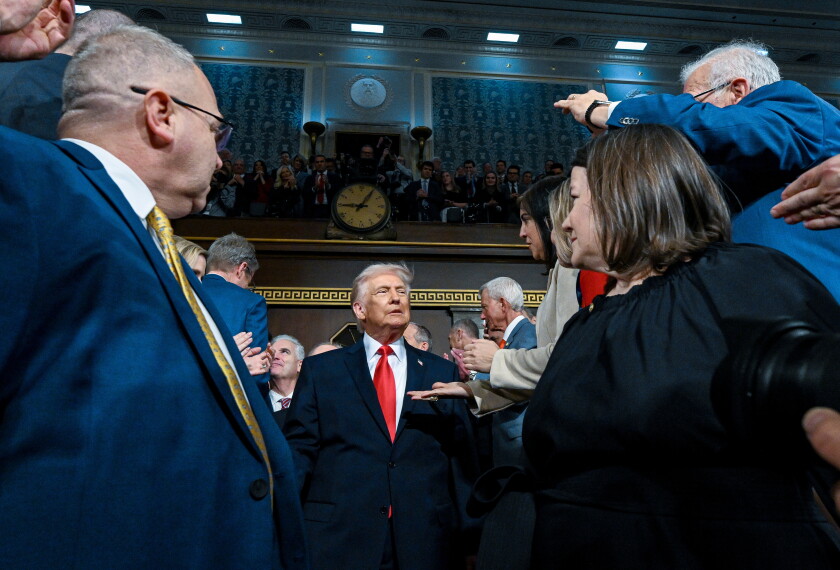
President Donald Trump enters to deliver the State of the Union address to a joint session of Congress in the House chamber at the U.S. Capitol in Washington, Tuesday, Feb. 24, 2026.
President Donald Trump enters to deliver the State of the Union address to a joint session of Congress in the House chamber at the U.S. Capitol in Washington, Tuesday, Feb. 24, 2026. The president devoted little time in the speech to discussing his education policies.
Kenny Holston/The New York Times via AP, Pool
Federal Education Department Will Send More of Its Programs to Other Agencies
Education grants for school safety, community schools, and family engagement will shift to Health and Human Services.
4 min read
Various school representatives and parent liaisons attend a family and community engagement think tank discussion at Lowery Conference Center on March 13, 2024 in Denver. One of the goals of the meeting was to discuss how schools can better integrate new students and families into the district. Denver Public Schools has six community hubs across the district that have serviced 3,000 new students since October 2023. Each community hub has different resources for families and students catering to what the community needs.
A program that helps state education departments and schools improve family engagement policies is among those the Trump administration will transfer from the U.S. Department of Education to the U.S. Department of Health and Human Services. In this photo, school representatives and parent liaisons attend a family and community engagement discussion on March 13, 2024, in Denver to discuss how schools can better integrate new students and families into the district.
Rebecca Slezak For Education Week
Federal New Trump Admin. Guidance Says Teachers Can Pray With Students
The president said the guidance for public schools would ensure "total protection" for school prayer.
3 min read
MADISON, AL - MARCH 29: Bob Jones High School football players touch the people near them during a prayer after morning workouts and before the rest of the school day on March 29, 2024, in Madison, AL. Head football coach Kelvis White and his brother follow in the footsteps of their father, who was also a football coach. As sports in the United States deals with polarization, Coach White and Bob Jones High School form a classic tale of team, unity, and brotherhood. (Photo by Jahi Chikwendiu/The Washington Post via Getty Images)
Football players at Bob Jones High School in Madison, Ala., pray after morning workouts before the rest of the school day on March 29, 2024. New guidance from the U.S. Department of Education says students and educators can pray at school, as long as the prayer isn't school-sponsored and disruptive to school and classroom activities, and students aren't coerced to participate.
Jahi Chikwendiu/Washington Post via Getty Images
