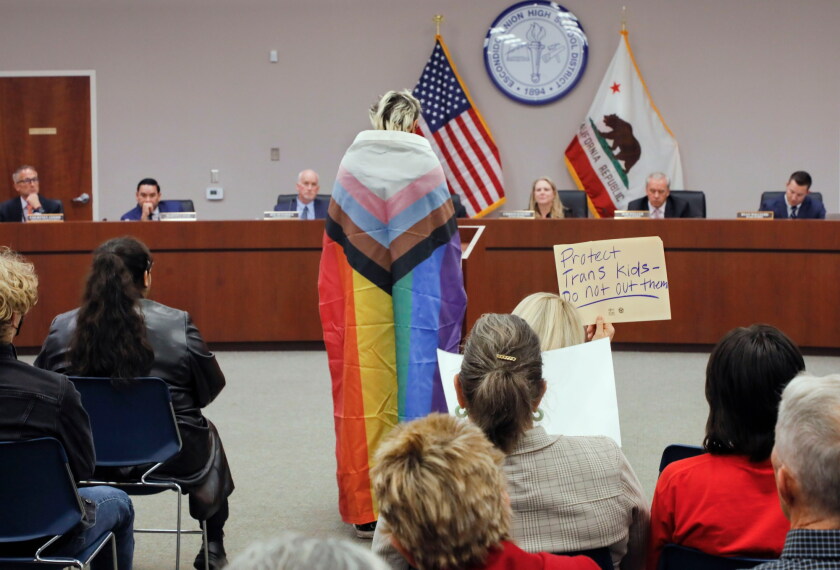
Over the dissents of two justices, the U.S. Supreme Court is declining to take up a case about whether educational institutions’ bias-reporting policies targeting hateful or derogatory speech have a chilling effect on students.
The case before the justices involved Indiana University’s bias-response teams, but one conservative advocacy group told the court that such policies and teams also “pervade K-12 schools,” which “are always eager to mimic their higher education comrades.”
Such bias-response policies are meant to foster a safe and conducive learning environment, free from discriminatory language, but the “bias-response teams” of officials who carry out such policies have come under fire from some conservative groups as another facet of diversity, equity, and inclusion goals that such groups find problematic.
Parents Defending Education says in its friend-of-the-court brief that some 115 school districts in 22 states and the District of Columbia have such policies. Bias-response teams “focus on perceived ‘microaggressions’” that “operate as anonymous snitch systems that are vulnerable to abuse and misuse,” the brief says.
The brief was filed in Speech First Inc. v. Whitten, in which a separate advocacy group challenged the bias-response teams at Indiana University.
That policy defines a bias incident as “any conduct, speech, or expression, motivated in whole or in part by bias or prejudice meant to intimidate, demean, mock, degrade, marginalize, or threaten individuals or groups based on that individual or group’s actual or perceived identities.”
Indiana University says in a brief that it is “expressly committed to encouraging free expression while offering educational opportunities to foster an inclusive and respectful environment.” The university says its bias-response program merely provides a forum for discussion about alleged incidents of bias, and that it doesn’t conduct investigations or carry out discipline of students involved in such complaints.
Speech First, which disputes those defenses, challenged the policy on First Amendment free speech grounds, but both a federal district court and the U.S. Court of Appeals for the 7th Circuit, in Chicago, ruled against the organization. The 7th Circuit court concluded that Speech First lacked standing to challenge the policy because it had not shown that its members faced a credible fear of discipline.
The Supreme Court on March 3 declined review, which means Indiana’s policy will remain in place for now. Justices Clarence Thomas and Samuel A. Alito Jr. said they would have heard the case.
Thomas, in a dissent from the denial of review only for himself, said three other federal appeals courts have taken a different view of bias-response policies than the 7th Circuit, thus creating a circuit split that the Supreme Court should resolve. He also expressed concerns about the breadth of such policies.
“Common features of bias response policies suggest that they may cause students to self-censor, fearing the consequences of a report to the bias response team and thinking that speech is no longer worth the trouble,” Thomas said. “Given the number of schools with bias response teams, this court eventually will need to resolve the split over a student’s right to challenge such programs.”
Citing specific school district policies
Parents Defending Education argues that such bias-response policies may cover a “nearly any perceived slight—say, a ‘microinsult’ or ‘microinvalidation,’” the brief says.
“The point of it all is unmistakable: coerce young children and their parents into silence while administrators and consultants institute radical, age-inappropriate curricula and ideological indoctrination,” PDE says in the brief.
Parents Defending Education says in its brief that some school districts have crafted their policies in this area from a report called “Responding to Hate and Bias at Schools” by the Learning for Justice project of the Southern Poverty Law Center.
PDE argues that the report takes too broad a view of bias to include “casual pejoratives” and even student recognition events.
The Southern Poverty Law Center declined a request for comment, but its guide says that “a school climate that encourages inclusion and promotes tolerance ... creates an atmosphere in which these acts are less likely to gain momentum and more likely to be quickly and widely denounced.”