Law & Courts

Supreme Court to Highlight Little Rock, Desegregation History in Exhibit to Open Next Fall

By Mark Walsh — December 31, 2022 3 min read
The first black students to enroll at Central High School in Little Rock, Ark., leave the building and walk toward a waiting Army station wagon following their classes on Oct. 2, 1957. Monday, Sept. 25, 2017, marks the 60th anniversary of when nine black students enrolled at the Arkansas school. One of the nine students is obscured by another student in this photograph.
  • Save to favorites
  • Print

The U.S. Supreme Court this fall will open an exhibit on school desegregation that will include the bench used by the federal district judge who ordered the integration of Central High School in Little Rock, Ark., in 1957.

Chief Justice John G. Roberts Jr. included the news in his year-end report on the federal judiciary, which is released on New Year’s Eve each year and typically includes some anecdotes and flourishes related to Supreme Court history.

Roberts’ discussion of U.S. District Judge Ronald N. Davies and the Little Rock crisis, which eventually involved the intervention of President Dwight D. Eisenhower, the 101st Airborne Division of the U.S. Army, and the Supreme Court itself, had a not-so-subtle connection to events at the high court this year.

“Judge Davies was physically threatened for following the law,” Roberts said about the judge from North Dakota who was on special assignment in the Little Rock federal courthouse when he was assigned that city’s desegregation case. “His wife feared for his safety. The judge was uncowed, and happily so were others who stuck up for the rule of law—not just with regards to the judge, but to even greater threats against the schoolchildren, their families, and leaders like the NAACP’s Daisy Bates.”

Roberts pivoted from that thought to thanking members of Congress “who are attending to judicial security needs” with the recent passage of a federal law that boosts safety for federal judges and their families. He did not mention the court’s decision this year in Dobbs v. Jackson Women’s Health Organization, which overruled Roe v. Wade and removed federal constitutional protection for abortion rights.

A leaked draft of the majority Dobbs opinion in May prompted protests outside the homes of several justices and the arrest of a man charged with planning an attack on Justice Brett M. Kavanaugh. Several justices have commented publicly about their concerns for personal security in the wake of the episode.

“A judicial system cannot and should not live in fear,” Roberts said in his year-end report. “The events of Little Rock teach about the importance of rule by law instead of by mob.”

Roberts gave a basic history lesson about the Little Rock case, which included the participation of Thurgood Marshall of the NAACP Legal Defense Fund and the role of the federal paratroopers in protecting the ability of nine Black students to attend Central High during the 1957-58 school year.

Davies later reflected on his ruling against Gov. Orval Faubus of Arkansas and his embrace of “interposition” between the state’s interest in preserved segregated schools and federal obligations.

“The law was very clear that the schools had to be integrated,” Davies said, in an observation quoted by Roberts.

The chief justice observed that the auxiliary Little Rock courtroom where Davies had presided had been decommissioned some years ago, but that the judge’s bench and other courtroom artifacts had been preserved. They will eventually be installed in an “era-faithful” courtroom at the federal courthouse in Little Rock.

But first, the bench and other artifacts have been loaned to the Supreme Court for an exhibit about the Little Rock and other school desegregations cases that will open in the court building this fall, Roberts said.

“The exhibit will introduce visitors to how the system of federal courts works, to the history of racial segregation and desegregation in our country, and to Thurgood Marshall’s towering contributions as an advocate before he became a justice,” Roberts said. “Come and visit the court and—starting this fall—have a close-up look at the historic bench Judge Davies used.”

Events

This content is provided by our sponsor. It is not written by and does not necessarily reflect the views of Education Week's editorial staff.
Sponsor
Artificial Intelligence Webinar
AI in Schools: What 1,000 Districts Reveal About Readiness and Risk
Move beyond “ban vs. embrace” with real-world AI data and practical guidance for a balanced, responsible district policy.
Content provided by Securly
This content is provided by our sponsor. It is not written by and does not necessarily reflect the views of Education Week's editorial staff.
Sponsor
Recruitment & Retention Webinar
K-12 Lens 2026: What New Staffing Data Reveals About District Operations
Explore national survey findings and hear how districts are navigating staffing changes that affect daily operations, workload, and planning.
Content provided by Frontline Education
Education Funding Webinar Congress Approved Next Year’s Federal School Funding. What’s Next?
Congress passed the budget, but uncertainty remains. Experts explain what districts should expect from federal education policy next.

EdWeek Top School Jobs

Teacher Jobs
Search over ten thousand teaching jobs nationwide — elementary, middle, high school and more.
View Jobs
Principal Jobs
Find hundreds of jobs for principals, assistant principals, and other school leadership roles.
View Jobs
Administrator Jobs
Over a thousand district-level jobs: superintendents, directors, more.
View Jobs
Support Staff Jobs
Search thousands of jobs, from paraprofessionals to counselors and more.
View Jobs

Read Next

Law & Courts Supreme Court’s Gender Identity Ruling Leaves Schools Seeking Clarity
Advocates say they would welcome more from the Supreme Court on gender-notification policies.
7 min read
The Supreme Court is photographed, Friday, Feb. 27, 2026, in Washington.
The Supreme Court is photographed, Friday, Feb. 27, 2026, in Washington. The high court recently ruled that California policies that sometimes limit or discourage schools from disclosing information to parents about children’s gender transitions and expressions at school likely violate parents’ constitutional rights
Rahmat Gul/AP
Law & Courts Supreme Court Backs Parents in School Gender Disclosure Fight
The Supreme Court restored an injunction blocking California policies on student gender transitions
8 min read
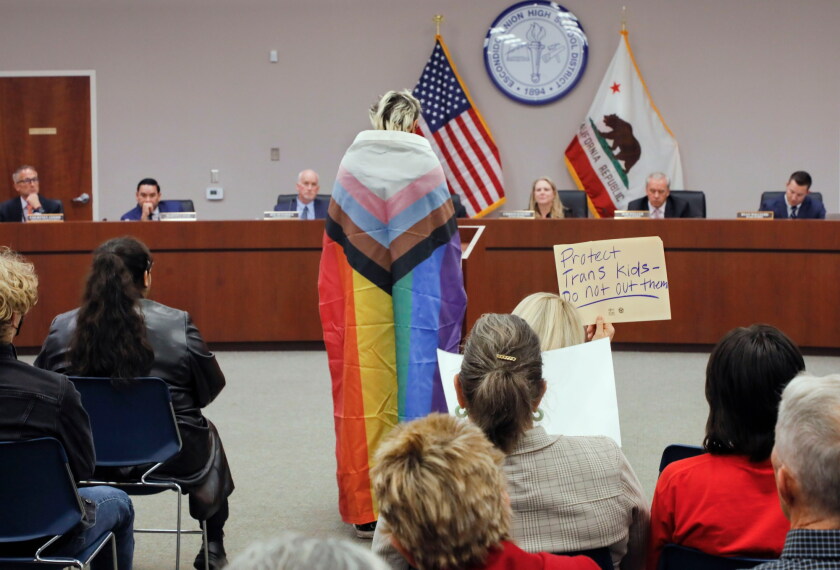
Teacher’s aide Amelia Mester, wrapped in a Pride flag, urges Escondido Union High School District not to have employees notify parents if they believe a student may be transgender in November 2025. A policy on the issue in the city’s elementary school district is the subject of a federal class-action lawsuit in which a judge just sided against the district.
Teacher’s aide Amelia Mester, wrapped in a Pride flag, urges Escondido Union High School District not to have employees notify parents if they believe a student may be transgender at a meeting in November 2025. Two parents and two teachers from the district sued in 2023, challenging California state guidance concerning student gender transitions and parental notification. The U.S. Supreme Court has now reinstated a lower-court decision overturning those state policies.
Charlie Neuman for The San Diego Union-Tribune/TNS
Law & Courts Appeals Court Allows Louisiana Ten Commandments Displays to Proceed
The court said it was premature to rule on the constitutionality of La. Ten Commandments displays.
3 min read
Students work under Ten Commandments and Bill of Rights posters on display in a classroom at Lehman High School in Kyle, Texas, Thursday, Oct. 16, 2025.
Students work under Ten Commandments and Bill of Rights posters on display in a classroom at Lehman High School in Kyle, Texas, Oct. 16, 2025. A federal appeals court has lifted a lower-court injunction blocking a Louisiana law that requires Ten Commandments displays, clearing the way for the law to take effect.
Eric Gay/AP
Law & Courts Social Media Companies Face Legal Reckoning Over Mental Health Harms to Children
Some of the biggest players from Meta to TikTok are getting a chance to make their case in courtrooms around the country.
6 min read
Social Media Kids Trial 26050035983057
Meta CEO Mark Zuckerberg leaves court after testifying in a landmark trial over whether social media platforms deliberately addict and harm children, on Feb. 18, 2026, in Los Angeles.
AP Photo/Damian Dovarganes
