Law & Courts

Supreme Court Ponders Copyright Extension

By Mark Walsh — October 16, 2002 3 min read
  • Save to favorites
  • Print

What do educational publishers, librarians, and the descendants of Dr. Seuss have at stake in a U.S. Supreme Court case about copyright?

Children's books that could be effected by the Supreme Court's decision.

Childhood favorites like these books might enter the public domain sooner if the court rejects the 1998 law.

A lot, judging by their willingness to file friend-of-the-court briefs in Eldred v. Ashcroft (Case No. 01-618). The high court last week heard arguments in the case, a challenge to the constitutionality of the Sonny Bono Copyright Term Extension Act of 1998.

The statute, named for the late singer and member of Congress, extended the terms of most copyrights by 20 years, and was aggressively sought by Hollywood lobbyists, particularly for the Walt Disney Co. The copyright on the first appearance of Mickey Mouse, in the 1928 animated film “Steamboat Willie,” was due to expire next year but was extended for two decades by the Bono Act.

Under the law, copyright protection for individual authors, composers, and artists grew from 50 years to 70 years after the creator’s death. Copyrights held by corporations were extended from 75 to 95 years.

Critics of the extension argue that serial extensions of the protected time frame amount to perpetual copyright protection in violation of the U.S. Constitution’s copyright clause, which gives Congress the power “to promote the progress of science and useful arts, by securing for limited times to authors and inventors the exclusive right to their respective writings and discoveries.” The law’s challengers also say it runs afoul of the First Amendment free-expression rights of those who would seek to publish works that are part of the public domain.

Copyright and the Web

Lawrence Lessig, a Stanford University law professor who is representing a varied group of challengers, told the justices during the Oct. 9 oral arguments that the rise of the Internet had brought about “a fundamentally important changed circumstance” to the issue of copyright.

The lead plaintiff challenging the extension is Eric Eldred, who runs a Web-based publisher of literature that is in the public domain. The Eldritch Press, Mr. Eldred’s company, is used by students around the world to gain free access to works by Nathaniel Hawthorne, Louisa May Alcott, and others.

“We are asserting that the opportunity to build upon works in the public domain is a vital First Amendment right,” Mr. Lessig told the Supreme Court justices last week. Several justices expressed sympathy for the challengers, but questioned whether they should overturn Congress on the issue.

Silver Screen

The law is being defended by the Bush administration and most of the commercial creative community, including several big educational publishers.

One brief in defense of the extension comes from the heirs of three prominent authors of books for children: Theodor S. Geisel, better known as Dr. Seuss; E.B. White, who wrote the classics Charlotte’s Web and Stuart Little; and Ludwig Bemelmans, who wrote the Madeline series.

Their heirs told the court that children’s books, in particular, take a while to reach classic status, and argued that extended copyrights can encourage further creative activity by the holders. For example, it has often taken decades for movie versions of famous children’s books to reach the screen, they said, such as the 54 years between the publication of Stuart Little in 1945 and the recent film, or the 46 years from the 1957 publication of Dr. Seuss’s The Cat in the Hat and next year’s planned movie release.

The heirs of the children’s authors argue that “it is the exclusivity of copyright protection that provides the incentive for the producers of other derivative works to invest the capital to transform these books into new media.”

Such new works, of course, also help drive sales of the original books.

Related Tags:

Events

This content is provided by our sponsor. It is not written by and does not necessarily reflect the views of Education Week's editorial staff.
Sponsor
Artificial Intelligence Webinar
Managing AI in Schools: Practical Strategies for Districts
How should districts govern AI in schools? Learn practical strategies for policies, safety, transparency, and responsible adoption.
Content provided by Lightspeed Systems
Education Funding Webinar Congress Approved Next Year’s Federal School Funding. What’s Next?
Congress passed the budget, but uncertainty remains. Experts explain what districts should expect from federal education policy next.
This content is provided by our sponsor. It is not written by and does not necessarily reflect the views of Education Week's editorial staff.
Sponsor
Student Absenteeism Webinar
Removing Transportation and Attendance Barriers for Homeless Youth
Join us to see how districts around the country are supporting vulnerable students, including those covered under the McKinney–Vento Act.
Content provided by HopSkipDrive

EdWeek Top School Jobs

Teacher Jobs
Search over ten thousand teaching jobs nationwide — elementary, middle, high school and more.
View Jobs
Principal Jobs
Find hundreds of jobs for principals, assistant principals, and other school leadership roles.
View Jobs
Administrator Jobs
Over a thousand district-level jobs: superintendents, directors, more.
View Jobs
Support Staff Jobs
Search thousands of jobs, from paraprofessionals to counselors and more.
View Jobs

Read Next

Law & Courts Supreme Court’s Gender Identity Ruling Leaves Schools Seeking Clarity
Advocates say they would welcome more from the Supreme Court on gender-notification policies.
7 min read
The Supreme Court is photographed, Friday, Feb. 27, 2026, in Washington.
The Supreme Court is photographed, Friday, Feb. 27, 2026, in Washington. The high court recently ruled that California policies that sometimes limit or discourage schools from disclosing information to parents about children’s gender transitions and expressions at school likely violate parents’ constitutional rights
Rahmat Gul/AP
Law & Courts Supreme Court Backs Parents in School Gender Disclosure Fight
The Supreme Court restored an injunction blocking California policies on student gender transitions
8 min read
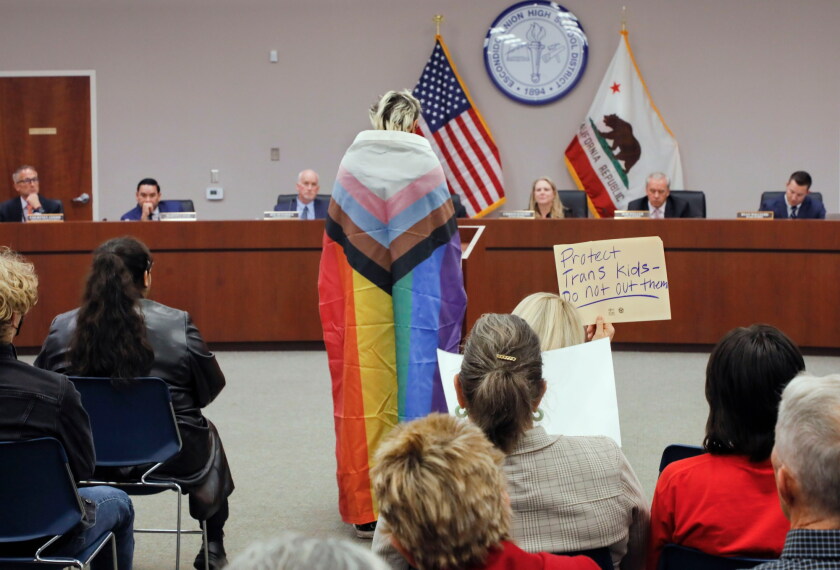
Teacher’s aide Amelia Mester, wrapped in a Pride flag, urges Escondido Union High School District not to have employees notify parents if they believe a student may be transgender in November 2025. A policy on the issue in the city’s elementary school district is the subject of a federal class-action lawsuit in which a judge just sided against the district.
Teacher’s aide Amelia Mester, wrapped in a Pride flag, urges Escondido Union High School District not to have employees notify parents if they believe a student may be transgender at a meeting in November 2025. Two parents and two teachers from the district sued in 2023, challenging California state guidance concerning student gender transitions and parental notification. The U.S. Supreme Court has now reinstated a lower-court decision overturning those state policies.
Charlie Neuman for The San Diego Union-Tribune/TNS
Law & Courts Appeals Court Allows Louisiana Ten Commandments Displays to Proceed
The court said it was premature to rule on the constitutionality of La. Ten Commandments displays.
3 min read
Students work under Ten Commandments and Bill of Rights posters on display in a classroom at Lehman High School in Kyle, Texas, Thursday, Oct. 16, 2025.
Students work under Ten Commandments and Bill of Rights posters on display in a classroom at Lehman High School in Kyle, Texas, Oct. 16, 2025. A federal appeals court has lifted a lower-court injunction blocking a Louisiana law that requires Ten Commandments displays, clearing the way for the law to take effect.
Eric Gay/AP
Law & Courts Social Media Companies Face Legal Reckoning Over Mental Health Harms to Children
Some of the biggest players from Meta to TikTok are getting a chance to make their case in courtrooms around the country.
6 min read
Social Media Kids Trial 26050035983057
Meta CEO Mark Zuckerberg leaves court after testifying in a landmark trial over whether social media platforms deliberately addict and harm children, on Feb. 18, 2026, in Los Angeles.
AP Photo/Damian Dovarganes