Standards & Accountability

Report Examines Privatized Schools’ Scores

By Rhea R. Borja — November 12, 2003 3 min read
  • Save to favorites
  • Print

A report that may be the first federal study to compare student achievement in privately managed public schools against that in other public schools sees both pluses and minuses for private companies.

“Public Schools: Comparison of Achievement Results for Students Attending Privately Managed and Traditional Schools in Six Cities,” from the U.S. General Accounting Office. Highlight of the 62- page report is also available. (Requires Adobe’s Acrobat Reader.)

The report, which the U.S. General Accounting Office prepared for the House Education and the Workforce Committee, uses student scores on state standardized tests and other school data to make the comparison.

“This report shows that some privately managed companies are having better results than traditional schools, but in some cases they didn’t,” said Marnie Shaul, the director of education, workforce, and income security issues for the GAO, the investigative arm of Congress.

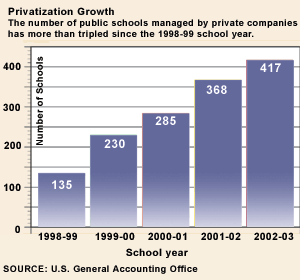
But she cautioned that the report, released last month, focuses on only a small sample of schools. She said it does not gauge the effectiveness of all 417 public schools nationwide that are managed by 47 for-profit companies. More than three-fourths of those schools are charter schools.

Still, officials at some education management companies see the report in a mostly positive light.

Adam Tucker, a spokesman for New York City-based Edison Schools Inc., the nation’s largest for-profit manager of public schools, with 130 nationwide, said the GAO study showed that education companies were improving student performance on standardized tests.

“There’s a lot of merit in the report,” he said. “It begins to understand the contribution that education management companies are making to school reform.”

Educators and policymakers are closely watching the performance of schools run by school management companies such as Edison.

Ms. Shaul pointed out that schools that have not made adequate yearly progress consistently for five years, as required under the federal No Child Left Behind Act, may be restructured. One option policymakers can consider, she said, is to hand the management reins of the schools to for-profit companies.

Range of Results
GAO researchers compared state reading and mathematics scores and other data from 14 elementary schools managed by private companies since 1998 with at least 28 traditional public elementary schools in Cleveland, Denver, Detroit, Phoenix, San Francisco, and St. Paul, Minn.

They analyzed public schools that were similar to the privately managed schools in grade configurations, enrollment, race and ethnicity, percentage of English-language learners, and percentage of students living in poverty.

In Denver, 5th graders at a privately managed school scored 15 percentile points higher on average—572, compared with 557—on the state reading exam than did their peers at traditional public schools in the city.

In San Francisco, 5th graders at a privately managed school scored 9 points higher on average in reading and 7 points higher in math on the Stanford Achievement Test than did students at traditional public schools there.

By contrast, 4th graders in privately managed schools in Cleveland scored 16 percentile points on average lower than students at traditional public schools in the city. And in St. Paul, 5th graders at privately managed schools scored 1256 points on average in reading on the Minnesota Comprehensive Assessment Program, compared with 1469 for students at traditional public schools there.

Student scores in Detroit and Phoenix were similar for the privately managed and traditional public schools the GAO studied.

Events

This content is provided by our sponsor. It is not written by and does not necessarily reflect the views of Education Week's editorial staff.
Sponsor
Special Education Webinar
Bridging the Math Gap: What’s New in Dyscalculia Identification, Instruction & State Action
Discover the latest dyscalculia research insights, state-level policy trends, and classroom strategies to make math more accessible for all.
Content provided by TouchMath
This content is provided by our sponsor. It is not written by and does not necessarily reflect the views of Education Week's editorial staff.
Sponsor
School & District Management Webinar
Too Many Initiatives, Not Enough Alignment: A Change Management Playbook for Leaders
Learn how leadership teams can increase alignment and evaluate every program, practice, and purchase against a clear strategic plan.
Content provided by Otus
This content is provided by our sponsor. It is not written by and does not necessarily reflect the views of Education Week's editorial staff.
Sponsor
College & Workforce Readiness Webinar
Building for the Future: Igniting Middle Schoolers’ Interest in Skilled Trades & Future-Ready Skills
Ignite middle schoolers’ interest in skilled trades with hands-on learning and real-world projects that build future-ready skills.
Content provided by Project Lead The Way

EdWeek Top School Jobs

Teacher Jobs
Search over ten thousand teaching jobs nationwide — elementary, middle, high school and more.
View Jobs
Principal Jobs
Find hundreds of jobs for principals, assistant principals, and other school leadership roles.
View Jobs
Administrator Jobs
Over a thousand district-level jobs: superintendents, directors, more.
View Jobs
Support Staff Jobs
Search thousands of jobs, from paraprofessionals to counselors and more.
View Jobs

Read Next

Standards & Accountability Explainer What’s the Purpose of Standards in Education? An Explainer
What are standards? Why are they important? What's the Common Core? Do standards improve student achievement? Our explainer has the answers.
11 min read
Photo of students taking test.
F. Sheehan for EdWeek / Getty
Standards & Accountability Florida's New African American History Standards: What's Behind the Backlash
The state's new standards drew national criticism and leave teachers with questions.
9 min read
Florida Governor and Republican presidential candidate Ron DeSantis speaks during a press conference at the Celebrate Freedom Foundation Hangar in West Columbia, S.C. July 18, 2023. For DeSantis, Tuesday was supposed to mark a major moment to help reset his stagnant Republican presidential campaign. But yet again, the moment was overshadowed by Donald Trump. The former president was the overwhelming focus for much of the day as DeSantis spoke out at a press conference and sat for a highly anticipated interview designed to reassure anxious donors and primary voters that he's still well-positioned to defeat Trump.
Florida Governor and Republican presidential candidate Ron DeSantis speaks during a press conference in West Columbia, S.C., on July 18, 2023. Florida officials approved new African American history standards that drew national backlash, and which DeSantis defended.
Sean Rayford/AP
Standards & Accountability Here’s What’s in Florida’s New African American History Standards
Standards were expanded in the younger grades, but critics question the framing of many of the new standards.
1 min read
Vice President Kamala Harris speaks at the historic Ritz Theatre in downtown Jacksonville, Fla., on July 21, 2023. Harris spoke out against the new standards adopted by the Florida State Board of Education in the teaching of Black history.
Vice President Kamala Harris speaks at the historic Ritz Theatre in downtown Jacksonville, Fla., on July 21, 2023. Harris spoke out against the new standards adopted by the Florida state board of education in the teaching of Black history.
Fran Ruchalski/The Florida Times-Union via AP
Standards & Accountability Opinion How One State Found Common Ground to Produce New History Standards
A veteran board member discusses how the state school board pushed past partisanship to offer a richer, more inclusive history for students.
10 min read
Image shows a multi-tailed arrow hitting the bullseye of a target.
DigitalVision Vectors/Getty