Opinion Blog


Rick Hess Straight Up

Education policy maven Rick Hess of the American Enterprise Institute think tank offers straight talk on matters of policy, politics, research, and reform. Read more from this blog.

School Choice & Charters Opinion

The Kind of School Reform That Parents Actually Want

By Rick Hess — October 25, 2021 3 min read
Image shows a multi-tailed arrow hitting the bullseye of a target.
  • Save to favorites
  • Print

School debates today feature what seems to be a paradox: Americans report exhaustion with school reform of pretty much every stripe, even as huge numbers of parents voice an appetite for novel options such as private school choice, home schooling, and “learning pods.”

What’s going on? How can parents simultaneously be exhausted by reform and hungry for options?

Let’s start with why Americans may be exhausted with reform. It’s fair to say that most parents and communities have had less-than-great experiences with “school reform” and the reformers who pursue it. From the train wreck of the Common Core State Standards to the renaissance of post-Katrina New Orleans, school reform has often felt like something that the comfortable denizens of Silicon Valley or Washington visit upon local parents and educators—whether they want it or not.

In fact, from a parent’s perspective, Big “R” Reform—in which reformers pursue ambitious reforms in pursuit of sweeping slogans (“closing achievement gaps” or “college for all”)—usually feels far removed from the things that will directly impact their child. Big R Reform can leave parents wondering how this addresses their pressing concerns about student safety, cruddy technology, or too-easy reading assignments. But instead of offering practical answers to practical concerns, reformers wind up encouraging parents to send emails to state legislators or wear brightly colored T-shirts to the state capitol—in the hope that it’ll eventually help lead to the enactment of some four-point plan.

For low-income families in particular, school reform has frequently taken the shape of yet another out-of-town funder pursuing yet another ambitious reform agenda cooked up by a mix of self-assured researchers, crusading twenty-somethings, and foundation executives. In a story that’s been told time and again, these families wind up feeling tuned out and ill-used for the sake of an outsider’s vision of “reform.” While each new wave of reform is led by reformers who pledge that “this time will be different,” it rarely works out that way.

Meanwhile, suburban middle-class families have gotten the message that school reform isn’t for them or their kids at all. For three decades, school choice reforms have been designed and marketed as tools for serving low-income children in the urban core. When suburban parents worried about No Child Left Behind-inspired cutbacks in arts, world languages, and gifted classes, they were told to worry less about their own kids and more about what “those other kids” needed.

So it’s hard to blame any parent, especially after the past year and a half, for not wanting more “reform-minded” disruption. It’s easy to see why parents who’ve got the resources and know-how would rather call a principal to get their child reassigned from teacher A to teacher B or ask a school board member to help get their kid into a program.

This understandable inclination to focus on solving specific problems rather than wading into the miasma of system change helps explain the expanded appetite for more and better school options. For millions of families, “school choice” has morphed from abstraction to potential solution.

This applies to parents frustrated that local public schools tended to stay closed last year while many private schools opened safely. To parents who found themselves tasked with home schooling when school districts closed and now want to retain some of the benefits via “hybrid-home schooling.” To the one-third of parents who are in a learning pod or say they’re interested in joining one—including more than half of Black parents and 45 percent of Latino parents. And to the parents who have doubled the nation’s home schooling population to 1 in 10 students. These parents aren’t seeking to reform their schools; they’re just looking for options that suit.

So the seeming paradox isn’t so paradoxical after all. Parents are skeptical of reform because they’re skeptical it’ll help their kids; new options appeal because parents believe that these actually will benefit their children. A useful reality check for educators, policymakers, and would-be reformers alike.

The opinions expressed in Rick Hess Straight Up are strictly those of the author(s) and do not reflect the opinions or endorsement of Editorial Projects in Education, or any of its publications.

Events

This content is provided by our sponsor. It is not written by and does not necessarily reflect the views of Education Week's editorial staff.
Sponsor
School Climate & Safety Webinar
There But Not Present: Rethinking Student Engagement
Learn how to recognize the early signs of disengagement and what the behavioral science reveals about which interventions actually work.
Content provided by Frontline Education
Teacher Preparation Webinar What Teacher Education Should Look Like in the Age of AI
Explore the current trends around the use of AI in teacher preparation and continuing education with data from the EdWeek Research Center.
English Learners Webinar How Can School Districts Better Support English Learners With Disabilities?
Join this webinar to hear recent findings from the EdWeek Research Center and discover practical strategies for improvement.

EdWeek Top School Jobs

Teacher Jobs
Search over ten thousand teaching jobs nationwide — elementary, middle, high school and more.
View Jobs
Principal Jobs
Find hundreds of jobs for principals, assistant principals, and other school leadership roles.
View Jobs
Administrator Jobs
Over a thousand district-level jobs: superintendents, directors, more.
View Jobs
Support Staff Jobs
Search thousands of jobs, from paraprofessionals to counselors and more.
View Jobs

Read Next

School Choice & Charters Explainer New Rules for Federal School Choice: What You Need to Know
Proposed rules from the IRS offer some details on how the first nationwide school choice program will work.
MINNEAPOLIS, MN, January 22, 2026: Students move through the halls at Washburn High School in Minneapolis, MN.
The Trump administration has released proposed regulations outlining how the first nationwide school choice program will operate when it launches next year. The regulations leave some major questions unaddressed but clarify other aspects for the tax-credit scholarship program.
Caroline Yang for Education Week
School Choice & Charters Federal Education Tax Credit Rules Are Finally Here. What We Know So Far
The Treasury Department unveiled regulations governing a massive infusion of education funding nationwide.
5 min read
The tax credit program would allow individuals who donate up to $1,700 to a scholarship granting organization to receive a dollar-for-dollar federal income tax credit in exchange. Pictured are students at Northeast Elementary located at 1024 Fleming Ave. in Jackson on Aug. 20, 2025.
Students at Northeast Elementary School in Jackson, Mich., on Aug. 20, 2025. A tax-credit scholarship program launching in January will allow individuals who donate up to $1,700 to a scholarship granting organization to receive a dollar-for-dollar federal income tax credit. Those SGOs can give out awards to cover private school tuition as well as some expenses for public school students.
Abra Richardson/mlive.com via TNS
School Choice & Charters Opinion What Do Parents Look for in a School?
Test scores aren’t the whole story. The CEO of GreatSchools talks about what parents want.
•
5 min read
The United States Capitol building as a bookcase filled with red, white, and blue policy books in a Washington DC landscape.
Luca D'Urbino for Education Week
School Choice & Charters Microschools Are Spreading. Some School Districts Have Opened Their Own
Districts see the small learning communities as an alternative for families that may otherwise leave.
8 min read
MLP 5851 2
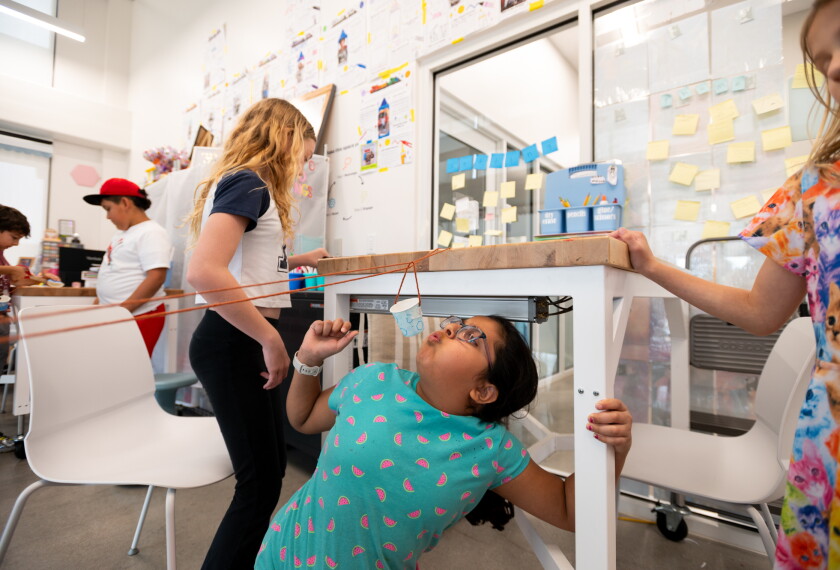
Daisy Wisbey, 11, and Eleanor Mukiri, 10, work on an engineering challenge at Creative Minds in Wichita, Kan., on Sept. 15, 2026. The Wichita public schools runs Creative Minds as a microschool, in which students from multiple grades learn together in a project-based learning format. Wichita is among a handful of public school districts that have begun their own microschools.
Melissa Lukenbaugh for Education Week