
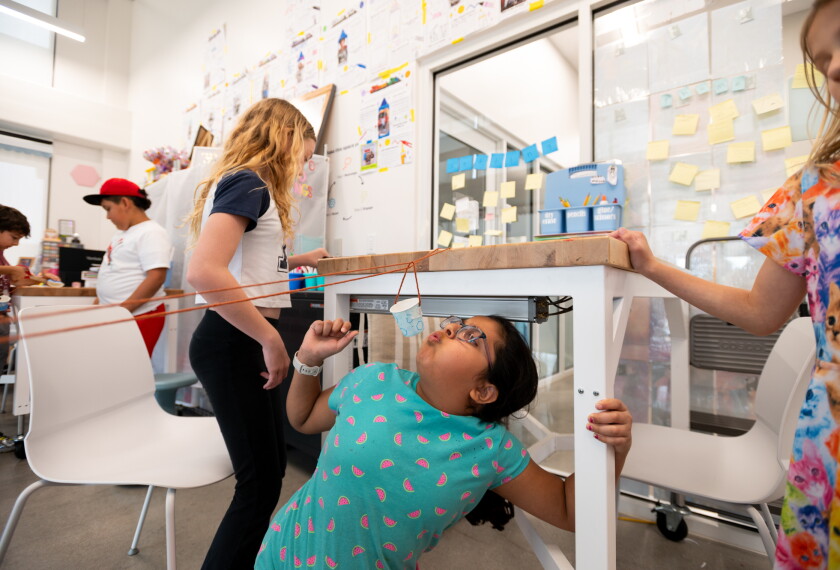
In 2024, as it faced growing competition for students from private schools, nearby public school districts, and the pull of home school, the Wichita public schools in Kansas decided to try something new.
The district reached out to families that indicated they planned to leave and asked if they would be interested in trying its newest school, called Creative Minds, a microschool where students from multiple grade levels would work with a single teacher and focus on project-based learning.
Interest was strong and it’s remained so. Today, Creative Minds has grown to four classrooms on two campuses serving about 40 students combined in kindergarten through 6th grade. The waitlist is around 200 students, and that comes purely from word of mouth—the district hasn’t advertised the existence of either school.
“I think it’s good to look at these different models because obviously the community is looking for something different,” said Robert Dickson, Wichita’s chief information officer. “Not everyone, but I think there’s a lot of different models that work for different families.”
Emerging from an alternative to remote schooling during the pandemic, interest in microschools—essentially, innovative, one-room schoolhouses that have traditionally been private or charter schools—has surged in recent years.
Meanwhile, growth in state-sponsored private school choice programs—such as vouchers, tax-credit scholarships, and education savings accounts, which give families public money to spend on private school tuition—have made microschools more financially viable and an option for more families, said Jonathan Schweig, a senior behavioral and social scientist at the RAND Corp. who has studied microschools.
The coming launch of a federal school choice program that will fund tax credit-backed scholarships for families to use on private or public education expenses could provide another financial boost for the microschool model.
To meet this moment, some public school district leaders are launching their own microschools. The goal is to entice families that would otherwise leave the district to stay.
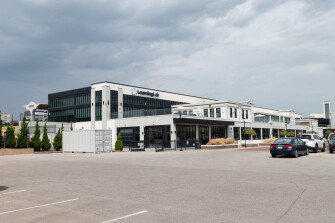
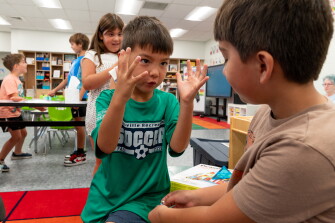
Creative Minds’ first campus is housed in the Learning Lab, an education incubator space in downtown Wichita that also includes a virtual school and a Khan Lab School (an independent school affiliated with Khan Academy). Creative Minds serves its 37 students in two classes with two teachers and a focus on project-based learning. A movable partition gives the teachers the flexibility to separate students by grade bands or combine all K-6 students into one class.
Wichita opened a second Creative Minds campus with two classes of 34 students and two teachers this fall inside one of its elementary schools.
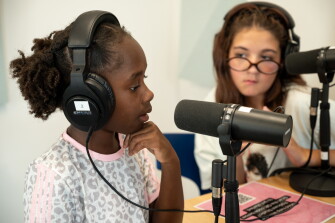
Even though it’s based out of a traditional school building, it feels different, said Dickson. The setup includes the same features of the original campus at Learning Lab: a podcasting room, a makerspace, a STEM lab, and flexible seating.
Students in Creative Minds must adhere to the same state standards as all other students in the district and take the same state assessments.
In addition to retaining students, Creative Minds has served as a lab for the district to try new things that its regular schools can later adopt, said Dyane Smokorowski, the district’s coordinator of digital literacy who has also taught at the microschool.
“If other schools want to try something innovative, we have others who want to start exploring project-based learning, they’ve just never had somebody show it” to them, she said.
Creative Minds “is becoming the lighthouse of what’s possible with project-based learning.”

Microschools are spreading, but no one can say by how much
With two campuses and more than 70 students, Creative Minds might be pushing the definition of a microschool—that is, if there was one.
Microschools tend to be small, private or charter schools that emphasize project-based learning in multiage classes where students progress at their own pace. But there’s no formal definition of a microschool, and they can be any small school of choice to which someone wants to apply the label, said Schweig, the RAND researcher.
The lack of a definition makes it impossible to pinpoint how many microschools are operating across the country, he said, much less how many school districts are operating. What is clear is that interest in the concept has surged since the pandemic and the school closures that it brought.
“A lot of parents dissatisfied with online schooling organized learning pods,” he said. “There were a large-ish number of parents who, once schools reopened, thought that something pod-like in a learning experience was actually better suited for their child’s needs.”
Wichita, Kansas’ largest district, has seen its enrollment drop by about 6,000 students over the past decade to today’s level of about 45,000, largely the result of declining birth rates, but student population shifts and competition from private schools and home schooling have also contributed. A microschool is one way to retain families, but not one that can fully stem the district’s contraction.
Microschools as a way to keep a small community’s school
A microschool can also be a creative means to keep a public school in a small community that might otherwise struggle to sustain one. That’s been the case in Carthage, Ind.
There, a new microschool opened this year on the site of an old public school campus that closed because of falling enrollment.
A church had bought the school building, but it was empty most of the week when services weren’t being held, said George Philhower, the superintendent of the neighboring Eastern Hancock schools, located east of Indianapolis.
So, church leaders approached Philhower about the district running a microschool in the building during the week. For the church, the setup is a way to earn revenue and serve its community, he said.
“It’s a small town that looked a lot different in the 1950s and 60s than it does right now,” Philhower said. “The church is the hub of the community, and they just thought, ‘if we can have a school arm as well, then that could be really cool.’”
The school opened this year with 30 students.
The Eastern Hancock district is approaching microschools differently than Wichita. Philhower’s district obtained a charter under the state’s charter school law to launch a statewide network of microschools. Philhower is the network’s CEO as well as the Eastern Hancock superintendent.
The arrangement allows the district to partner with different organizations and communities to open microschools anywhere in the state. The Indiana Microschool Collaborative, as the network is called, currently oversees five microschools, four of which opened or came under the collaborative’s umbrella this year.
It launched its first campus last year in a summer camp that sat empty during the school year. The “classroom” is housed in a pole barn that doesn’t look like a traditional school, said Philhower. There’s a big focus on play and individualized, self-paced learning. Instead of report cards, students earn badges, like in scouting, for academic proficiency. That school serves 100 students in K-8 and now has a 140-student waitlist.
Since then, Philhower has been approached by a district on the state’s border with Ohio to run a microschool there, as well as by a private microschool that wanted to come under the collaborative’s umbrella. Philhower’s district provides the administrative services—such as payroll and navigating required state audits—that can be difficult for a single educator or small staff to juggle, he said.
The district launched its fifth microschool in partnership with Indiana University East. It’s a high school located on the college campus where students take some college courses and some classes with their own dedicated high school teachers.
Each microschool is distinct, and that’s how Philhower wants it.
“I believe that every kid should get to go to a school that they feel like is designed just for them,” he said. “It’s our job to figure out what that should look like. And ‘just for them’ doesn’t mean that it’s like a theme park every day, but this is the space where [students] feel comfortable growing.”
District lessons from running microschools
Philhower said his district—which has 1,200 students, 40% of whom choose to attend the district’s schools from outside its boundaries—is still figuring out how to handle marketing and public relations for the new project, so it can make more people aware of their endeavor without getting bogged down in what can be the touchy politics of school choice.
In Wichita, district leaders have found that a microschool’s success hinges on the teacher in a way it wouldn’t in a traditional school. Not only does the teacher have to be talented and creative, they must be able to forge strong relationships with families, said Smokorowski, the digital literacy coordinator.
“There’s no principal to say, ‘If you’ve got a problem, come talk to the principal first and then I will go to the teacher,’” she said. “It is up to the teacher to build those relationships with the entire family. And that takes time to build those skill sets. That’s not something any of us learn in pre-service.”
The district is now considering training early-career educators in its system to be microschool teachers with the specific skills necessary to be successful in that role.
And sometimes, a microschool doesn’t pan out.
That was the case in the Vail school district in Arizona. The district launched a microschool after it saw more families leaving the district to home-school around the pandemic.
The microschool, which served elementary grades, provided à la carte educational opportunities for home-schooling families, such as field trips, math lessons, and space and equipment to do science experiments, said Kelly Pinkerton, the chief learning and innovation officer for Vail schools. The district also reached out to the local home-schooling community to bring in new families, not just those on the cusp of leaving Vail schools.
Over time, however, families moved on to other programs, such as the district’s blended learning program and the state’s education savings account program, which gives money to families to use on approved education expenses, Pinkerton said.
With an ESA, families who formerly attended the microschool now use the state money to pay the Vail district to participate in select classes and extracurriculars.
But Pinkerton said her district has benefited from its microschool experiment. The idea behind it, finding creative ways to reach more families, lives on.
“What we learned is, sometimes people want something that’s a little bit different, and we have to think outside of the box for how we can best partner with families,” she said.


