Ever since COVID-19 closed U.S. schools for in-person instruction in March 2020, questions about pandemic learning loss have shaped reactions to new data on student learning. How much did achievement fall while schools were closed? (The short answer: A lot.) Do we see signs of recovery? (For the most part, no.)
Yet the latest results from the National Assessment of Educational Progress, also known as the “nation’s report card” or NAEP, illustrate how this COVID-centric lens distorts as much as it reveals.
Yes, science scores for 8th graders are down since 2019, the last time kids were tested in that subject. High school seniors have also lost ground in reading and math. But achievement in each of these subjects was already trending downward before the pandemic—and there’s no reason to expect a “return to normal,” or to pre-pandemic learning conditions, would stop or reverse these declines.
Twelfth grade reading scores hit a recent peak in 2009 and fell significantly over the following decade. Twelfth grade math peaked in 2013 and had also fallen by 2019. Eighth grade science scores held steady between 2015 and 2019, but the scores of 4th graders (who were not included in the latest round of science testing) fell over that same period.
This phenomenon of pre-pandemic learning loss is also evident in 8th grade math, 8th grade U.S. history, and in reading in both 4th and 8th grades. In math, pandemic-era disruptions clearly accelerated the downward trend. But the picture that emerges for reading and U.S. history is one of steady decline since the middle of the last decade. The pandemic hardly registers as a blip.
Pre-pandemic learning loss was steepest for the nation’s lowest-performing students, who also suffered the most from school closures and now seem to be in free fall. In 8th grade reading, for example, scores at the 10th percentile fell by 10 points between 2013 and 2019 and by another 9 points between 2019 and 2024, with the total loss amounting to nearly two years’ worth of typical learning. Meanwhile, high-performing students held steady over this same period and, despite the pandemic, are scoring nearly as high as ever. The gap between the lowest-performing and highest-performing students is now widening across all subjects and grades, highlighting the stark reality that schools today are equipping only some students for postsecondary success.
If the pandemic is not solely to blame for our current woes, what is? The “nation’s report card” is designed to tell us what’s happening to student achievement rather than why, but the data can inform the search for culprits. Possible candidates should have emerged in the first half of the 2010s, plausibly affect learning across multiple subjects, and disproportionately harm low-performing students (while leaving high-performers mainly untouched). Given emerging evidence of widening achievement gaps in other developed countries, factors that transcend national boundaries merit special consideration.
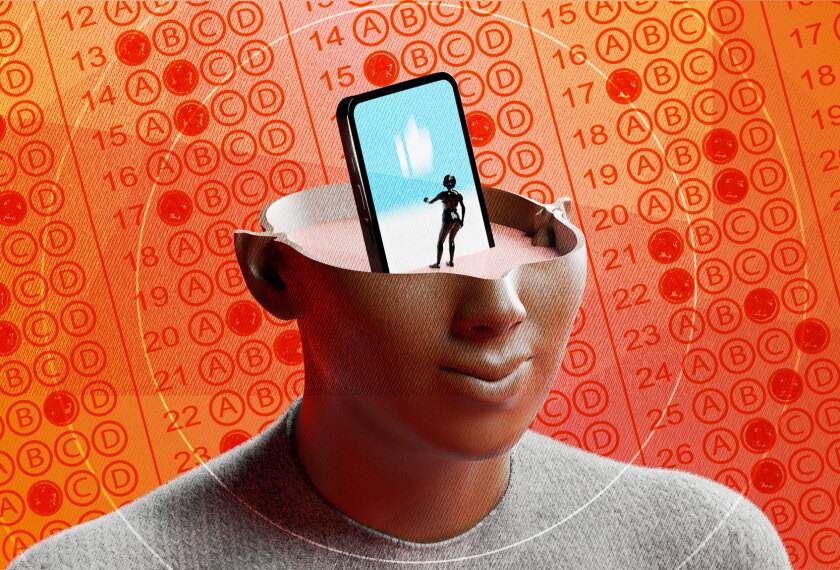
To my knowledge the only candidate that checks all those boxes is the rise of smartphones and, in particular, the advent of social media platforms targeting youth. The timing fits. Phones distract students from math homework just as much as they do from reading. Surveys show that disadvantaged students spend the most time on their devices, while motivated students of all backgrounds may be able to use them to enhance their learning. New York University psychologist Jonathan Haidt has argued convincingly that these technologies are a key driver of our current crisis in youth mental health. While we lack a definitive causal link between smartphones and learning, the circumstantial evidence is sufficiently strong to justify more experimentation with bell-to-bell phone bans in schools, as well as efforts to rein in students’ near-constant use of other digital devices while in class.
The 'nation’s report card' is designed to tell us what’s happening to student achievement rather than why, but the data can inform the search for culprits.
In addition to developing and testing strategies to protect students from their phones, policymakers need to consider ways to promote higher levels of learning going forward. Here it is worth looking to our past, when elected officials from both political parties came together around a reform agenda grounded in articulating clear standards for student learning and holding schools accountable for ensuring kids met those standards on state tests. That approach had plenty of critics but, when implemented first at the state level in the 1990s, and then taken nationally with the signing into law, in 2002, of the No Child Left Behind Act (NCLB), it produced results: steadily rising levels of achievement driven by unusually large gains for low-performers—precisely the opposite of the pattern over the past decade. A loosening of that law’s provisions began around 2011 and may also have contributed to our recent backsliding.
I’m not advocating carbon copies of past reforms. We need to learn from what worked and what didn’t, including acknowledging an overemphasis under NCLB on subjects covered by state tests, like reading and math, at the expense of civics, history, and science instruction. That lopsided approach surely contributed to low scores in those other subjects on NAEP. The metrics used to gauge school performance need to set realistic targets for improvement and focus on what schools contribute to student learning, not the inherent advantages and disadvantages students bring with them to school.
Policymakers and educators have urgent work to do, as do parents who play an especially critical role in their children’s education. Potential solutions to the chronic absenteeism crisis now afflicting our public schools require educators to partner with parents to reemphasize the importance of regular attendance.
We must also find common ground on the smartphone issue. Research shows 93% of kids ages 13 to 17 have their own smartphones, up from 73% in 2014-15. Parents can set limits on how and when children use these devices. I’m a parent, my two older sons have phones, and I know just how hard that is. I take comfort in being able to reach my boys as needed, but I also understand and appreciate the call from experts to put the phones away. Coupled with greater accountability around student achievement, it may be the single most important thing we can do to help our kids learn.