Education Funding Photo Essay

Observing an Uncertain Future for School Districts in North Carolina

By Education Week Photo Staff — June 17, 2015 4 min read
  • Save to favorites
  • Print

On assignment for Education Week, photographer Justin Cook reflects on his return to his familial roots as he documented two North Carolina school districts that benefited from the Obama administration’s education improvement agenda, and now face dwindling federal funds.

A giant dresser on Hamilton Street stands in homage to the furniture industry in downtown High Point, N.C.

I knew High Point, North Carolina, because my dad was born there, and my grandmother told me lots of stories about growing up on Montlieu Avenue. I worked in a camera store on Main Street one summer in college. I went to high school down the road in Greensboro, so an assignment in Guilford county schools was like going home. But photographing at Parkview Expressive Arts Magnet School was like working at the center of my being: I’m a product of an arts magnet elementary in Montgomery, Ala. Without that experience, who knows where I would be today. I doubt I’d be shooting photos for Education Week.
The mood I set out to capture was “uncertainty.” What will happen to all the progress when some of the federal funds, specifically from President Obama’s Race to the Top initiative, dry up? Especially in North Carolina’s Title I schools, with the highest percentages of students from low-income families? Especially in a state where teachers have some of the lowest pay in the nation?
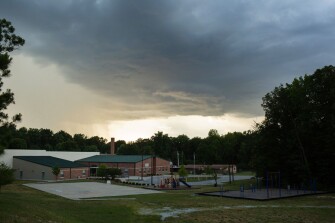
A summer storm lingers over Parkview Expressive Arts Magnet School in High Point, N.C. Parkview stands to lose several federal Race to the Top grants and other funding, which have spurred academic improvements at the school.

I arrived in High Point on a Sunday afternoon, checked into my hotel, and immediately drove to the school. I wanted to walk the neighborhood and make some landscape images. It was about 6:45 p.m. and the sky was dark with thunderclouds to the west. The sun sets after 8:30 p.m. this time of year, and the light was only getting better. There, in the school parking lot, was the vista I sought: A thunderhead towered in a white plume beyond the school, its base churning black ready to burst. I made some frames, then hurried down the street to the park that overlooked the school for a better view. A family with two little kids passed me on the sidewalk. “Mister, you better get inside, it’s about to rain,” a little boy hollered. A cold wind rushed over the hill. The cloud broke in the distance before it could reach us.
I returned to my car and drove downtown in the drizzle to capture more landscapes. High Point’s center is lined with quaint shops, restaurants, a theater, and posh furniture-showcase buildings. Economic diversification has helped High Point survive the outsourcing of the furniture industry that is still central to its economy. But if you drive less than a mile from downtown, it’s clear the investment hasn’t reached everyone. Five-year estimates from the American Community Survey 2013 show that 21 percent of High Point’s 103,000 people live in poverty, and 32 percent of children under 18 live in poverty.

Teacher Virginia Stanfield shares end-of-grade scores with Ishlah Fate in her 5th grade math class at Parkview. Ishlah was elated after scoring significantly higher on the test under Ms. Stansfield’s instruction.

On Monday, I found that 5th grade math teacher Virginia Stanfield and her colleagues at Parkview seemed undeterred, and even driven by these circumstances. She’s raised her students’ test scores faster and higher than other teachers, and won a $20,000 bonus from the Teacher Incentive Fund. She has reinvested most of that money into the classroom, buying supplies, prizes, food, and even clothes for students.

Virginia Stanfield, a 5th grade math teacher at Parkview., used part of a $20,000 bonus to stock a closet with supplies and prizes for students.

Federal grants have also equipped each of her 5th graders with tablets, which they use with many lessons. Stanfield says the arts programs offer her students new experiences and build confidence, and the real secrets to their success are the smaller class sizes (15 students), after-school tutoring, and personalized instruction afforded by the grants. Stanfield also reaches beyond the school walls and develops relationships with parents. Her students were focused, polite, and funny as she taught them how to develop a business plan to sell lemonade: Math through entrepreneurship.

Donjana Wilson, 11, uses a tablet in Virginia Stanfield’s 5th-grade math class. Federal grants have enabled each student to have access to tablets at the Parkview.

The next day, I drove about an hour from High Point and found that teachers at East Iredell Elementary in Statesville have become students themselves, of data. Three times a year, they collect academic performance data, and fill yellow folders with personalized instruction plans for each student. They hone in on where students perform below grade level, and adjust their curriculum accordingly. Intervention specialist Vikki Stevens and instructional facilitator Janna Sells help lead the charge with a battlefield sense of purpose. Their conference room looks more like a war room: the walls are plastered with giant sheets of paper, marker-scribbled with year-by-year data analysis, color-coded progress charts, and intervention strategies – their plans in a long slog to “save students.”
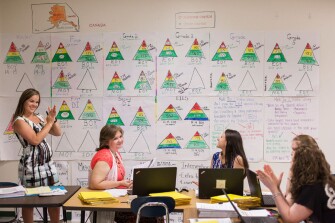
Janna Sells, left, an instructional facilitator at East Iredell Elementary School in Statesville, N.C., celebrates with 2nd grade teachers after discussing data that show that most of 2nd grade students are performing at or above their grade level during a professional learning community meeting at the school.

I photographed them as they met with teachers from several grade levels, and celebrated a successful school year. According to their numbers, 458 students at East Iredell performed below grade level at the beginning of the 2013-2014 school year, but by the end of the 2014-2015 school year that number dropped to 168. The staff seemed at once exhilarated and exhausted by their efforts.

A detail of charts that graph student progress at East Iredell. Data are analyzed thrice yearly at the beginning, middle, and end of the year. Red indicates percentages of students performing well below the grade level, yellow just below grade level, and green at or above grade level.
Folders full of data and personalized intervention plans for every student are stacked at East Iredell.
An intervention specialist at East Iredell, Vikki Stevens, faces an uncertain future herself, as federal monies that fund her position end in June.

But the federal i3 grant that funds Stevens’ role at the school ends June 30th, and so does her job. She’s currently looking to see if she can stay at the school in another role, or move to another district that employs intervention specialists. In Statesville and High Point it was clear that while computing devices and technology may equip our kids for the times, old-fashioned relationships and intervention win their future.

Serenity Estrada, 8, and Brianna Rodriguez, 8, work on problems with instructional facilitator Janna Sells during a 3rd grade math intervention session at East Iredell.
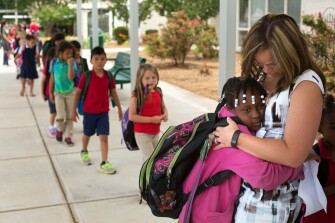
Janna Sells hugs 3rd grade student Shamonica Branch at the end of the school day at East Iredell.

A version of this article first appeared in the Full Frame blog.

Events

Jobs Regional K-12 Virtual Career Fair: DMV
Find teaching jobs and K-12 education jubs at the EdWeek Top School Jobs virtual career fair.
This content is provided by our sponsor. It is not written by and does not necessarily reflect the views of Education Week's editorial staff.
Sponsor
Artificial Intelligence Webinar
Making AI Work in Schools: From Experimentation to Purposeful Practice
AI use is expanding in schools. Learn how district leaders can move from experimentation to coordinated, systemwide impact.
Content provided by Frontline Education
This content is provided by our sponsor. It is not written by and does not necessarily reflect the views of Education Week's editorial staff.
Sponsor
Student Well-Being & Movement Webinar
Building Resilient Students: Leadership Beyond the Classroom
How can schools build resilient, confident students? Join education leaders to explore new strategies for leadership and well-being.
Content provided by IMG Academy

EdWeek Top School Jobs

Teacher Jobs
Search over ten thousand teaching jobs nationwide — elementary, middle, high school and more.
View Jobs
Principal Jobs
Find hundreds of jobs for principals, assistant principals, and other school leadership roles.
View Jobs
Administrator Jobs
Over a thousand district-level jobs: superintendents, directors, more.
View Jobs
Support Staff Jobs
Search thousands of jobs, from paraprofessionals to counselors and more.
View Jobs

Read Next

Education Funding Trump Sidestepped Congress on More Than $1 Billion in Ed. Spending Last Year
Newly published documents show how the Ed. Dept. departed from Congress' plans.
13 min read
The likeness of George Washington is seen on a U.S. one dollar bill, March 13, 2023, in Marple Township, Pa. The nonpartisan Congressional Budget Office says it expects the federal government will be awash in debt over the next 30 years.
Newly published budget documents show the U.S. Department of Education, in the first year of President Donald Trump's second term, took roughly $1 billion Congress appropriated for specific education programs and spent it differently than how lawmakers intended—or didn't spend it all.
Matt Slocum/AP
Education Funding Federal Funds for Schools Will Still Flow Through Ed. Dept. System—For Now
The Trump administration has been touting its transfer of K-12 programs to the Labor Department.
5 min read
Remaining letters on the Department of Education on Wednesday, March 18, 2026, in Washington.
Remaining letters on the U.S. Department of Education building in Washington on Wednesday, March 18, 2026. Despite the agency's efforts to shift management of many of its programs to the U.S. Department of Labor, key K-12 funds will continue to flow through the Education Department's grants system this summer.
Allison Robbert/AP
Education Funding Trump's Budget Proposes Billions in K-12 Cuts. Will They Happen?
Trump is proposing level funding for Title I, a modest boost for special education, and major cuts elsewhere.
6 min read
A third-grade teacher at the Mountain View Elementary School's Global Immersion Academy in Morganton, N.C. works with her students in the Spanish portion of the program. With the inaugural class of the Global Immersion Academy (GIA) at at the school entering fourth grade this year, Burke County Public Schools is seeing more signs of success for its dual language program.
A teacher in a North Carolina dual-language program works with her students. In his latest budget proposal, President Donald Trump once again proposes to eliminate the $890 million fund that pays for supplemental services for English learners. Schools can use Title III funds for costs tied to dual-language programs that educate English learners.
Jason Koon/The News-Herald via AP
Education Funding Trump Again Proposes Major Education Cuts in New Budget Proposal
The president again wants lawmakers to consider billions in K-12 spending cuts and program eliminations.
7 min read
The Senate and the Capitol Dome are illuminated in Washington, early Thursday, April 2, 2026, as Congress meets in a short, pro forma session.
The Senate and the Capitol dome are illuminated in Washington early in the day on Thursday, April 2, 2026. For the second year in a row, the White House budget proposes major cuts to federal education programs that the Republican-led Congress rejected last year.
J. Scott Applewhite/AP
