School Choice & Charters Photo Essay

Nurturing Success at a Los Angeles Charter School

By Education Week Photo Staff — June 28, 2016 2 min read
  • Save to favorites
  • Print

Photographer Patrick Fallon writes about his experiences photographing a charter school in Los Angeles, and how it contrasts with the high school he attended.
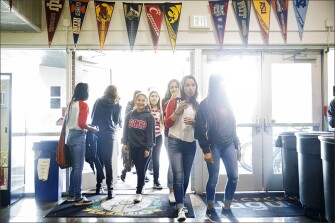
Students arrive for classes at Alliance Collins Family College-Ready High School, a public charter school in Huntington Park, Calif.

On my recent assignment for Education Week that chronicled the 25th anniversary of the charter schools movement, I couldn’t help but think of some of the major contrasts of my own large public high school experience and that of the students at Alliance Collins Family College-Ready High School.

The high school that I graduated from in 2007 – Redondo Union High School in Redondo Beach, Calif. – is a massive beast of a campus. It’s the second-largest in area in California at 56 acres—with over 2,700 students. By comparison, the Alliance charter school that I visited has a population of less than a quarter of that and operates inside a shuttered shoe factory in an industrial part of the Los Angeles area. The downtown skyline looms on the northern horizon.

Just a few miles north of the Alliance Collins Family College-Ready High School, the skyline of downtown Los Angeles stands at sunset as seen from a bridge overlooking the Los Angeles River.

The 100-year-old Redondo campus has views of the Pacific Ocean. It was there where I started working with photography on the school’s yearbook and newspaper staffs, and realized that photographing people and news events could be my job. Friday nights in the fall were spent covering football games and talking to newspaper photographers – some of whom I now work alongside covering events for competing publications.

While some skylights in the campus at Alliance Collins funneled natural light into the hallways, I felt a little starved for natural light and windows as I walked around the school. Going outside for science experiments or meal breaks proved to be a welcome reprieve. Every so often, freight trains rumbled and roared from the tracks that run parallel to the school.

But the lack of natural light and noisy interruptions didn’t detract from the strong intimacy I observed among the students, staff and administrators. While I never felt “lost” at Redondo High, I could easily see how other students there might feel that way. The closer environment of Alliance Collins helps keep everyone connected, focused and more accountable.


Student Krystal Lopez completes a class assignment about Freedom Riders in a U.S. history class at Alliance Collins.
Alberto Esparza and Valerie Flores, right, prepare a lab experiment with teacher Matt Duda, left, during chemistry class.
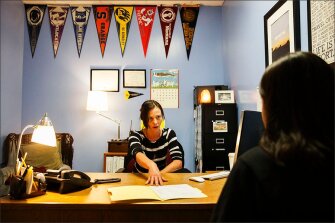
Counselor Lani E. Advokat discusses the college application process with junior Susana Delgadillo.
A poster pays tribute to parents who have become actively involved in their child’s education at Alliance Collins. The school serves mostly low-income, Latino students.

I was most impressed by the high college acceptance rate of the 2016 class at Alliance Collins: Every graduating student was accepted into a 4-year university. There was no shortage of posters and banners supporting students in this quest – a visual representation of how the school creates an environment and an expectation that students will go onto, and be ready for college.

It was this very explicit expectation for success that tied both schools together for me. With the right environment and resources, hopefully the future of all students can be shaped to grow positively in high school and enable them to explore their individual talents.

Related Tags:

A version of this article first appeared in the Full Frame blog.

Events

This content is provided by our sponsor. It is not written by and does not necessarily reflect the views of Education Week's editorial staff.
Sponsor
Artificial Intelligence Webinar
Managing AI in Schools: Practical Strategies for Districts
How should districts govern AI in schools? Learn practical strategies for policies, safety, transparency, and responsible adoption.
Content provided by Lightspeed Systems
This content is provided by our sponsor. It is not written by and does not necessarily reflect the views of Education Week's editorial staff.
Sponsor
Student Absenteeism Webinar
Turning Attendance Data Into Family Action
This California district cut chronic absenteeism in half. Learn how they used insight and early action to reach families and change outcomes.
Content provided by SchoolStatus
This content is provided by our sponsor. It is not written by and does not necessarily reflect the views of Education Week's editorial staff.
Sponsor
College & Workforce Readiness Webinar
Climb: A New Framework for Career Readiness in the Age of AI
Discover practical strategies to redefine career readiness in K–12 and move beyond credentials to develop true capability and character.
Content provided by Pearson

EdWeek Top School Jobs

Teacher Jobs
Search over ten thousand teaching jobs nationwide — elementary, middle, high school and more.
View Jobs
Principal Jobs
Find hundreds of jobs for principals, assistant principals, and other school leadership roles.
View Jobs
Administrator Jobs
Over a thousand district-level jobs: superintendents, directors, more.
View Jobs
Support Staff Jobs
Search thousands of jobs, from paraprofessionals to counselors and more.
View Jobs

Read Next

School Choice & Charters Are Charter Schools the Right Fit for Rural Communities?
Rural charter leaders face challenges growing student enrollment and providing access to services.
6 min read
Gabe Kidner and Lilly Petersen, along with classmates from Highmark Charter School in South Weber, Utah, release small trout that they worked to raise at Adams Reservoir in Layton, Utah, on May 15, 2017.
Students from Highmark Charter School in South Weber, Utah, release small trout that they worked to raise at Adams Reservoir in Layton, Utah, on May 15, 2017. The number of rural states that now allow charter schools has increased significantly over the past 10 years.
Scott G. Winterton/The Deseret News via AP
School Choice & Charters The 3 States That Don't Allow Charter Schools—and Why
Rural states were historically resistant to charter schools, but that has changed in recent years.
7 min read
Robert Hill, Head of School at Alice M. Harte Charter School, talks with students in New Orleans on Dec. 18, 2018. Charter schools, which are publicly funded and privately operated, are often located in urban areas with large back populations, intended as alternatives to struggling city schools.
Robert Hill, Head of School at Alice M. Harte Charter School, talks with students in New Orleans on Dec. 18, 2018. Charter schools tend to be more popular in urban rather than rural areas.
Gerald Herbert/AP
School Choice & Charters Opt In or Not? States Weigh Big Decision on Federal School Vouchers
A new federal program provides tax credits for donations to groups that provide private-school scholarships.
7 min read
Penelope Koutoulas holds signs supporting school choice in a House committee meeting on education during a special session of the state legislature Tuesday, Jan. 28, 2025, in Nashville, Tenn.
Penelope Koutoulas holds signs supporting school choice in a House committee meeting on education during a special session of the state legislature Tuesday, Jan. 28, 2025, in Nashville, Tenn. The One, Big Beautiful Bill Act championed by President Donald Trump includes the first federal school voucher program. States will decide whether to opt in to the offering.
George Walker IV/AP
School Choice & Charters Spotlight Spotlight on The Landscape of Charter Schools
This Spotlight explores the dynamic and evolving world of school choice, focusing on charter schools and private school choice programs.