School Choice & Charters Photo Essay

Nurturing Success at a Los Angeles Charter School

By Education Week Photo Staff — June 28, 2016 2 min read
  • Save to favorites
  • Print

Photographer Patrick Fallon writes about his experiences photographing a charter school in Los Angeles, and how it contrasts with the high school he attended.
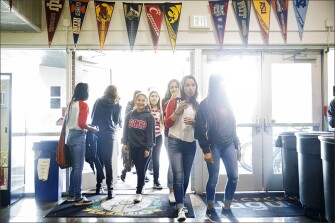
Students arrive for classes at Alliance Collins Family College-Ready High School, a public charter school in Huntington Park, Calif.

On my recent assignment for Education Week that chronicled the 25th anniversary of the charter schools movement, I couldn’t help but think of some of the major contrasts of my own large public high school experience and that of the students at Alliance Collins Family College-Ready High School.

The high school that I graduated from in 2007 – Redondo Union High School in Redondo Beach, Calif. – is a massive beast of a campus. It’s the second-largest in area in California at 56 acres—with over 2,700 students. By comparison, the Alliance charter school that I visited has a population of less than a quarter of that and operates inside a shuttered shoe factory in an industrial part of the Los Angeles area. The downtown skyline looms on the northern horizon.

Just a few miles north of the Alliance Collins Family College-Ready High School, the skyline of downtown Los Angeles stands at sunset as seen from a bridge overlooking the Los Angeles River.

The 100-year-old Redondo campus has views of the Pacific Ocean. It was there where I started working with photography on the school’s yearbook and newspaper staffs, and realized that photographing people and news events could be my job. Friday nights in the fall were spent covering football games and talking to newspaper photographers – some of whom I now work alongside covering events for competing publications.

While some skylights in the campus at Alliance Collins funneled natural light into the hallways, I felt a little starved for natural light and windows as I walked around the school. Going outside for science experiments or meal breaks proved to be a welcome reprieve. Every so often, freight trains rumbled and roared from the tracks that run parallel to the school.

But the lack of natural light and noisy interruptions didn’t detract from the strong intimacy I observed among the students, staff and administrators. While I never felt “lost” at Redondo High, I could easily see how other students there might feel that way. The closer environment of Alliance Collins helps keep everyone connected, focused and more accountable.


Student Krystal Lopez completes a class assignment about Freedom Riders in a U.S. history class at Alliance Collins.
Alberto Esparza and Valerie Flores, right, prepare a lab experiment with teacher Matt Duda, left, during chemistry class.
Counselor Lani E. Advokat discusses the college application process with junior Susana Delgadillo.
A poster pays tribute to parents who have become actively involved in their child’s education at Alliance Collins. The school serves mostly low-income, Latino students.

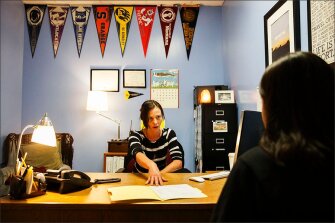
I was most impressed by the high college acceptance rate of the 2016 class at Alliance Collins: Every graduating student was accepted into a 4-year university. There was no shortage of posters and banners supporting students in this quest – a visual representation of how the school creates an environment and an expectation that students will go onto, and be ready for college.

It was this very explicit expectation for success that tied both schools together for me. With the right environment and resources, hopefully the future of all students can be shaped to grow positively in high school and enable them to explore their individual talents.

Related Tags:

A version of this article first appeared in the Full Frame blog.

Events

This content is provided by our sponsor. It is not written by and does not necessarily reflect the views of Education Week's editorial staff.
Sponsor
Artificial Intelligence Webinar
Managing AI in Schools: Practical Strategies for Districts
How should districts govern AI in schools? Learn practical strategies for policies, safety, transparency, and responsible adoption.
Content provided by Lightspeed Systems
This content is provided by our sponsor. It is not written by and does not necessarily reflect the views of Education Week's editorial staff.
Sponsor
Student Absenteeism Webinar
Removing Transportation and Attendance Barriers for Homeless Youth
Join us to see how districts around the country are supporting vulnerable students, including those covered under the McKinney–Vento Act.
Content provided by HopSkipDrive
This content is provided by our sponsor. It is not written by and does not necessarily reflect the views of Education Week's editorial staff.
Sponsor
Reading & Literacy Webinar
Two Jobs, One Classroom: Strengthening Decoding While Teaching Grade-Level Text
Discover practical, research-informed practices that drive real reading growth without sacrificing grade-level learning.
Content provided by EPS Learning

EdWeek Top School Jobs

Teacher Jobs
Search over ten thousand teaching jobs nationwide — elementary, middle, high school and more.
View Jobs
Principal Jobs
Find hundreds of jobs for principals, assistant principals, and other school leadership roles.
View Jobs
Administrator Jobs
Over a thousand district-level jobs: superintendents, directors, more.
View Jobs
Support Staff Jobs
Search thousands of jobs, from paraprofessionals to counselors and more.
View Jobs

Read Next

School Choice & Charters They Said No to the Federal School Choice Program. Now, 3 Dems Are Reconsidering
Advocacy to get Democratic states to participate has ramped up both locally and nationally.
4 min read
Democratic Oregon Gov. Tina Kotek speaks at a news conference in Portland, Ore., on Saturday, Sept. 27, 2025, after Republican President Donald Trump said he would send troops to the city.
Oregon Gov. Tina Kotek, a Democrat, speaks at a news conference in Portland, Ore., on Sept. 27, 2025. Kotek and three other Democratic governors initially said their states wouldn't participate in the first federal private school choice program. Now, three of those governors, including Kotek, are reconsidering their stances and say they haven't made up their minds.
Claire Rush/AP
School Choice & Charters The Nation's Largest School Choice Program Excludes Muslim Schools, Lawsuit Says
The largest state to allow public funds for private schooling faces its first legal challenge.
4 min read
US NEWS TEXAS SCHOOL VOUCHERS DISCRIMINATION LAWSUIT DA
Kelly Hancock, Texas' acting state comptroller, speaks alongside Gov. Greg Abbott in Richland Hills, Texas, on May 17, 2022, when Hancock was a state senator. Hancock has excluded Islamic schools from Texas' new, $1 billion private school choice program, which he now oversees, according to a new lawsuit.
Elias Valverde II/The Dallas Morning News via TNS
School Choice & Charters Video Private School Choice Is Growing. What Comes Next?
States are investing billions of dollars in public funds for families to use on private schooling.
1 min read
School Choice & Charters The Legal Fight Over Private School Choice: Who Is Suing and Why?
Court battles are underway—or recently wrapped up—for programs in at least nine states.
1 min read
Arkansas Gov. Sarah Huckabee Sanders, left, attends a news conference with Tennessee Gov. Bill Lee, right, Tuesday, Nov. 28, 2023, in Nashville, Tenn. Gov. Lee presented the Education Freedom Scholarship Act of 2024, his administration's legislative proposal to establish statewide universal school choice.
Arkansas Gov. Sarah Huckabee Sanders, left, attends a news conference with Tennessee Gov. Bill Lee in Nashville, Tenn. on Nov. 28, 2023. Both Republican governors have championed new programs that let families in their states use public funds for private education. The programs in both states are facing legal challenges.
George Walker IV/AP