

Public schools can meet the requirements of a new Louisiana law that calls for a Ten Commandments poster in every classroom without violating students’ constitutional rights, Attorney General Liz Murrill argued.
The law, signed June 19, has already been challenged in federal court. But supporters of such displays are emboldened by recent U.S. Supreme Court decisions they see as cracking open the door to more religious displays and texts in schools.
Teachers could display the text alongside classroom rules, historical quotes, cartoon jokes, and even quotes from the musical “Hamilton” to add context without promoting a specific religion, Murrill’s office said in a federal court legal brief filled with images of punchy hypothetical examples.
One example includes an internet meme depicting Regina George, a popular high school student from the movie “Mean Girls,” saying: “Why are you so obsessed with me?” with an exasperated look on her face. The still from the film is printed alongside the text of the Ten Commandments and surrounded by headlines from news articles about ACLU lawsuits challenging public displays of the religious text in various communities.
“We believe there are numerous ways that this law can be applied constitutionally and in ways that create really, really powerful teaching moments for students in our schools,” Murrill said at an Aug. 5 press conference surrounded by large printed examples propped up on easels.
Murrill’s brief accompanied a request to dismiss a lawsuit brought by a group of parents, the ACLU, Americans United for Separation of Church and State, and the Freedom From Religion Foundation that argues that mandating the Ten Commandments displays would violate students’ religious liberty.
‘Tell the child not to look at it,’ governor says
“I think we’ve forgotten in this country that democracy actually means majority rules,” Republican Gov. Jeff Landry said at the news conference after a reporter asked him what he would tell parents who are offended by the new legal mandate. “And so what I would say to those parents is that if there are posters in a school and they find them so vulgar, tell the child not to look at it.”
The state’s new law requires all public schools and colleges in the state to display the Ten Commandments in every classroom no later than Jan. 1, 2025. Louisiana officials have agreed not to draft rules under the law until Nov. 15 while courts consider the legal challenge.
Calling Moses, the biblical figure who received the Ten Commandments in scripture, the “original lawmaker,” Murrill argued the biblical laws are relevant to students because they are foundational to U.S. law and history. Some historians have disputed conservatives’ claims about the extent to which protestant Christianity influenced key historical documents.
Here are some examples of suggested classroom posters from the state’s legal brief.
1. Alongside classroom rules
“An elementary school or teacher might use the Commandments as an illustration of rules before laying out the class rules,” the brief said.
2. In a ‘dad joke’
Computer classes could show the text on a “humor-inspired poster,” the brief suggests.
3. With techniques to control stuttering
“For schools and teachers focused on rhetoric, debate, or the study of speech-language pathology, they might use this opportunity to reinforce strategies for overcoming stuttering,” the brief said.
(In the biblical book of Exodus, Moses describes himself as “slow of speech and tongue.”)
4. With a ‘Hamilton’ quote
Arts classrooms may show Charlton Heston’s portrayal of Moses in a 1956 film alongside lyrics from the musical “Hamilton,” the filing said.

5. Paired with the writings of civil rights leaders
A teacher may display the commandments with information about civil rights leaders, the brief said.
“For example, Martin Luther King Jr., who famously required Birmingham campaign volunteers to sign ‘ten commandments of non-violence,’ or Thurgood Marshall, whom the New York Times memorably described as ‘brandishing’ the Constitution as Moses brandished the Ten Commandments.”

6. With a quote from Justice Ruth Bader Ginsburg
History teachers may display the Ten Commandments alongside other historic documents and a quote from the late U.S. Supreme Court Justice Ruth Bader Ginsburg, the filing said.

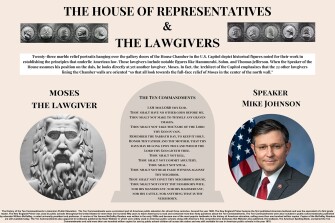
7. Showing the commandments depicted in the U.S. Capitol
Posters “might draw inspiration from the incredible architecture and artwork in the U.S. House of Representatives’ chamber, adding that one of Louisiana’s own congressmen serves as Speaker and looks directly at Moses when presiding from the dais,” said the brief, showing a poster that includes an image of Republican Speaker of the House Mike Johnson.
Legal challenges over church-state issues in schools
Louisiana’s new law comes amid a flood of state actions that test the limits of the church-state divide in public schools, among them a directive from Oklahoma Secretary of Education Ryan Walters that schools put a Bible in every classroom and incorporate it into lessons.
Biblical scholars have questioned the educational purpose of those mandates and suggested they may be difficult for untrained teachers to implement in a way that respects students from all backgrounds.
Lawmakers in Arizona, Georgia, Oklahoma, South Carolina, Utah, and West Virginia have all introduced bills similar to Louisiana’s, but no others have passed, Education Week reported in June.

Parents suing to stop Louisiana’s law, who include nonreligious families and include clergy from a variety of faith backgrounds, have argued the law violates the Supreme Court precedent established in the 1980 case Stone v. Graham. In that decision, the court held that a Kentucky school’s display of the Ten Commandments violated the establishment clause of the First Amendment because the display “had no secular legislative purpose” and was “plainly religious in nature.”
That ruling relied on a test, from the 1971 case of Lemon v. Kurtzman, that says that a statute must have a secular legislative purpose; its primary effect must neither advance nor inhibit religion, and it must not foster an excessive government entanglement with religion.
“There is no evidence that the Framers of the Constitution considered the Ten Commandments to be a basis for either American law or government,” said the plaintiff’s suit, disputing characterizations in the Louisiana bill.
But Murrill’s brief argued that the Stone precedent was no longer applicable because the Supreme Court effectively overruled the so-called “Lemon test” in the 2022 case of Kennedy v. Bremerton School District, which centered on a high school football coach who prayed in the middle of the field after games.
The court has also ruled that students can refuse to say the Pledge of Allegiance in school if they have a religious objection, but it has not said that schools must stop saying the pledge altogether, the brief said.
“As with the Pledge of Allegiance, while students may have a right to opt out of participating in specific lessons, activities, or observances that cause them to violate their faith, they do not have a right to remove content from the curriculum (or the classroom wall) because the presence allegedly offends them,” it said.


