States

Legislative Update

March 21, 2001 4 min read
  • Save to favorites
  • Print

The following is a summary of governors’ education proposals for fiscal 2002. The figures for the state budget and for precollegiate education spending include money for state education administration, but not federal, flow-through dollars. Percentage increases are based on rounded numbers, and estimated enrollment reflects the state’s projected public school enrollment for 2001-02, unless otherwise noted. Depending on the state, figures may or may not include prekindergarten spending and enrollment.

Florida | New Hampshire | North Carolina | Rhode Island | Wisconsin

FLORIDA

Governor: Jeb Bush (R)
Proposed FY 2002 state budget:
$ 51.2 billion
Proposed FY 2002 K-12 budget:
$7.80 billion
FY 2001 K-12 budget:
$7.79 billion
Proposed percent change K-12 budget:
+0.1 percent
Estimated K-12 enrollment:
2.4 million

Highlights:

Gov. Jeb Bush

  • Governor’s K-12 budget proposal does not include approximately $175 million in expected savings from Florida Retirement System that are slated to be passed on to school districts.
  • Proposed budget includes a new $50 million fund devoted to teacher recruitment and retention that would provide $1,000 signing bonuses for first- time teachers. Bonuses could be matched by contributions from local districts to potentially increase their value.
  • Mr. Bush’s budget also includes $11 million in new funding for professional-development program designed to give teachers effective strategies for reading instruction; that money would provide training for 10,000 teachers in grades K-3.

NEW HAMPSHIRE

Governor: Jeanne Shaheen (D)
Proposed FY 2002 state budget:
$2.9 billion
Proposed FY 2001 K-12 budget:
$950 million
FY 2002 K-12 budget:
$901 million
Proposed percent change K-12 budget:
+5.4 percent
Estimated K-12 enrollment:
208,000

Highlights:

  • Proposed K-12 budget figures are for first year of governor’s biennial budget. Increase does not account for an $18 million education trust, previously included in state education department funds, that is now set aside elsewhere in budget.

  • Governor has separately proposed a new school funding system to solve state’s long-running school finance problems. That plan also would set performance standards for schools, hold schools accountable for meeting those new goals, and provide money for schools having trouble.

  • Ms. Shaheen also wants $6 million over two years to strengthen literacy instruction in kindergarten through 3rd grade and additional money to expand health insurance for low-income children to every eligible child through a public-private matching-grant program.

  • State university system would get 5 percent increase under proposed budget, which would also set aside $1 million in scholarships for high- performing high school graduates to attend in-state colleges and universities.


NORTH CAROLINA

Governor: Michael F. Easley (D)
Proposed FY 2002 state budget:
$26.3 billion
Proposed FY 2002 K-12 budget:
$6.7 billion
FY 2001 K-12 budget:
$6.5 billion
Proposed percent change K-12 budget:
+3.1 percent
Estimated K-12 enrollment:
1.3 million

Highlights:
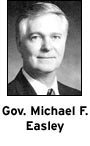
Gov. Michael F. Easley

  • In his first biennial budget proposal, Gov. Easley has proposed $72 million to pay for 2 percent salary increase for teachers.
  • Making good on his campaign promise, Mr. Easley has proposed setting aside $49.6 million to lower class sizes in elementary schools.
  • Nearly $5 million would go toward recruiting teachers to help curb state’s growing teacher shortage.

RHODE ISLAND

Governor: Lincoln Almond (R)
Proposed FY 2002 state budget:
$2.6 billion
Proposed FY 2002 K-12 budget: $706 million
FY 2001 K-12 budget:
$664 million
Proposed percent change K-12 budget:
+6.3 percent
Estimated K-12 enrollment:
159,000

Highlights:

Gov. Lincoln Almond

  • To help address state’s long-standing equity debate, governor proposes new way to give aid to local districts. For fiscal 2002, new formula would guarantee each district at least what it received for fiscal 2001, then distribute another $26.3 million across state based on districts’ enrollment, concentration of poverty, and local tax burden.

  • Overall 5.6 percent increase in total aid to local districts in governor’s plan still falls short of 7.5 percent total increase recommended last fall by task force Mr. Almond appointed to study equity issue.

  • Governor recommends increase, from $2.4 million to $3.1 million, in state aid available to help districts add all-day kindergarten programs.


WISCONSIN

Governor: Scott McCallum (R)
Proposed FY 2002 state budget:
$17.62 billion
Proposed FY 2002 K-12 budget:
$7.66 billion
FY 2001 K-12 budget:
$ 7.40 billion
Proposed percent change K-12 budget:
+3.5 percent
Estimated K-12 enrollment:
880,000

Highlights:

  • Governor’s proposal reflects first year of biennial budget that calls for modifying per-pupil spending formula for special education students to shift more of cost of educating such students from school districts to state. Under plan, state special education spending would rise from $319 million to $329 million in coming fiscal year.
  • Gov. McCallum also recommends expanding a class-size-reduction program in high-poverty schools to include more grades; funding would rise from $58 million in fiscal 2001 to $65 million in fiscal 2002.
  • Governor proposes increasing spending for testing development and administration, from $6 million to $11 million, in coming fiscal year.

Related Tags:

A version of this article appeared in the March 21, 2001 edition of Education Week as Legislative Update

Events

This content is provided by our sponsor. It is not written by and does not necessarily reflect the views of Education Week's editorial staff.
Sponsor
College & Workforce Readiness Webinar
Smarter Tools, Stronger Outcomes: Empowering CTE Educators With Future-Ready Solutions
Open doors to meaningful, hands-on careers with research-backed insights, ideas, and examples of successful CTE programs.
Content provided by Pearson
This content is provided by our sponsor. It is not written by and does not necessarily reflect the views of Education Week's editorial staff.
Sponsor
Professional Development Webinar
Recalibrating PLCs for Student Growth in the New Year
Get advice from K-12 leaders on resetting your PLCs for spring by utilizing winter assessment data and aligning PLC work with MTSS cycles.
Content provided by Otus
School Climate & Safety Webinar Strategies for Improving School Climate and Safety
Discover strategies that K-12 districts have utilized inside and outside the classroom to establish a positive school climate.

EdWeek Top School Jobs

Teacher Jobs
Search over ten thousand teaching jobs nationwide — elementary, middle, high school and more.
View Jobs
Principal Jobs
Find hundreds of jobs for principals, assistant principals, and other school leadership roles.
View Jobs
Administrator Jobs
Over a thousand district-level jobs: superintendents, directors, more.
View Jobs
Support Staff Jobs
Search thousands of jobs, from paraprofessionals to counselors and more.
View Jobs

Read Next

States States Are Banning Book Bans. Will It Work?
Approved legislation aims to stop school libraries from removing books for partisan reasons.
5 min read
Amanda Darrow, director of youth, family and education programs at the Utah Pride Center, poses with books that have been the subject of complaints from parents in Salt Lake City on Dec. 16, 2021. The wave of attempted book banning and restrictions continues to intensify, the American Library Association reported Friday. Numbers for 2022 already approach last year's totals, which were the highest in decades.
Eight states have passed legislation restricting school officials from pulling books out of school libraries for partisan or ideological reasons. In the past five years, many such challenges have focused on books about race or LGBTQ+ people. Amanda Darrow, the director of youth, family and education programs at the Utah Pride Center, poses with books that have been the subject of complaints from parents in Salt Lake City on Dec. 16, 2021. (Utah is not one of the eight states.)
Rick Bowmer/AP
States McMahon Touts Funding Flexibility for Iowa That Falls Short of Trump Admin. Goal
The Ed. Dept. is allowing the state education agency to consolidate small sets of funds from four grants.
6 min read
U.S. Secretary of Education Linda McMahon is interviewed by Indiana’s Secretary of Education Katie Jenner during the 2025 Reagan Institute Summit on Education in Washington, D.C., on Sept. 18, 2025.
U.S. Secretary of Education Linda McMahon, pictured here in Washington on Sept. 18, 2025, has granted Iowa a partial waiver from provisions of the Every Student Succeeds Act, saying the move is a step toward the Trump administration's goal of "returning education to the states." The waiver allows Iowa some additional flexibility in how it spends the limited portion of federal education funds used by the state department of education.
Leah Millis for Education Week
States Zohran Mamdani Picks Manhattan Superintendent as NYC Schools Chancellor
Kamar Samuels is a veteran educator of the nation's largest school system.
Cayla Bamberger & Chris Sommerfeldt, New York Daily News
2 min read
Zohran Mamdani speaks during a victory speech at a mayoral election night watch party on Nov. 4, 2025, in New York.
Zohran Mamdani speaks during a victory speech at a mayoral election night watch party on Nov. 4, 2025, in New York. The new mayor named a former teacher and principal and current superintendent as chancellor of the city’s public schools.
Yuki Iwamura/AP
States Undocumented Students Still Have a Right to Education. Will That Change in 2026?
State-level challenges to a landmark 1982 Supreme Court ruling are on the rise.
5 min read
Demonstrators hold up signs protesting an immigration bill as it is discussed in the Senate chamber at the state Capitol Thursday in Nashville, Tenn. The bill would allow public school systems in Tennessee to require K-12 students without legal status in the country to pay tuition or face denial of enrollment, which is a challenge to the federal law requiring all children be provided a free public education regardless of legal immigration status.
Demonstrators hold up signs protesting an immigration bill as it was discussed in the Senate chamber at the state Capitol in Nashville, Tenn., on April 10, 2025. The bill, which legislators paused, would have allowed schools in the state to require undocumented students to pay tuition. It was one of six efforts taken by states in 2025 to limit undocumented students' access to free, public education.
John Amis/AP
