Law & Courts

High Court Refuses Case on Parent’s Criticism of District Leader

By Mark Walsh — May 15, 2008 1 min read
  • Save to favorites
  • Print

The U.S. Supreme Court declined last week to hear the appeal of an Ohio superintendent in a lawsuit brought by a parent who says she faced retaliation for publicly criticizing the school district’s treatment of her daughter, who has diabetes.

The court’s refusal without comment to hear the appeal in Evans v. Jenkins (Case No. 07-1210) means that the parent’s suit will go forward on a First Amendment retaliation claim.

A three-judge panel of the U.S. Court of Appeals for the 6th Circuit, in Cincinnati, had ruled unanimously in January for reinstating the First Amendment claim brought by Shara Jenkins against Lloyd Evans, the superintendent of the Rock Hill district in Ironton, Ohio, and the 1,780-student district itself. The appeals court said Ms. Jenkins may have a valid claim that the superintendent had retaliated against her for public criticisms she made that were protected by the First Amendment. The appeals court upheld the dismissal of certain other claims in the suit.

The case arose out of a dispute over whether a school nurse would administer insulin shots to Ms. Jenkins’ daughter and an allegation from the mother that the superintendent had tried to bar the student from the school. Ms. Jenkins wrote a letter to a local newspaper criticizing her daughter’s school, and she filed a complaint with the U.S. Department of Education’s office for civil rights, according to court papers. After that, her suit contends, someone in the district filed a complaint about Ms. Jenkins with the local children’s-services agency.

In an appeal of the 6th Circuit decision, lawyers for the superintendent sought to convince the Supreme Court that there was a split among the federal circuit courts over whether a parent’s criticism of public school officials must be on a matter of public concern for it to be considered speech protected by the First Amendment.

See Also

For more stories on this topic see Law and Courts.

Providing parents with constitutional protection for “purely private” complaints “greatly interferes with a public school’s ability to operate efficiently and effectively,” Mr. Evans’ appeal argued.

The Supreme Court’s refusal to hear the appeal is not a decision on the merits of the case, but it does mean that Ms. Jenkins will be able to pursue the First Amendment claim at the trial-court level.

A version of this article appeared in the May 21, 2008 edition of Education Week

Events

EdWeek Top School Jobs

Teacher Jobs
Search over ten thousand teaching jobs nationwide — elementary, middle, high school and more.
View Jobs
Principal Jobs
Find hundreds of jobs for principals, assistant principals, and other school leadership roles.
View Jobs
Administrator Jobs
Over a thousand district-level jobs: superintendents, directors, more.
View Jobs
Support Staff Jobs
Search thousands of jobs, from paraprofessionals to counselors and more.
View Jobs

Read Next

Law & Courts What Schools Need to Know About the Supreme Court’s Transgender Sports Ruling
The justices upheld two state laws that bar transgender girls from participating in female sports.
10 min read
A group prays outside of the Supreme Court ahead of the court's ruling on whether transgender girls and women can play on school athletic teams, on June 30, 2026, on Capitol Hill in Washington.
A group prays outside of the U.S. Supreme Court ahead of the court's ruling on whether transgender girls and women can play on school athletic teams, on June 30, 2026, in Washington. The court upheld two state laws barring transgender girls from joining girls' school sports teams.
Jose Luis Magana/AP
Law & Courts Judges Strike Down Trump Admin.'s Student Loan Forgiveness Overhaul
Two judges sided with advocates who said the program risked becoming a tool for political retribution.
3 min read
In this May 5, 2018, file photo, graduates at the University of Toledo commencement ceremony in Toledo, Ohio.
Graduates at the University of Toledo commencement ceremony in Toledo, Ohio, on May 5, 2018. Two judges have ruled against the Trump administration's overhaul of a public service loan forgiveness program for which teachers have qualified.
Carlos Osorio/AP
Law & Courts Supreme Court Upholds Birthright Citizenship, Rejecting Trump's Proposed Limits
The justices relied on the 14th Amendment and federal law to rule that anyone born in the U.S. is a citizen.
4 min read
Members of the Supreme Court sit for a group portrait in Washington, Oct. 7, 2022. Bottom row, from left, Justice Sonia Sotomayor, Justice Clarence Thomas, Chief Justice John Roberts, Justice Samuel Alito and Justice Elena Kagan. Top row, from left, Justice Amy Coney Barrett, Justice Neil Gorsuch, Justice Brett Kavanaugh, and Justice Ketanji Brown Jackson. The Supreme Court justices will take the bench Monday, July 1, 2024, to release their last few opinions of the term, including their most closely watched case: whether former President Donald Trump has immunity from criminal prosecution.
Members of the Supreme Court sit for a group portrait in Washington, Oct. 7, 2022. Bottom row, from left, Justice Sonia Sotomayor, Justice Clarence Thomas, Chief Justice John Roberts, Justice Samuel Alito, and Justice Elena Kagan. Top row, from left, Justice Amy Coney Barrett, Justice Neil Gorsuch, Justice Brett Kavanaugh, and Justice Ketanji Brown Jackson. The high court, on June 30, 2026, rejected President Donald Trump's executive order on birthright citizenship.
J. Scott Applewhite/AP
Law & Courts States Can Ban Transgender Athletes, Supreme Court Decides
The court ruled that state bans in Idaho and West Virginia don’t violate the Constitution or Title IX.
3 min read
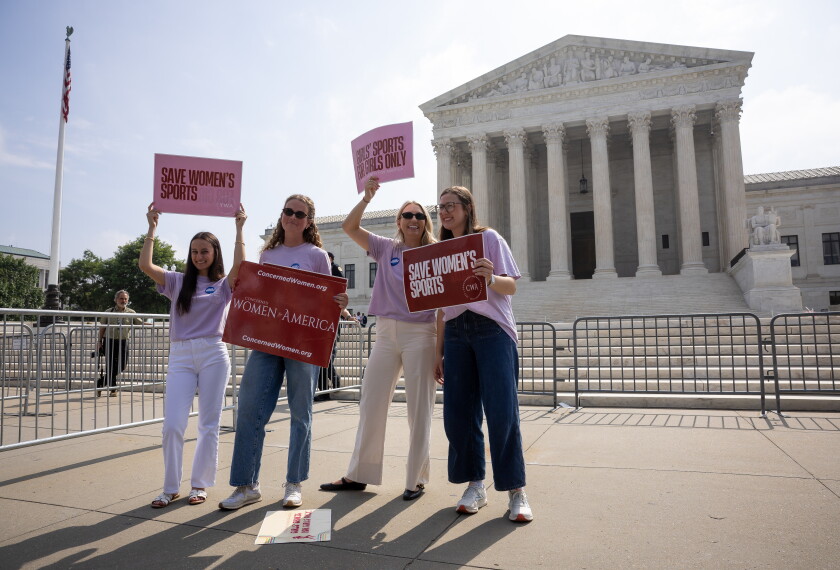
People advocate for a ban on transgender women and girls participating in women's and girls' sports outside the U.S. Supreme Court building as the court announced decisions in Washington, on June 29, 2026.
People advocate for a ban on transgender women and girls participating in women's and girls' sports outside the U.S. Supreme Court building as the court announced decisions in Washington, on June 29, 2026. The Supreme Court ruled on June 30, 2026, that states may enforce laws restricting transgender athletes’ participation on girls’ and women’s sports teams.
Francis Chung/Politico via AP