Law & Courts

High Court Declines Challenge to District Policy Protecting Transgender Students

By Mark Walsh — December 15, 2020 2 min read
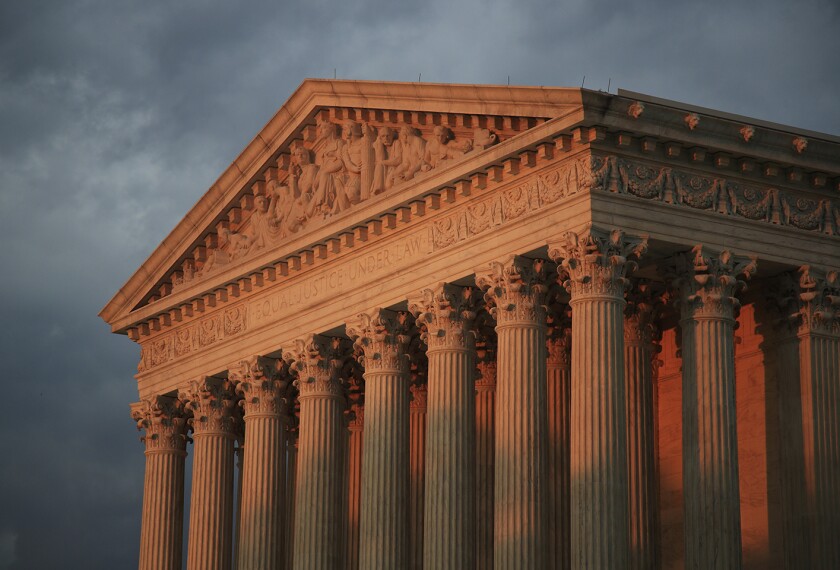
This Oct. 4, 2018, photo shows the U.S. Supreme Court at sunset in Washington. The Supreme Court has declined to take up an appeal from parents in Oregon who want to prevent transgender students from using locker rooms and bathrooms matching their gender identity.
  • Save to favorites
  • Print

The U.S. Supreme Court has declined to take up the appeal of a group of parents and students who objected to an Oregon school district’s policy of allowing transgender students to use restrooms, locker rooms, and showers matching their gender identity.

The challengers sued over the policy of the 3,000-student Dallas, Ore., school district, which adopted its student safety plan after a student at Dallas High School who was born biologically female began identifying as male in 2015. The plan allowed the student to use facilities matching his gender identity and included training for staff and lessons for students against bullying and harassment.

The parents and students objected to the policy as a form of sex discrimination that violated Title IX of the Education Amendments of 1972, as well arguing that their parental and privacy rights were infringed.

Both a federal district court and a panel of the U.S. Court of Appeals for the 9th Circuit, in San Francisco, upheld the school district’s policy.

“We ... hold that a policy that treats all students equally does not discriminate based on sex in violation of Title IX, and that the normal use of privacy facilities does not constitute actionable sexual harassment under Title IX just because a person is transgender,” the 9th Circuit panel ruled in February. “We hold further that the Fourteenth Amendment does not provide a fundamental parental right to determine the bathroom policies of the public schools to which parents may send their children.”

In their appeal of that ruling in Parents for Privacy v. Barr (Case No. 20-62), the parents and students (and two parental organizations) said the district’s policy “interferes with parents’ rights to direct the upbringing of their children, schoolchildren’s rights to bodily privacy, parents’ and children’s rights to free exercise of religion, and children’s rights to be free from hostile educational environments under Title IX.”

The appeal also said the case would give the justices the chance to address questions left unanswered in their June decision in Bostock v. Clayton County, Ga., which held that transgender employees were protected by federal anti-discrimination law.

The Dallas district, in a brief urging the high court not to hear the case, pointed out that the transgender boy who inspired the policy used facilities corresponding to his gender identity without incident before graduating.

The challengers “are not using Title IX to ensure that they have equal access to bathrooms and locker rooms as compared to members outside their protected class. Rather, they are trying to use Title IX to take away something which the school district granted the transgender boy to ensure that he was not denied equal access to bathrooms or locker rooms just because his gender did not match the gender typically associated with his sex at birth.”

The justices on Dec. 7 declined without comment to hear the parents’ and students’ appeal.

Events

This content is provided by our sponsor. It is not written by and does not necessarily reflect the views of Education Week's editorial staff.
Sponsor
Teaching Webinar
Closing the Practice Gap: Essential Insights for Leaders
Three instructional experts will share strategies for making students’ reading and math practice more engaging and impactful this year.
Content provided by Renaissance
This content is provided by our sponsor. It is not written by and does not necessarily reflect the views of Education Week's editorial staff.
Sponsor
Student Absenteeism Webinar
Attendance Isn't an Attendance Problem
Boost attendance by strengthening relationships, belonging, and support with practical strategies from Doug Fisher & Nancy Frey.
Content provided by Corwin
This content is provided by our sponsor. It is not written by and does not necessarily reflect the views of Education Week's editorial staff.
Sponsor
School & District Management Webinar
The Principal's Role in Collective Efficacy and Student Outcomes
Learn practical strategies that help principals translate their confidence into stronger collective teacher efficacy and student outcomes.
Content provided by Otus

EdWeek Top School Jobs

Teacher Jobs
Search over ten thousand teaching jobs nationwide — elementary, middle, high school and more.
View Jobs
Principal Jobs
Find hundreds of jobs for principals, assistant principals, and other school leadership roles.
View Jobs
Administrator Jobs
Over a thousand district-level jobs: superintendents, directors, more.
View Jobs
Support Staff Jobs
Search thousands of jobs, from paraprofessionals to counselors and more.
View Jobs

Read Next

Law & Courts Wisconsin's Appeals Court Overturns Ruling That Had Restored Collective Bargaining Power
Unions are expected to appeal, sending the case to the Wisconsin Supreme Court, which is controlled by liberal justices.
4 min read
FILE - A crowd fills the Wisconsin Capitol rotunda on the fifth day of labor demonstrations, Feb. 16, 2011, in Madison, Wis. Thousands came to protest the governor's proposal to eliminate collective bargaining for most public workers. Seven unions representing teachers and other public workers in Wisconsin filed a lawsuit Thursday, Nov. 30, 2023, attempting to end the state's near-total ban on collective bargaining for most public employees.
A crowd protesting legislation to significantly curb collective bargaining in Wisconsin fills the state Capitol rotunda on the fifth day of labor demonstrations on Feb. 16, 2011, in Madison, Wis. The proposal passed and has been in place for 15 years, and a lawsuit seeking to end it is now headed to the state's high court.
Craig Schreiner/Wisconsin State Journal via AP
Law & Courts What Schools Need to Know About the Supreme Court’s Transgender Sports Ruling
The justices upheld two state laws that bar transgender girls from participating in female sports.
10 min read
A group prays outside of the Supreme Court ahead of the court's ruling on whether transgender girls and women can play on school athletic teams, on June 30, 2026, on Capitol Hill in Washington.
A group prays outside of the U.S. Supreme Court ahead of the court's ruling on whether transgender girls and women can play on school athletic teams, on June 30, 2026, in Washington. The court upheld two state laws barring transgender girls from joining girls' school sports teams.
Jose Luis Magana/AP
Law & Courts Judge Voids Trump Admin. Rule Excluding Education From ‘Professional’ Degrees
A judge ruled the agency didn't have the authority to adopt such a narrow definition.
4 min read
Graduates in the School of Education hold up books as their degrees are conferred during Harvard's 371st Commencement, on May 26, 2022, in Cambridge, Mass.
Graduates in the School of Education hold up books during Harvard's 371st Commencement on May 26, 2022, in Cambridge, Mass. The Trump administration excluded education fields when it set a definition of "professional" degree to implement a new law instituting graduate student borrowing limits.
Mary Schwalm/AP
Law & Courts Opinion How State Courts Are Quietly Shaping U.S. Education
In education, the real action is often at the state level, not in Washington, explains Derek Black.
8 min read
The United States Capitol building as a bookcase filled with red, white, and blue policy books in a Washington DC landscape.
Luca D'Urbino for Education Week
