Education Funding

Equity Advocates Hit the Highway

By Laura Greifner — August 13, 2007 1 min read
  • Save to favorites
  • Print

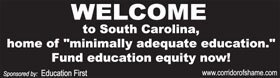
Forget “Smiling faces, beautiful places.” Billboards in South Carolina sported a new—if unofficial—slogan throughout much of the summer: “Welcome to South Carolina, home of ‘minimally adequate education.’ ”

Two billboards, along Interstate 95 and near the intersection of Interstate 26, in the southeastern part of the state, were posted as part of a campaign by Education First, a business-oriented coalition that is pressuring lawmakers on the issue of equity in school spending.
BRIC ARCHIVE

South Carolina is among the states wrestling with the issue. The phrase “minimally adequate education” stems from a 1999 state supreme court decision in the case of Abbeville v. South Carolina, requiring the legislature to provide for such an education—without defining it.

After the case was sent back to the state circuit court in Lee County, a judge ruled in 2005 that the state was, in fact, providing “the opportunity for each child to receive a minimally adequate education,” except for early-childhood education. (“S.C. Judge Tells State to Do More for Young Children,” Jan. 11, 2006.)

On July 12, the judge declined to revisit that decision—four days before the billboards were raised.

“The legislature has continued to be unhelpful to rural schools” in 2007, said Charles T. “Bud” Ferillo Jr., a coordinator of the campaign and a Columbia-based public relations executive. “Education First is trying to bring attention in the population of South Carolina for, ultimately, a legislative solution.”

Asked for Republican Gov. Mark Sanford’s comment, a member of his staff pointed to gubernatorial spokesman Joel Sawyer’s recent statements in the South Carolina newspaper The State.

“They’re devoting energy to billboards rather than substantive education reforms,” Mr. Sawyer told the newspaper.

The two billboards together cost about $3,900 for a 30-day display and were to remain up until about the middle of this month. Mr. Ferillo said that Education First hopes that grassroots contributions will allow the billboards to be displayed for the 2008 legislative session or the election season.

See Also

See other stories on education issues in South Carolina, along with data on South Carolina’s public school system.

A version of this article appeared in the August 15, 2007 edition of Education Week

Events

This content is provided by our sponsor. It is not written by and does not necessarily reflect the views of Education Week's editorial staff.
Sponsor
College & Workforce Readiness Webinar
From Exposure to Experience: Designing Accessible Work-Based Learning
Learn how schools can create meaningful experiences that help every student build skills, connections, and a clearer path to their future.
Content provided by Project Lead The Way
This content is provided by our sponsor. It is not written by and does not necessarily reflect the views of Education Week's editorial staff.
Sponsor
School & District Management Webinar
A Tale of Two School Districts: Forecasting Enrollment
Forecasting enrollment is hard. Here’s how two different districts are navigating times of change with data that considers the whole picture.
Content provided by Zonda Education
Reading & Literacy K-12 Essentials Forum Strategies to Create a Culture of Reading in Schools
Join this free virtual event to learn how teachers and school district leaders ensure students are reading enough.

EdWeek Top School Jobs

Teacher Jobs
Search over ten thousand teaching jobs nationwide — elementary, middle, high school and more.
View Jobs
Principal Jobs
Find hundreds of jobs for principals, assistant principals, and other school leadership roles.
View Jobs
Administrator Jobs
Over a thousand district-level jobs: superintendents, directors, more.
View Jobs
Support Staff Jobs
Search thousands of jobs, from paraprofessionals to counselors and more.
View Jobs

Read Next

Education Funding School Funding at the Heart of Massive Protests in France
Secondary students have called out dilapidated buildings, a lack of air conditioning, and inequities across schools.
4 min read
A police officer chases a protester during scuffles following a demonstration against under-resourced schools, in Paris, Tuesday, Oct. 6, 2026.
Teresa Suarez/AP
Education Funding Opinion An Expert Explains How the Federal Scholarship Tax Credit Will Work
A former Ed. Dept. official predicts the program will generate $3 billion for scholarships in 2027.
•
9 min read
The United States Capitol building as a bookcase filled with red, white, and blue policy books in a Washington DC landscape.
Luca D'Urbino for Education Week
Education Funding Ed. Dept. Meets Research Spending Deadline—But Bigger Funding Challenges Loom
The Institute of Education Sciences finished spending more than $170 million set to expire Sept. 30.
3 min read
Director of the United States Office of Management and Budget Russell Vought walks down a staircase on Capitol Hill in Washington, Thursday, July 16, 2026.
Russell Vought, director of the White House Office of Management and Budget, walks down a staircase on Capitol Hill in Washington on July 16, 2026. The OMB withheld millions of dollars from the U.S. Department of Education's research arm for months, raising the possibility it wouldn't spend the money on education research and data collection in time for its Sept. 30, 2026, expiration.
Allison Robbert/AP
Education Funding Trump's Ed. Dept. Is Still Disrupting Grants—Just More Quietly Than Before
The agency is deploying subtler procedures that result in fewer new grants and less stability for recipients.
11 min read
Senate Minority Leader Chuck Schumer, D-N.Y., center, confers with Sen. Brian Schatz, D-Hawaii, talk following a Senate Democratic Caucus meeting, at the Capitol in Washington, Tuesday, Feb. 3, 2026.
Sen. Brian Schatz, D-Hawaii, (right, speaking with Senate Democratic Leader Chuck Schumer) secured a commitment from Education Secretary Linda McMahon to supply additional funding for Native Hawaiian Education Program grantees when the U.S. Department of Education hadn't launched a competition for new grants. The Trump administration practice of abruptly canceling existing competitive education grants has slowed, but the Education Department is using procedures that result in fewer new grants and less stability for funding recipients.
J. Scott Applewhite/AP