Blog

Your Education Road Map

Politics K-12

Politics K-12 kept watch on education policy and politics in the nation’s capital and in the states. This blog is no longer being updated, but you can continue to explore these issues on edweek.org by visiting our related topic pages: Federal, States.

Federal

Education Department Details New Survey to Explore COVID-19’s Effects on Students

By Evie Blad — February 05, 2021 2 min read
Image of coronavirus and data.
  • Save to favorites
  • Print

A first-of-its-kind federal data collection will provide monthly updates on how many students are attending school in-person and other indicators related to education during the COVID-19 pandemic, the U.S. Department of Education announced Friday.

The survey results will be reported monthly and later analyzed alongside students’ scores on the 2022 National Assessment of Educational Progress to track the academic effects of the pandemic, the agency said.

The data collection, made in response to an executive order from President Joe Biden, will also help track his goal of reopening “a majority of K-8 schools” within the first 100 days of his administration.

See Also

Public School 95 in the Gravesend section of Brooklyn is one of many schools in New York ordered to close due to a flare-up of coronavirus cases in the area on Oct. 5, 2020.
Kathy Willens/AP
Federal Biden Launches New Strategy to Combat COVID-19, Reopen Schools
Evie Blad, January 21, 2021
5 min read

Notably, the data will not be pulled from every school in the country, and it is not likely to include many high schools. Rather the survey will collect “high-quality data from a nationally and state-representative sample” of 3,500 schools that enroll 4th-graders and 3,500 schools that enroll 8th-graders, the agency said in a news release.

“President Biden is committed to the safe reopening of schools and to addressing the educational disparities and inequities that the pandemic has exposed and exacerbated,” said a statement from Ian Rosenblum, acting assistant secretary of the 0ffice of elementary and secondary education. “To do that, we need more information about how students are learning during this pandemic — and we simply don’t have it right now.”

Private organizations and and academic researchers who’ve collected data on the pandemic’s effects on schools have identified a lack of an official federal survey on the issue as a key shortcoming. The data can be used to track the effectiveness of local efforts and to target resources to deal with the fallout from the crisis for years to come, they’ve said.

Former U.S. Secretary of Education Betsy DeVos said in October that she didn’t believe it was her agency’s role to collect such data, which some education groups called “a missed opportunity.”

School administrators have stressed that any new data collection shouldn’t be too cumbersome and that the results should have a known purpose, like directing new resources to support students.

The data collection will not be as extensive as some had hoped. A summary of included data points released by the Education Department notably does not include school-linked cases of COVID-19, for example.

Among the data the survey will collect:

  • Whether schools are open with full-time in-person instruction, with a hybrid of online and in-person instruction, or fully remote.
  • Enrollment by instructional mode by race and ethnicity, socioeconomic status, English-learner status, and disability status.
  • Attendance rates by instructional mode by race and ethnicity, socioeconomic status, English-learner status, disability status, and housing status.
  • Frequency of in-person learning for students in a given school.
  • Average number of hours of synchronous instruction for students in remote instruction.
  • Student groups prioritized by schools for in-person instruction. For example, some schools have sought to return the youngest students and those with disabilities for in-person instruction first.

The data will be reported monthly using the existing infrastructure from the NAEP data collection starting this month, the Education Department said, and it plans to report “key findings” to the public.

A version of this news article first appeared in the Politics K-12 blog.

Events

This content is provided by our sponsor. It is not written by and does not necessarily reflect the views of Education Week's editorial staff.
Sponsor
Artificial Intelligence Webinar
Managing AI in Schools: Practical Strategies for Districts
How should districts govern AI in schools? Learn practical strategies for policies, safety, transparency, and responsible adoption.
Content provided by Lightspeed Systems
Jobs Virtual Career Fair for Teachers and K-12 Staff
Find teaching jobs and K-12 education jubs at the EdWeek Top School Jobs virtual career fair.
This content is provided by our sponsor. It is not written by and does not necessarily reflect the views of Education Week's editorial staff.
Sponsor
Student Absenteeism Webinar
Turning Attendance Data Into Family Action
This California district cut chronic absenteeism in half. Learn how they used insight and early action to reach families and change outcomes.
Content provided by SchoolStatus

EdWeek Top School Jobs

Teacher Jobs
Search over ten thousand teaching jobs nationwide — elementary, middle, high school and more.
View Jobs
Principal Jobs
Find hundreds of jobs for principals, assistant principals, and other school leadership roles.
View Jobs
Administrator Jobs
Over a thousand district-level jobs: superintendents, directors, more.
View Jobs
Support Staff Jobs
Search thousands of jobs, from paraprofessionals to counselors and more.
View Jobs

Read Next

Federal Ed. Dept. Hangs Banner of Charlie Kirk Alongside MLK Jr., Ben Franklin
It's part of a celebration of the nation's 250th anniversary.
1 min read
New banners of Booker T. Washington, Catharine Beecher and Charlie Kirk hang from the Department of Education, Sunday, March 1, 2026, in Washington.
New banners of Booker T. Washington, Catharine Beecher, and Charlie Kirk hang from the U.S. Department of Education on March 1, 2026, in Washington.
Allison Robbert/AP
Federal Ed. Dept. Wants to Revamp Assistance Program It Calls 'Duplicative,' 'Confusing'
The department's Comprehensive Centers have already been through a year of shakeups.
3 min read
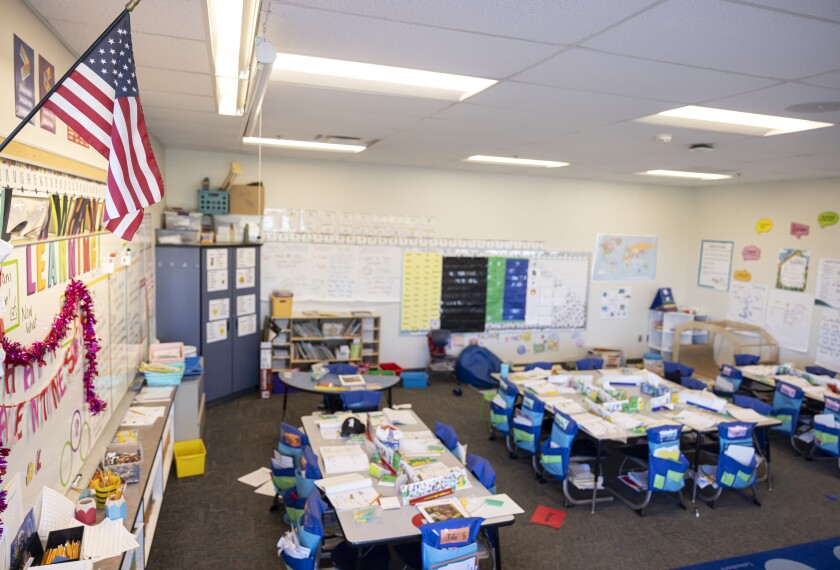
A first grade classroom at a school in Colorado Springs, on Feb. 12, 2026.
A 1st grade classroom at a school in Colorado Springs, Colo., on Feb. 12, 2026. The U.S. Department of Education released a proposal to rework a decades-old program charged with helping states and school districts problem-solve and deploy new initiatives, calling the current structure “duplicative” and “confusing.”
Kevin Mohatt for Education Week
Federal Will the Ed. Dept. Act on Recommendations to Overhaul Its Research Arm?
An adviser's report called for more coherence and sped-up research awards at the Institute of Education Sciences.
6 min read
The U.S. Department of Education building is pictured on Oct. 24, 2025, in Washington, D.C.
The U.S. Department of Education building in Washington is pictured on Oct. 24, 2025. A new report from a department adviser calls for major overhauls to the agency's research arm to facilitate timely research and easier-to-use guides for educators and state leaders.
Maansi Srivastava for Education Week
Federal Trump Talks Up AI in State of the Union, But Not Much Else About Education
The president didn't mention two of his cornerstone education policies from the past year.
4 min read
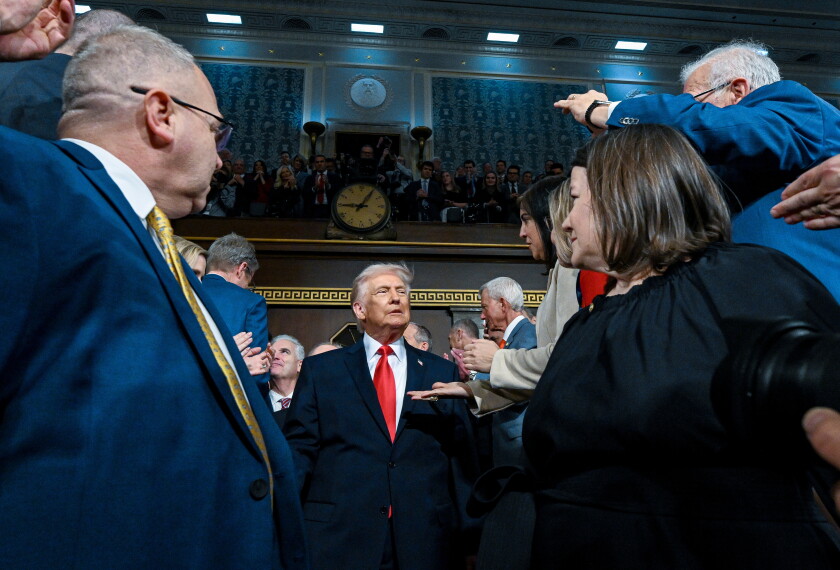
President Donald Trump enters to deliver the State of the Union address to a joint session of Congress in the House chamber at the U.S. Capitol in Washington, Tuesday, Feb. 24, 2026.
President Donald Trump enters to deliver the State of the Union address to a joint session of Congress in the House chamber at the U.S. Capitol in Washington, Tuesday, Feb. 24, 2026. The president devoted little time in the speech to discussing his education policies.
Kenny Holston/The New York Times via AP, Pool