Law & Courts

Education and the Supreme Court: The 2002-03 Term

July 09, 2003 3 min read
  • Save to favorites
  • Print

It was another significant year for education at the U.S. Supreme Court. In contrast to last term, when the court addressed K-12 issues such as private school vouchers, drug testing of extracurricular participants, and the privacy of education records, two higher education cases—both dealing with affirmative action—were the most closely watched by educators.

Here are capsule summaries of the education-related cases decided by the high- court in its 2002-2003 term. (Opinions require Adobe’s Acrobat Reader.)

14TH AMENDMENT

Consideration of race in college admissions

Grutter v. Bollinger (No. 02- 241) and Gratz v. Bollinger (No. 02- 516)

The court ruled 5-4 in Grutter that educational diversity is a compelling governmental interest that justified the University of Michigan law school’s consideration of race in seeking a “critical mass” of underrepresented minority students. But the court held 6-3 in Gratz that Michigan’s undergraduate system of awarding points toward admission to minority applicants violated the 14th Amendment’s guarantee of equal protection of the law.

CHILDREN’S INTERNET PROTECTION ACT

Federal requirement for Web filters in public libraries

United States v. American Library Association (No. 02-361)

The court ruled 6-3 to uphold a federal law that requires public libraries receiving federal technology funding to install filtering software to block obscenity, child pornography, and, for minors, other material deemed harmful to them. The same law applies to federally financed Internet connections in school classrooms and libraries, but the school provision wasn’t challenged in this case.

GAY RIGHTS

State prohibition of same-sex sodomy

Lawrence v. Texas (02-102)

The court’s 6-3 ruling invalidating a Texas criminal law against same-sex sexual conduct, with five justices voting to overrule a 1986 decisions that backed sodomy laws, is being hailed by some educators as an important step in eliminating anti-gay bias in schools.

FALSE CLAIMS ACT

Liability of local governments

Cook County V. United States ex rel. Chandler (No. 01-1572)

A unanimous court ruled that local governments, such as cities and school districts, may be sued under the False Claims Act, a Civil War-era statute designed to root out fraud in federal contracts. The court held that it was clear when the law was enacted in 1863 that local governments were considered persons for the purposes of certain lawsuits.

FAMILY AND MEDICAL LEAVE ACT OF 1993

States not immune from suits by their employees

Nevada Department of Human Resources v. Hibbs (No. 01-1368)

In a 6-3 ruling, the court said Congress was within its authority in abrogating states’ 11th Amendment immunity from lawsuits when it passed the medical-leave law. The ruling has implications for school districts in at least three states— California, Maryland, and North Carolina—where districts have been ruled to be arms of the state for 11th Amendment purposes.

SONNY BONO COPYRIGHT TERM EXTENSIONS ACT OF 1998

Constitutionality of 20-year extension of copyright protections

Eldred v. Ashcroft (No. 01-618)

The court upheld a 1998 action by Congress to extend copyright protection by an additional 20 years in most cases. Internet publishers had objected that the law would make it more difficult to make classic works of literature and art available to students online. But textbook publishers joined others in the traditional creative community in defending the copyright extension. The court’s 7-2 decision said the extension violates neither the U.S. Constitution’s copyright clause nor the First Amendment.

CHILD SEXUAL ABUSE

State effort to extend statute of limitations on sex crimes

Stogner v. California (No. 01-1757)

In a decision with implications for cases of sexual abuse of students by educators, as well as the sex-abuse scandals of the Roman Catholic Church, the court struck down a California law that had extended the statute of limitations in certain cases where alleged victims of child sex abuse came forward years after the crimes. In a 5-4 ruling, the court said that while the state’s interest in prosecuting child sex-abuse cases was important, the law nonetheless violated the U.S. Constitution’s “ex post facto” clause, which prohibits laws with retroactive effects.

Related Tags:

Events

This content is provided by our sponsor. It is not written by and does not necessarily reflect the views of Education Week's editorial staff.
Sponsor
Artificial Intelligence Webinar
Managing AI in Schools: Practical Strategies for Districts
How should districts govern AI in schools? Learn practical strategies for policies, safety, transparency, and responsible adoption.
Content provided by Lightspeed Systems
This content is provided by our sponsor. It is not written by and does not necessarily reflect the views of Education Week's editorial staff.
Sponsor
Recruitment & Retention Webinar
K-12 Lens 2026: What New Staffing Data Reveals About District Operations
Explore national survey findings and hear how districts are navigating staffing changes that affect daily operations, workload, and planning.
Content provided by Frontline Education
Education Funding Webinar Congress Approved Next Year’s Federal School Funding. What’s Next?
Congress passed the budget, but uncertainty remains. Experts explain what districts should expect from federal education policy next.

EdWeek Top School Jobs

Teacher Jobs
Search over ten thousand teaching jobs nationwide — elementary, middle, high school and more.
View Jobs
Principal Jobs
Find hundreds of jobs for principals, assistant principals, and other school leadership roles.
View Jobs
Administrator Jobs
Over a thousand district-level jobs: superintendents, directors, more.
View Jobs
Support Staff Jobs
Search thousands of jobs, from paraprofessionals to counselors and more.
View Jobs

Read Next

Law & Courts Supreme Court’s Gender Identity Ruling Leaves Schools Seeking Clarity
Advocates say they would welcome more from the Supreme Court on gender-notification policies.
7 min read
The Supreme Court is photographed, Friday, Feb. 27, 2026, in Washington.
The Supreme Court is photographed, Friday, Feb. 27, 2026, in Washington. The high court recently ruled that California policies that sometimes limit or discourage schools from disclosing information to parents about children’s gender transitions and expressions at school likely violate parents’ constitutional rights
Rahmat Gul/AP
Law & Courts Supreme Court Backs Parents in School Gender Disclosure Fight
The Supreme Court restored an injunction blocking California policies on student gender transitions
8 min read
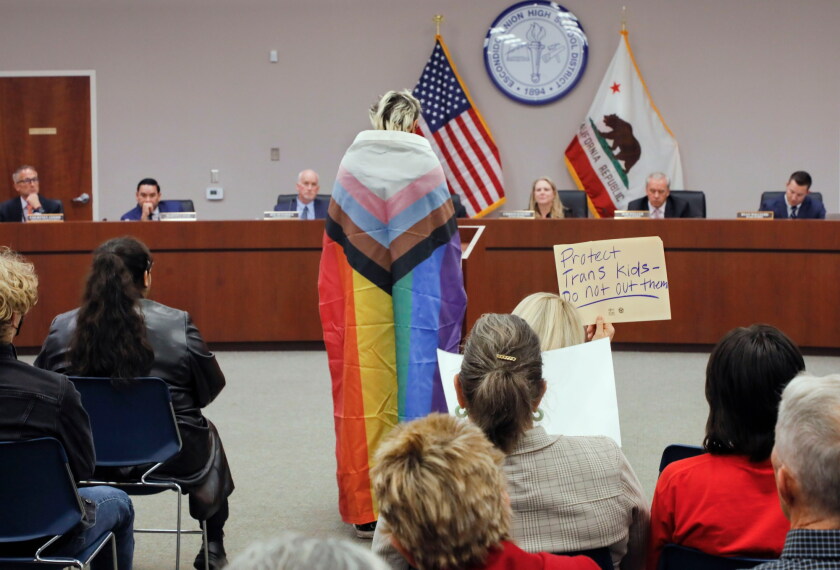
Teacher’s aide Amelia Mester, wrapped in a Pride flag, urges Escondido Union High School District not to have employees notify parents if they believe a student may be transgender in November 2025. A policy on the issue in the city’s elementary school district is the subject of a federal class-action lawsuit in which a judge just sided against the district.
Teacher’s aide Amelia Mester, wrapped in a Pride flag, urges Escondido Union High School District not to have employees notify parents if they believe a student may be transgender at a meeting in November 2025. Two parents and two teachers from the district sued in 2023, challenging California state guidance concerning student gender transitions and parental notification. The U.S. Supreme Court has now reinstated a lower-court decision overturning those state policies.
Charlie Neuman for The San Diego Union-Tribune/TNS
Law & Courts Appeals Court Allows Louisiana Ten Commandments Displays to Proceed
The court said it was premature to rule on the constitutionality of La. Ten Commandments displays.
3 min read
Students work under Ten Commandments and Bill of Rights posters on display in a classroom at Lehman High School in Kyle, Texas, Thursday, Oct. 16, 2025.
Students work under Ten Commandments and Bill of Rights posters on display in a classroom at Lehman High School in Kyle, Texas, Oct. 16, 2025. A federal appeals court has lifted a lower-court injunction blocking a Louisiana law that requires Ten Commandments displays, clearing the way for the law to take effect.
Eric Gay/AP
Law & Courts Social Media Companies Face Legal Reckoning Over Mental Health Harms to Children
Some of the biggest players from Meta to TikTok are getting a chance to make their case in courtrooms around the country.
6 min read
Social Media Kids Trial 26050035983057
Meta CEO Mark Zuckerberg leaves court after testifying in a landmark trial over whether social media platforms deliberately addict and harm children, on Feb. 18, 2026, in Los Angeles.
AP Photo/Damian Dovarganes
