With the future of affirmative action in college admissions in doubt, the Department of Education last week began publicizing race-neutral alternatives that aim to bring about diversity through class rank, socioeconomic status, and other means.

|
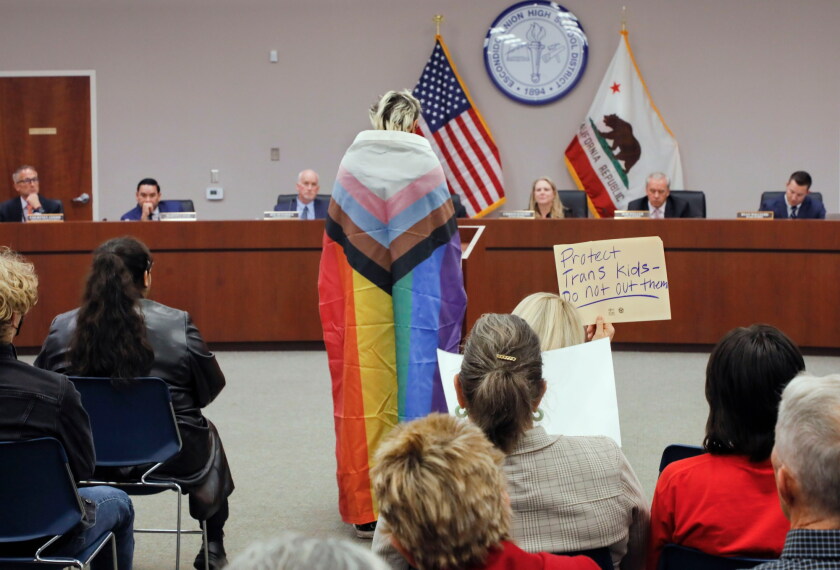
A supporter of using race in admissions protests at the Supreme Court April 1. A new report promotes alternatives. |
Department officials released a report March 28 outlining what they see as successful race-neutral admissions polices, along with other colorblind recruitment and outreach efforts.
The document was made available a few days before the U.S. Supreme Court heard oral arguments April 1 on two potentially momentous cases challenging the constitutionality of race-conscious admissions approaches at the University of Michigan.
The officials said the goal of their document, “Race-Neutral Alternatives in Postsecondary Education: Innovative Approaches to Diversity,” was not to endorse any particular policy. Rather, they said, they hope that the 40-page report will generate “innovative thinking” about ways to produce diversity on campus, said Gerald A. Reynolds, the department’s assistant secretary for civil rights.
“We’re trying to do some of the legwork for universities,” Mr. Reynolds said at press conference last week. “We’re trying to offer some opportunities for schools that are interested—nothing more, nothing less.”
While describing the pursuit of diversity in schools and society as an important goal, the report says there are “serious and important reasons” for educational institutions to seek race- neutral alternatives. One such reason, it says, is that racial preferences are being struck down by courts.
The report highlights polices such as the widely discussed “percentage plans” that grant high school students admissions according to class rank in Texas, California, and Florida. It also cites programs that help prepare disadvantaged K-12 students for higher education, by giving them better information about applying for college and financial aid.
The report also lays out what it sees as the benefits of race- neutral policies, such as the federal Gaining Early Awareness and Readiness for Undergraduate Programs, or GEAR-UP, a discretionary-grant program supporting efforts to help low-income students prepare for college; and TRIO, a federal program assisting first-generation, low-income college students, among others.
The report concludes with the famous quotation from Martin Luther King Jr. in which he envisioned a world that would judge individuals not by “the color of their skin but by the content of their character.”
Report ‘Deeply Misleading’
But members of Harvard University’s Civil Rights Project found little merit in the content of the report, or the quality of its research. The Education Department’s work amounts to “unsubstantiated hopeful expressions” that gloss over the failures of race-neutral efforts to increase diversity, according to a statement from the project, a research organization that studies issues such as school desegregation.
The report, “Race-Neutral Approaches in Postsecondary Education: Innovative Approaches to Diversity,” is available from the Education Department.
“It really isn’t helpful, because it doesn’t give all the information that’s out there about these programs,” said Patricia Marin, a research associate with the Harvard project. “Some of the information they provide is deeply misleading.”
In two studies released earlier this year, the Civil Rights Project argued that the “percent” plans in California, Florida, and Texas skirt their stated goals of race-neutrality by relying on race-targeted recruitment and outreach to maintain even modest levels of diversity on campus. The Education Department’s latest report basically ignores that contradiction, Ms. Marin contends.
It also ignores extensive research—some of it produced by universities using percentage plans—that reveals such policies’ shortcomings, she said.
Secretary of Education Rod Paige has publicly voiced his opposition to racial preferences in admissions, as has President Bush. The administration in January filed a legal brief with the Supreme Court objecting to the University of Michigan’s policies.
The new study argues that the “No Child Left Behind” Act of 2001, an ambitious overhaul of the main federal law on elementary and secondary education, will eventually help diversify college campuses, “not through artificial means such as the use of racial preferences,” but by preparing more K-12 students for college.
Mr. Reynolds said he asked agency officials to begin putting together the document shortly after he started work at the agency last year. The department intends to stage a conference on April 28-29 in Miami for officials to share information about race-neutral programs, he said.