Law & Courts

Court Says ‘Gifties’ Misapplied Talents

By Andrew Trotter — March 20, 2007 3 min read
  • Save to favorites
  • Print

Precocious maybe, but a group of gifted students showed little merit in a lawsuit they brought against the Chicago school system, a federal appeals court has ruled.

Twenty-four 8th graders in Beaubien Elementary School’s program for the gifted in 2003 contended in the suit that their principal violated their First Amendment free-speech rights by disciplining them for wearing T-shirts they had designed.

The students were protesting what they claimed was an unfair vote for a T-shirt design to be worn by all the school’s 8th graders in the 2002-03 school year.

There were tensions between students in the 8th grade gifted program, which draws students from all over Chicago, and neighborhood students at the 1,000-student school, U.S. Circuit Judge Richard A. Posner, a member of the three-judge panel considering the case in the U.S. Court of Appeals for the 7th Circuit, in Chicago, noted in his opinion.

The gifted students referred to themselves as “gifties” and sometimes to the other students as “tards,” for “retards,” Judge Posner wrote in a unanimous Feb. 20 opinion.

Michael D. Brandt, a student in the gifted program, submitted to the contest his cartoon of a grinning student giving a “thumbs-up” sign and walking Beaubien Elementary’s bulldog mascot.

Gifted students in Chicago were disciplined for wearing T-shirts with this design, after it failed to win a school contest. The students contended their free-speech rights were violated, but a federal appeals court disagreed.

Gifted students in Chicago were disciplined for wearing T-shirts with this design, after it failed to win a school contest. The student contended their free-speech rights were violated, but a federal appeals court disagreed.

The “gifties” voted as a bloc for Mr. Brandt’s design for the 8th grade class T-shirt—which would ensure a win, they thought, because the 72 other 8th graders would presumably spread their votes across 29 other designs. But the teacher in charge unexpectedly held a runoff vote for the three most popular designs, including Mr. Brandt’s. With a field of three, the gifted students’ bloc-voting scheme failed.

So Mr. Brandt had his design printed on T-shirts with the words “Gifties 2003” added to the back.

The gifted students wore the shirts to school, in defiance of Beaubien’s principal, who said that would be disrespectful and possibly disruptive.

The students were punished by being kept out of gym and lab classes and by being barred from after-school activities on nine days when at least one of them wore the shirt. Later, the principal, on the advice of a school intervention team, decided to allow the T-shirt. Nonetheless, the students asked in their suit that school officials be barred from telling anyone about the incident, such as colleges or potential employers.

In his opinion for the court’s ruling against the suit, Judge Posner slyly gave the “gifties” credit for intelligence.

“But craftily,” he said, “they first wore the forbidden shirt on the day when citywide tests were administered to public school students. They figured the school would not take disciplinary action against them on that day lest that lower the school’s average test scores (they are gifties, after all).”

Judge Posner said there had been no constitutional violation: “[T]he picture and the few words imprinted on the Brandt T-shirt are no more expressive of an idea or opinion that the First Amendment might be thought to protect than a young child’s talentless infantile drawing which Brandt’s design successfully mimics.”

The judge gave some credit to the students’ contention that the T-shirts became protected expression because they were worn as part of a protest against the class T-shirt vote.

“But the importance of context cuts both ways,” the judge wrote. “The protesters in this case are … privileged schoolchildren in a school that contains a majority of nonprivileged children. They insist that unless their T-shirt is adopted by the entire 8th grade, they will as it were secede, and flaunt their own T-shirt. They do not recognize the principal’s authority or the legitimacy of the school’s procedures for determining the winner of contests.”

The 7th Circuit court panel ordered the students to pay the 420,000-student Chicago district’s legal costs of $10,556.

See Also

For more stories on this topic see Law & Courts.

A version of this article appeared in the March 21, 2007 edition of Education Week

Events

This content is provided by our sponsor. It is not written by and does not necessarily reflect the views of Education Week's editorial staff.
Sponsor
Artificial Intelligence Webinar
Managing AI in Schools: Practical Strategies for Districts
How should districts govern AI in schools? Learn practical strategies for policies, safety, transparency, and responsible adoption.
Content provided by Lightspeed Systems
Education Funding Webinar Congress Approved Next Year’s Federal School Funding. What’s Next?
Congress passed the budget, but uncertainty remains. Experts explain what districts should expect from federal education policy next.
This content is provided by our sponsor. It is not written by and does not necessarily reflect the views of Education Week's editorial staff.
Sponsor
Student Absenteeism Webinar
Removing Transportation and Attendance Barriers for Homeless Youth
Join us to see how districts around the country are supporting vulnerable students, including those covered under the McKinney–Vento Act.
Content provided by HopSkipDrive

EdWeek Top School Jobs

Teacher Jobs
Search over ten thousand teaching jobs nationwide — elementary, middle, high school and more.
View Jobs
Principal Jobs
Find hundreds of jobs for principals, assistant principals, and other school leadership roles.
View Jobs
Administrator Jobs
Over a thousand district-level jobs: superintendents, directors, more.
View Jobs
Support Staff Jobs
Search thousands of jobs, from paraprofessionals to counselors and more.
View Jobs

Read Next

Law & Courts Supreme Court’s Gender Identity Ruling Leaves Schools Seeking Clarity
Advocates say they would welcome more from the Supreme Court on gender-notification policies.
7 min read
The Supreme Court is photographed, Friday, Feb. 27, 2026, in Washington.
The Supreme Court is photographed, Friday, Feb. 27, 2026, in Washington. The high court recently ruled that California policies that sometimes limit or discourage schools from disclosing information to parents about children’s gender transitions and expressions at school likely violate parents’ constitutional rights
Rahmat Gul/AP
Law & Courts Supreme Court Backs Parents in School Gender Disclosure Fight
The Supreme Court restored an injunction blocking California policies on student gender transitions
8 min read
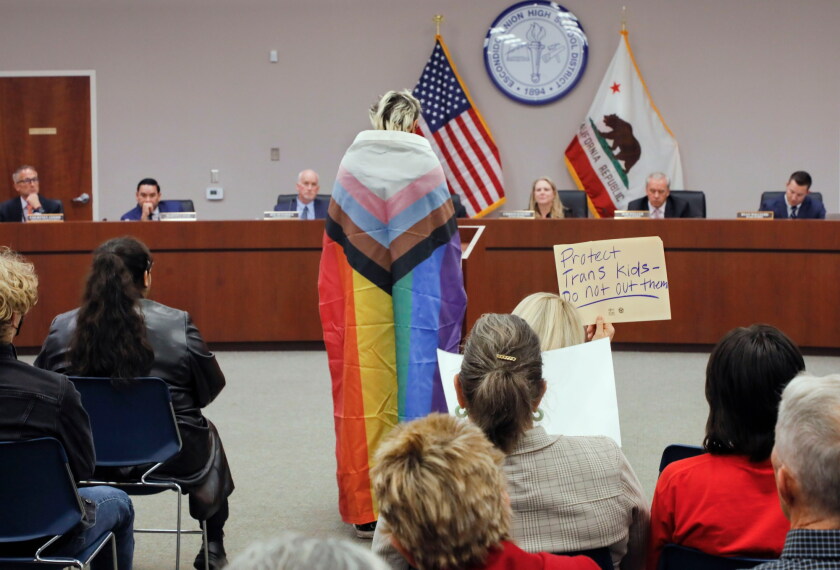
Teacher’s aide Amelia Mester, wrapped in a Pride flag, urges Escondido Union High School District not to have employees notify parents if they believe a student may be transgender in November 2025. A policy on the issue in the city’s elementary school district is the subject of a federal class-action lawsuit in which a judge just sided against the district.
Teacher’s aide Amelia Mester, wrapped in a Pride flag, urges Escondido Union High School District not to have employees notify parents if they believe a student may be transgender at a meeting in November 2025. Two parents and two teachers from the district sued in 2023, challenging California state guidance concerning student gender transitions and parental notification. The U.S. Supreme Court has now reinstated a lower-court decision overturning those state policies.
Charlie Neuman for The San Diego Union-Tribune/TNS
Law & Courts Appeals Court Allows Louisiana Ten Commandments Displays to Proceed
The court said it was premature to rule on the constitutionality of La. Ten Commandments displays.
3 min read
Students work under Ten Commandments and Bill of Rights posters on display in a classroom at Lehman High School in Kyle, Texas, Thursday, Oct. 16, 2025.
Students work under Ten Commandments and Bill of Rights posters on display in a classroom at Lehman High School in Kyle, Texas, Oct. 16, 2025. A federal appeals court has lifted a lower-court injunction blocking a Louisiana law that requires Ten Commandments displays, clearing the way for the law to take effect.
Eric Gay/AP
Law & Courts Social Media Companies Face Legal Reckoning Over Mental Health Harms to Children
Some of the biggest players from Meta to TikTok are getting a chance to make their case in courtrooms around the country.
6 min read
Social Media Kids Trial 26050035983057
Meta CEO Mark Zuckerberg leaves court after testifying in a landmark trial over whether social media platforms deliberately addict and harm children, on Feb. 18, 2026, in Los Angeles.
AP Photo/Damian Dovarganes