Law & Courts

Court Backs Race-Neutral Criteria in Selective K-12 Schools

By Mark Walsh — December 20, 2023 4 min read
People protest outside of the Supreme Court in Washington on June 29, 2023. The Supreme Court struck down affirmative action in college admissions, declaring race cannot be a factor and forcing institutions of higher education to look for new ways to achieve diverse student bodies.
  • Save to favorites
  • Print

A federal appeals court has upheld a facially race-neutral admissions program for the Boston school system’s selective “exam schools,” ruling that a plan based in part on socioeconomic factors passes muster under the U.S. Supreme Court’s recent decision against race-conscious college admissions.

The Dec. 19 decision by a unanimous three-judge panel of the U.S. Court of Appeals for the 1st Circuit, in Boston, likely has no current practical effect on that city’s exam schools, but it is the first to interpret a K-12 policy with potential racial effects after the Supreme Court’s affirmative-action decision in June.

The Boston public schools dropped the challenged admissions program and adopted a new one for Boston Latin School, Boston Latin Academy, and John D. O’Bryant School of Mathematics and Science in 2022. The new system added back entrance exams, which had been dropped during the COVID-19 pandemic, and also considers grade point averages and the census tracts where students live.

That led to a system for the 2021-22 school year that relied on grade point averages and preferences for students from low-income ZIP codes. The goal was to increase racial, socioeconomic, and geographic diversity at the exam schools, but race was not any kind of tip factor.

That plan was challenged by a coalition of families represented by the Pacific Legal Foundation, which argued that the plan would reduce the admission of white and Asian American students and was adopted with a racially discriminatory purpose in violation of the 14th Amendment’s equal-protection clause.

The 1st Circuit in April 2021 had refused to block the 2021-22 plan, ruling that it was likely constitutional despite some evidence of racially insensitive remarks about Asian Americans by the then-chairman of the Boston school committee.

In the new opinion in Boston Parent Coalition for Academic Excellence v. Boston School Committee, the 1st Circuit said that after its earlier decision, the Boston Globe disclosed additional racially insensitive emails between Boston school committee members.

The challengers asked both a federal district court and the 1st Circuit to reconsider their earlier decisions allowing the 2021-22 plan to be used. Both courts refused.

“More evidence of intent does not change the result of this case, given that our analysis assumes that the plan was chosen precisely to alter racial demographics,” Judge William J. Kayatta Jr. wrote for the 1st Circuit panel.

The court upheld the 2021-22 plan on the merits, saying the challengers had failed to show that the plan had a disparate impact on white and Asian American applicants. It rejected the challengers’ arguments that a school board’s mere intent to boost racial diversity was enough to invalidate a facially race-neutral plan.

Appeals panel weighs impact of Supreme Court affirmative action ruling

The court said its conclusion was supported by the Supreme Court’s June decision in Students for Fair Admissions v. President and Fellows of Harvard College, which struck down race-conscious admissions programs at Harvard and the University of North Carolina.

“The [parent] coalition’s ‘intent only’ theory runs counter to what appears to be the view of a majority of the members of the Supreme Court as expressed in Students for Fair Admissions,” Kayatta said.

He said that three justices in the majority in the Harvard/UNC decision—Clarence Thomas, Neil M. Gorsuch, and Brett M. Kavanaugh—“separately stressed that universities can lawfully employ valid facially neutral selection criteria that tend towards the same result.”

Kayatta suggested that those three justices combined with the three dissenters—Sonia Sotomayor, Elena Kagan, and Ketanji Brown Jackson, who would have upheld race-conscious admissions—added up to a majority that would likely uphold a facially race-neutral K-12 admissions plan such as Boston’s even if the goal was to boost racial diversity.

“Granted, no concurring opinion expressly held that a school may adopt a facially neutral admissions policy precisely because it would reduce racial disparities in the student body as compared to the population of eligible applicants,” Kayatta said. “But the message is clear.”

Erin Wilcox, a lawyer with Pacific Legal Foundation, said in a statement, “It’s disappointing that just six months after the Supreme Court’s landmark affirmative action ruling—where it held that ‘eliminating racial discrimination means eliminating all of it’—the 1st Circuit held … that it’s perfectly legal for Boston to use racial proxies to determine who is admitted to some of its best public schools.”

She noted that her organization is representing challengers to another race-neutral admissions plan for a selective K-12 magnet school whose appeal is pending consideration by the Supreme Court. That case is Coalition for TJ v. Fairfax County Public Schools and involves Thomas Jefferson High School for Science and Technology in Virginia.

A decision by the high court on whether to take up the TJ case could come as soon as January.

Pacific Legal did not immediately respond to a question about whether it viewed Boston’s current admission plan for its exam schools as legally satisfactory.
Events

This content is provided by our sponsor. It is not written by and does not necessarily reflect the views of Education Week's editorial staff.
Sponsor
School & District Management Webinar
Too Many Initiatives, Not Enough Alignment: A Change Management Playbook for Leaders
Learn how leadership teams can increase alignment and evaluate every program, practice, and purchase against a clear strategic plan.
Content provided by Otus
This content is provided by our sponsor. It is not written by and does not necessarily reflect the views of Education Week's editorial staff.
Sponsor
Artificial Intelligence Webinar
Beyond Teacher Tools: Exploring AI for Student Success
Teacher AI tools only show assigned work. See how TrekAi's student-facing approach reveals authentic learning needs and drives real success.
Content provided by TrekAi
This content is provided by our sponsor. It is not written by and does not necessarily reflect the views of Education Week's editorial staff.
Sponsor
College & Workforce Readiness Webinar
Building for the Future: Igniting Middle Schoolers’ Interest in Skilled Trades & Future-Ready Skills
Ignite middle schoolers’ interest in skilled trades with hands-on learning and real-world projects that build future-ready skills.
Content provided by Project Lead The Way

EdWeek Top School Jobs

Teacher Jobs
Search over ten thousand teaching jobs nationwide — elementary, middle, high school and more.
View Jobs
Principal Jobs
Find hundreds of jobs for principals, assistant principals, and other school leadership roles.
View Jobs
Administrator Jobs
Over a thousand district-level jobs: superintendents, directors, more.
View Jobs
Support Staff Jobs
Search thousands of jobs, from paraprofessionals to counselors and more.
View Jobs

Read Next

Law & Courts Supreme Court Backs Parents in School Gender Disclosure Fight
The Supreme Court restored an injunction blocking California policies on student gender transitions
8 min read
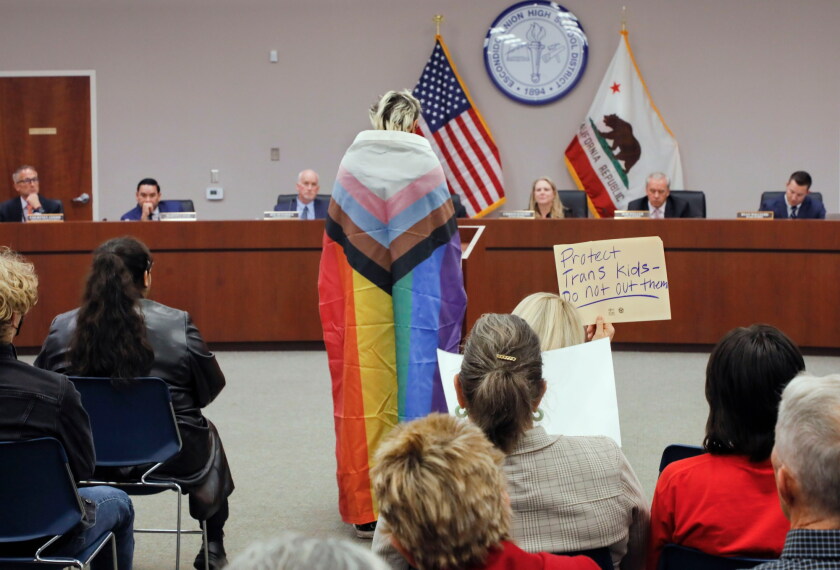
Teacher’s aide Amelia Mester, wrapped in a Pride flag, urges Escondido Union High School District not to have employees notify parents if they believe a student may be transgender in November 2025. A policy on the issue in the city’s elementary school district is the subject of a federal class-action lawsuit in which a judge just sided against the district.
Teacher’s aide Amelia Mester, wrapped in a Pride flag, urges Escondido Union High School District not to have employees notify parents if they believe a student may be transgender at a meeting in November 2025. Two parents and two teachers from the district sued in 2023, challenging California state guidance concerning student gender transitions and parental notification. The U.S. Supreme Court has now reinstated a lower-court decision overturning those state policies.
Charlie Neuman for The San Diego Union-Tribune/TNS
Law & Courts Appeals Court Allows Louisiana Ten Commandments Displays to Proceed
The court said it was premature to rule on the constitutionality of La. Ten Commandments displays.
3 min read
Students work under Ten Commandments and Bill of Rights posters on display in a classroom at Lehman High School in Kyle, Texas, Thursday, Oct. 16, 2025.
Students work under Ten Commandments and Bill of Rights posters on display in a classroom at Lehman High School in Kyle, Texas, Oct. 16, 2025. A federal appeals court has lifted a lower-court injunction blocking a Louisiana law that requires Ten Commandments displays, clearing the way for the law to take effect.
Eric Gay/AP
Law & Courts Social Media Companies Face Legal Reckoning Over Mental Health Harms to Children
Some of the biggest players from Meta to TikTok are getting a chance to make their case in courtrooms around the country.
6 min read
Social Media Kids Trial 26050035983057
Meta CEO Mark Zuckerberg leaves court after testifying in a landmark trial over whether social media platforms deliberately addict and harm children, on Feb. 18, 2026, in Los Angeles.
AP Photo/Damian Dovarganes
Law & Courts Supreme Court Strikes Trump Tariffs in Case Brought by Educational Toy Companies
Two educational toy companies were among the leading challengers to the president's tariff policies
3 min read
Members of the Supreme Court sit for a new group portrait following the addition of Associate Justice Ketanji Brown Jackson, at the Supreme Court building in Washington, Oct. 7, 2022. Bottom row, from left, Associate Justice Sonia Sotomayor, Associate Justice Clarence Thomas, Chief Justice of the United States John Roberts, Associate Justice Samuel Alito, and Associate Justice Elena Kagan. Top row, from left, Associate Justice Amy Coney Barrett, Associate Justice Neil Gorsuch, Associate Justice Brett Kavanaugh, and Associate Justice Ketanji Brown Jackson.
Members of the U.S. Supreme Court sit for a new group portrait following the addition of Justice Ketanji Brown Jackson, at the court building in Washington, Oct. 7, 2022. On Feb. 20, 2026, the court ruled 6-3 to strike down President Donald Trump's broad tariff policies, ruling that they were not authorized by the federal statute that he cited for them.
J. Scott Applewhite/AP
